

-
×
 Fluent - Laëticia Donval
1 × 17,00 €
Fluent - Laëticia Donval
1 × 17,00 € -
×
 La mémoire en acte - Quarente ans de création musicale
1 × 15,00 €
La mémoire en acte - Quarente ans de création musicale
1 × 15,00 € -
×
 Bambi # 4 - Collectif
1 × 12,00 €
Bambi # 4 - Collectif
1 × 12,00 € -
×
 Lazy Painter - Angela Gjergjaj, Jordi Bucher and Mirco Petrini
1 × 22,00 €
Lazy Painter - Angela Gjergjaj, Jordi Bucher and Mirco Petrini
1 × 22,00 € -
×
 La grande surface de réparation - Gilles Pourtier
1 × 20,00 €
La grande surface de réparation - Gilles Pourtier
1 × 20,00 € -
×
 Gros Gris n°4 - Duel
2 × 12,80 €
Gros Gris n°4 - Duel
2 × 12,80 € -
×
 Je ne peux pas ne pas - Geneviève Romang
1 × 24,00 €
Je ne peux pas ne pas - Geneviève Romang
1 × 24,00 € -
×
 Eros negro n°4 - Démoniak
1 × 5,00 €
Eros negro n°4 - Démoniak
1 × 5,00 € -
×
 Rue Englelab, La révolution par les livres - Iran 1979 - 1983 - Hannah Darabi
1 × 48,00 €
Rue Englelab, La révolution par les livres - Iran 1979 - 1983 - Hannah Darabi
1 × 48,00 € -
×
 interférence - 2 - maycec
1 × 12,00 €
interférence - 2 - maycec
1 × 12,00 € -
×
 Sans titre - Chris Kiss
1 × 12,00 €
Sans titre - Chris Kiss
1 × 12,00 € -
×
 Shanghai Cosmetic - Leslie Moquin
1 × 19,00 €
Shanghai Cosmetic - Leslie Moquin
1 × 19,00 € -
×
 Sans titre - Benjamin Hartmann
1 × 12,00 €
Sans titre - Benjamin Hartmann
1 × 12,00 € -
×
 SKKS - Gilles Pourtier
1 × 20,00 €
SKKS - Gilles Pourtier
1 × 20,00 € -
×
 Strates & Archipels - Pierre Merle
1 × 25,00 €
Strates & Archipels - Pierre Merle
1 × 25,00 € -
×
 Der Erste Rotkehlchen - Le livre
1 × 17,00 €
Der Erste Rotkehlchen - Le livre
1 × 17,00 € -
×
 (page 1 et 17) - Lorraine Druon
1 × 3,00 €
(page 1 et 17) - Lorraine Druon
1 × 3,00 € -
×
 9 octobre 1977 - Roberto Varlez
1 × 5,00 €
9 octobre 1977 - Roberto Varlez
1 × 5,00 € -
×
 À partir de n°1 - Coll.
1 × 15,00 €
À partir de n°1 - Coll.
1 × 15,00 € -
×
 Le Cygne de Popper - Alice Brière-Haquet, Janik Coat
1 × 9,00 €
Le Cygne de Popper - Alice Brière-Haquet, Janik Coat
1 × 9,00 € -
×
 ICCMHW - Atelier Choque Le Goff
1 × 15,00 €
ICCMHW - Atelier Choque Le Goff
1 × 15,00 € -
×
 Avec ce qu'il resterait à dire - Anne Maurel
1 × 13,00 €
Avec ce qu'il resterait à dire - Anne Maurel
1 × 13,00 € -
×
 Rasclose - Geoffroy Mathieu
1 × 17,00 €
Rasclose - Geoffroy Mathieu
1 × 17,00 € -
×
 Catalogue Art Guys - That's painting productions, Bernard Brunon
1 × 10,00 €
Catalogue Art Guys - That's painting productions, Bernard Brunon
1 × 10,00 € -
×
 Gruppen n°14 - Collectif
1 × 15,00 €
Gruppen n°14 - Collectif
1 × 15,00 € -
×
 Eurob0ys Crysis - Massimiliano Bomba, Leon Sadler, Yannick Val Gesto
1 × 6,00 €
Eurob0ys Crysis - Massimiliano Bomba, Leon Sadler, Yannick Val Gesto
1 × 6,00 € -
×
 Génération dakou - Yann Jun + CD
1 × 28,00 €
Génération dakou - Yann Jun + CD
1 × 28,00 € -
×
 Les voiles de Sainte-Marthe - Christian Rosset
1 × 18,00 €
Les voiles de Sainte-Marthe - Christian Rosset
1 × 18,00 € -
×
 Slanted 24 - Istanbul
1 × 21,00 €
Slanted 24 - Istanbul
1 × 21,00 € -
×
 Revue Les Saisons n°3
1 × 20,00 €
Revue Les Saisons n°3
1 × 20,00 € -
×
 Poétique d'une introspection visuelle - Jean-Charles Andrieu de Levis, Alex Barbier
2 × 12,00 €
Poétique d'une introspection visuelle - Jean-Charles Andrieu de Levis, Alex Barbier
2 × 12,00 € -
×
 Darkest Night - Joel Van Audenhaege
1 × 35,00 €
Darkest Night - Joel Van Audenhaege
1 × 35,00 € -
×
 Le chateau enchanté - Atelier Mclane
1 × 20,00 €
Le chateau enchanté - Atelier Mclane
1 × 20,00 € -
×
 Promenade au pays de l'écriture - Armando Petrucci
1 × 16,00 €
Promenade au pays de l'écriture - Armando Petrucci
1 × 16,00 € -
×
 Artzines #12 Provo Special
1 × 10,00 €
Artzines #12 Provo Special
1 × 10,00 € -
×
 Oblikvaj 4 - Last minute Shodo - Thomas Perrodin, Ensemble Batida
1 × 10,00 €
Oblikvaj 4 - Last minute Shodo - Thomas Perrodin, Ensemble Batida
1 × 10,00 € -
×
 Feminist Art Activisms and Artivisms - Katy Deepwell (ed.)
1 × 29,00 €
Feminist Art Activisms and Artivisms - Katy Deepwell (ed.)
1 × 29,00 € -
×
 Rupture (fragments) - Benjamin Monti, Jean-Charles Andrieu de Levis
2 × 20,00 €
Rupture (fragments) - Benjamin Monti, Jean-Charles Andrieu de Levis
2 × 20,00 € -
×
 Manifeste d'intérieurs ; penser dans les médias élargis - Javier Fernández Contreras
1 × 10,00 €
Manifeste d'intérieurs ; penser dans les médias élargis - Javier Fernández Contreras
1 × 10,00 € -
×
 Pas vu Pas pris - Collectif, Olivier Deloignon, Guillaume Dégé
1 × 25,00 €
Pas vu Pas pris - Collectif, Olivier Deloignon, Guillaume Dégé
1 × 25,00 € -
×
 Aristide n°4
2 × 13,50 €
Aristide n°4
2 × 13,50 € -
×
 Eldorado maximum - Les commissaires anonymes
1 × 14,00 €
Eldorado maximum - Les commissaires anonymes
1 × 14,00 € -
×
 Roven n°4
2 × 18,00 €
Roven n°4
2 × 18,00 € -
×
 Imagos - Noémie Lothe
2 × 20,00 €
Imagos - Noémie Lothe
2 × 20,00 € -
×
 La France de tête #04
1 × 3,00 €
La France de tête #04
1 × 3,00 € -
×
 Débris N°2 - Théo Garnier Greuez
1 × 15,00 €
Débris N°2 - Théo Garnier Greuez
1 × 15,00 € -
×
 ARTZINES #1, Paris issue
1 × 10,00 €
ARTZINES #1, Paris issue
1 × 10,00 € -
×
 Assembly - Sam Porritt
1 × 22,00 €
Assembly - Sam Porritt
1 × 22,00 € -
×
 Crise de foie - Christine Demias
1 × 10,00 €
Crise de foie - Christine Demias
1 × 10,00 € -
×
 Le corps travesti - Michel Journiac
1 × 35,00 €
Le corps travesti - Michel Journiac
1 × 35,00 € -
×
 il y avait une ville - Laeticia L'Heureux
1 × 20,00 €
il y avait une ville - Laeticia L'Heureux
1 × 20,00 € -
×
 Saint Julien l'hospitalier Tome 1 - Claire Pedot
1 × 25,00 €
Saint Julien l'hospitalier Tome 1 - Claire Pedot
1 × 25,00 €


People of the Mud – Luis Alberto Rodriguez


55,00 €
People of the Mud is a powerful new series by Luis Alberto Rodriguez, made collaboratively amongst the communities of County Wexford in Ireland, where ancient tradition and modern life rub shoulders daily.
Rupture de stock
People of the Mud is a powerful new series by Berlin-based US-Dominican artist Luis Alberto Rodriguez, made collaboratively amongst the communities of County Wexford in Ireland, where ancient tradition and modern life rub shoulders daily.
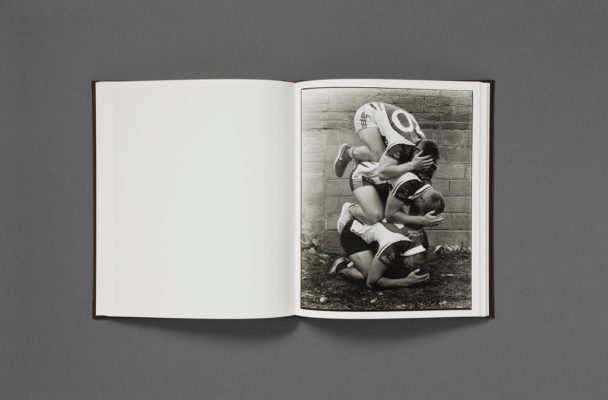
With a background in professional dance, Rodriguez’s work pays tribute to the metaphorical weight of centuries of physical labour behind cultivating the landscape and maintaining cultural heritage. Images of scarred limbs and hands, weathered faces and choreographed bodies appear as a cartography of this labour, reflecting how culture both shapes and is shaped by individuals. Elsewhere, we see the exaggerated glamour of modern female Irish dancers taken out of the glitzy ballrooms and into the fields, creating a rupture across time and space.
While in Wexford, Rodriguez was struck by the intense physicality of the sport of hurling. Considered to be the fastest sport on grass, while watching slow-motion footage of hurling Rodriguez saw that within seconds the players would go through pushing, shoving, grabbing, hugging, knocking each other down and then lifting one another up. Rodriguez worked with players to reform these gestures: creating sculptures out of bodies, directing and literally layering players upon one another.
At the outset of his project, Rodriguez wanted to create a large family photograph, an idea that was quickly surpassed by other strands of enquiry. However, with a step backwards we can see People of the Mud as just that – a collective community portrait of all the different elements that construct modern, rural Irish identities. Just like any family portrait, it is at times dysfunctional and contradictory; it gathers all the ruptures and continuities between the past and present in modern Ireland, while being held in a landscape and moment in time. This moment is both still – posed and paused – and in perpetual motion, looking towards the future.
| Poids | 700 g |
|---|---|
| Dimensions | 23 × 27,5 cm |
Vous aimerez peut-être aussi…

Livre architecture, design & urbanisme
28,00 €
Le livre de Laurent Chardon Dédale regroupe différentes séries de photographies prises au cours des années 2003 à 2013 et documente un Paris et ses alentours en transformation.
Produits similaires

Livre Photo
12,00 €
Derrière la couverture d’In The Navy de Julien Kedryna – beau leurre minimaliste – se cache une suite d’images-nuggets grasses et gaies.
-20%

Livre paysage
Le prix initial était : 25,00 €.20,00 €Le prix actuel est : 20,00 €.
La poésie et le beauté des rivages
Livre Photo
17,00 €
Fluent de Laëtitia Donval est la deuxième des trois résidences initiées par Lumière d’Encre ↗ autour des fleuves côtiers des Pyrénées-Orientales

17,00 €
Dans la vallée de l’Agly, Gilles Pourtier et Anne-Claire Broc’h ont observé la géologie du terrain, au plus près du cours du fleuve.

Livre Photo
32,00 €
Des silhouettes solitaires en attente d’un départ.

Livre d'artiste
8,00 €
Le pectus excavatum, « thorax en entonnoir » est une malformation du thorax congénitale.
-20%
Livre art contemporain
Le prix initial était : 16,00 €.12,80 €Le prix actuel est : 12,80 €.
Combats polymorphes, divertissants, déraisonnables ou nécessaires

Livre Photo
15,00 €
akaBB – tribute to Roni Horn is not a photographic diary, and neither is it a simple hommage to Roni Horn’s book.