

-
×
 Salt Crystal - Fabio Parizzi
2 × 22,00 €
Salt Crystal - Fabio Parizzi
2 × 22,00 € -
×
 Konrad Becker - Dictionnaire de réalité stratégique
1 × 20,00 €
Konrad Becker - Dictionnaire de réalité stratégique
1 × 20,00 € -
×
 ARTZINES #1, Paris issue
1 × 10,00 €
ARTZINES #1, Paris issue
1 × 10,00 € -
×
 Link Human / Robot - Collectif dir. Emmanuelle Grangier
1 × 18,00 €
Link Human / Robot - Collectif dir. Emmanuelle Grangier
1 × 18,00 € -
×
 Mökki n°4
1 × 10,00 €
Mökki n°4
1 × 10,00 € -
×
 Pour voir, Emscher Park - Gaëtane Lamarche-Vadel
1 × 7,00 €
Pour voir, Emscher Park - Gaëtane Lamarche-Vadel
1 × 7,00 € -
×
 Illusive prosody - Alex Beaurain
1 × 30,40 €
Illusive prosody - Alex Beaurain
1 × 30,40 € -
×
 Dear Paul - Paul Van der Eerden
2 × 20,00 €
Dear Paul - Paul Van der Eerden
2 × 20,00 € -
×
 Pas vu Pas pris - Collectif, Olivier Deloignon, Guillaume Dégé
1 × 25,00 €
Pas vu Pas pris - Collectif, Olivier Deloignon, Guillaume Dégé
1 × 25,00 € -
×
 Wayfaring - Patrick Messina, André S. Labarthe
1 × 35,00 €
Wayfaring - Patrick Messina, André S. Labarthe
1 × 35,00 € -
×
 Atopoz - Collectif
1 × 14,00 €
Atopoz - Collectif
1 × 14,00 € -
×
 Comment quitter la terre ? - Jill Gasparina, Christophe Kihm, Anne-Lyse Renon
1 × 10,00 €
Comment quitter la terre ? - Jill Gasparina, Christophe Kihm, Anne-Lyse Renon
1 × 10,00 € -
×
 Der Erste Rotkehlchen - Le livre
1 × 17,00 €
Der Erste Rotkehlchen - Le livre
1 × 17,00 € -
×
 SKKS - Gilles Pourtier
1 × 20,00 €
SKKS - Gilles Pourtier
1 × 20,00 € -
×
 Vacuité 9090 - Jérémy Piningre
1 × 10,00 €
Vacuité 9090 - Jérémy Piningre
1 × 10,00 € -
×
 Dédale - Laurent Chardon
1 × 28,00 €
Dédale - Laurent Chardon
1 × 28,00 € -
×
 Cyclone - Juliette Chalaye
1 × 8,00 €
Cyclone - Juliette Chalaye
1 × 8,00 € -
×
 Recto Versu - Bill Noir
1 × 15,00 €
Recto Versu - Bill Noir
1 × 15,00 € -
×
 Je ne peux pas ne pas - Geneviève Romang
1 × 24,00 €
Je ne peux pas ne pas - Geneviève Romang
1 × 24,00 € -
×
 Turbo Decompress - Coll.
1 × 18,00 €
Turbo Decompress - Coll.
1 × 18,00 € -
×
 De lave et de fer - Laurent Feynerou
1 × 22,00 €
De lave et de fer - Laurent Feynerou
1 × 22,00 € -
×
 Imago - Bill Noir
1 × 11,00 €
Imago - Bill Noir
1 × 11,00 € -
×
 š! #39 'The End' - coll.
1 × 10,00 €
š! #39 'The End' - coll.
1 × 10,00 € -
×
![twen [1959–1971]](https://i0.wp.com/librairie-lame.com/wp-content/uploads/2024/12/f4.jpg?fit=250%2C373&ssl=1) twen [1959–1971]
1 × 28,00 €
twen [1959–1971]
1 × 28,00 € -
×
 Critique & création - L.L. de Mars
1 × 5,00 €
Critique & création - L.L. de Mars
1 × 5,00 € -
×
 Aristide n°4
1 × 13,50 €
Aristide n°4
1 × 13,50 € -
×
 Piano - Joseph Charroy
1 × 12,00 €
Piano - Joseph Charroy
1 × 12,00 € -
×
 Les Grands Ensembles - Léo Guy-Denarcy
1 × 8,00 €
Les Grands Ensembles - Léo Guy-Denarcy
1 × 8,00 € -
×
 Before Science - Gilles Pourtier, Anne-Claire Broc'h
1 × 17,00 €
Before Science - Gilles Pourtier, Anne-Claire Broc'h
1 × 17,00 € -
×
 L'inventaire des destructions - Éric Watier
1 × 12,00 €
L'inventaire des destructions - Éric Watier
1 × 12,00 € -
×
 Watch out - Anne-Émilie-Philippe
1 × 9,00 €
Watch out - Anne-Émilie-Philippe
1 × 9,00 € -
×
 Deep state - Mathieu Desjardins
1 × 20,00 €
Deep state - Mathieu Desjardins
1 × 20,00 € -
×
 Titanic Orchestra - Julien Mauve
1 × 25,00 €
Titanic Orchestra - Julien Mauve
1 × 25,00 € -
×
 Critique d'art n°56
1 × 16,00 €
Critique d'art n°56
1 × 16,00 € -
×
 Saint Julien l'hospitalier Tome 3 - Claire Pedot
1 × 25,00 €
Saint Julien l'hospitalier Tome 3 - Claire Pedot
1 × 25,00 € -
×
 Le chateau enchanté - Atelier Mclane
1 × 20,00 €
Le chateau enchanté - Atelier Mclane
1 × 20,00 € -
×
 Seoul Flowers & Trees - tribute to Lee Friedlander
1 × 25,00 €
Seoul Flowers & Trees - tribute to Lee Friedlander
1 × 25,00 € -
×
 Débris N°2 - Théo Garnier Greuez
1 × 15,00 €
Débris N°2 - Théo Garnier Greuez
1 × 15,00 € -
×
 Saint Julien l'hospitalier Tome 2 - Claire Pedot
2 × 25,00 €
Saint Julien l'hospitalier Tome 2 - Claire Pedot
2 × 25,00 € -
×
 Le vieux père - Laurent Kropf
1 × 20,00 €
Le vieux père - Laurent Kropf
1 × 20,00 € -
×
 The Shelf - Journal 3
1 × 20,00 €
The Shelf - Journal 3
1 × 20,00 € -
×
 Dernier royaume - Quentin Derouet
1 × 24,00 €
Dernier royaume - Quentin Derouet
1 × 24,00 € -
×
 À partir de n°1 - Coll.
1 × 15,00 €
À partir de n°1 - Coll.
1 × 15,00 € -
×
 Un peu comme voir dans la nuit - Leif Elggren + CD
1 × 28,00 €
Un peu comme voir dans la nuit - Leif Elggren + CD
1 × 28,00 € -
×
 akaBB - tribute to Roni horn
1 × 15,00 €
akaBB - tribute to Roni horn
1 × 15,00 € -
×
 Strates - Else Bedoux
1 × 12,00 €
Strates - Else Bedoux
1 × 12,00 € -
×
 Good Company - Paul Van der Eerden
1 × 15,00 €
Good Company - Paul Van der Eerden
1 × 15,00 € -
×
 Dessins pour Rugir - Virginie Rochetti
1 × 10,00 €
Dessins pour Rugir - Virginie Rochetti
1 × 10,00 € -
×
 L’Écureuil de James - Alice Brière-Haquet, Liuna Virardi
1 × 9,00 €
L’Écureuil de James - Alice Brière-Haquet, Liuna Virardi
1 × 9,00 € -
×
 Inframince et hyperlié - Philippe Lipcare
1 × 12,00 €
Inframince et hyperlié - Philippe Lipcare
1 × 12,00 € -
×
 ARTZINES #3 - Tokyo issue
1 × 10,00 €
ARTZINES #3 - Tokyo issue
1 × 10,00 € -
×
 Prose postérieure - Les commissaires anonymes
1 × 15,00 €
Prose postérieure - Les commissaires anonymes
1 × 15,00 € -
×
 Idoine & Nayoung Kim
1 × 5,00 €
Idoine & Nayoung Kim
1 × 5,00 € -
×
 Prendre l’image, Le graphisme comme situation politique - Olivier Huz
1 × 10,00 €
Prendre l’image, Le graphisme comme situation politique - Olivier Huz
1 × 10,00 € -
×
 Le blanc nez - Fouss Daniel
1 × 20,00 €
Le blanc nez - Fouss Daniel
1 × 20,00 € -
×
 Marcel Proust en cinq minutes — Jackson B. Smith
1 × 16,00 €
Marcel Proust en cinq minutes — Jackson B. Smith
1 × 16,00 € -
×
 Copy This Book - Eric Schrijver
1 × 17,00 €
Copy This Book - Eric Schrijver
1 × 17,00 € -
×
 Architecture-Belvédère - Lou-Andréa Lassalle & Bérénice Béguerie
1 × 30,00 €
Architecture-Belvédère - Lou-Andréa Lassalle & Bérénice Béguerie
1 × 30,00 € -
×
 Rue Englelab, La révolution par les livres - Iran 1979 - 1983 - Hannah Darabi
1 × 48,00 €
Rue Englelab, La révolution par les livres - Iran 1979 - 1983 - Hannah Darabi
1 × 48,00 € -
×
 In The Navy - Julien Kedryna
1 × 12,00 €
In The Navy - Julien Kedryna
1 × 12,00 € -
×
 WREK The Algorithm! - Aarnoud Rommens, Olivier Deprez
1 × 10,00 €
WREK The Algorithm! - Aarnoud Rommens, Olivier Deprez
1 × 10,00 € -
×
 Papier magazine n°06 - Coupe du monde
1 × 20,00 €
Papier magazine n°06 - Coupe du monde
1 × 20,00 € -
×
 fig. #6 - antithèse
1 × 20,00 €
fig. #6 - antithèse
1 × 20,00 € -
×
 Mökki n°2
1 × 10,00 €
Mökki n°2
1 × 10,00 € -
×
 Revue La Ronde n°14
1 × 3,00 €
Revue La Ronde n°14
1 × 3,00 €


Huts, Temples, Castles – Ursula Schulz-Dornburg


45,00 €
In 1969, when the architectural photographer Ursula Schulz-Dornburg moved to Düsseldorf with her two young children
En stock
In the wake of the Second World War, aiming to occupy the children rampaging streets and parks, the City of Amsterdam founded Jongensland, a space where boys (and the occasional, officially disallowed girl) could play, build, create, and destroy, largely without supervision. Located on an island accessible only by rowboat, Jongensland grew into a sprawling settlement built experimentally from scrap materials by its young inhabitants. Here, children would cook food, raise animals, build fires, and trade with each other. Without adult intervention, they relied on shared resourcefulness and collaborative ingenuity.
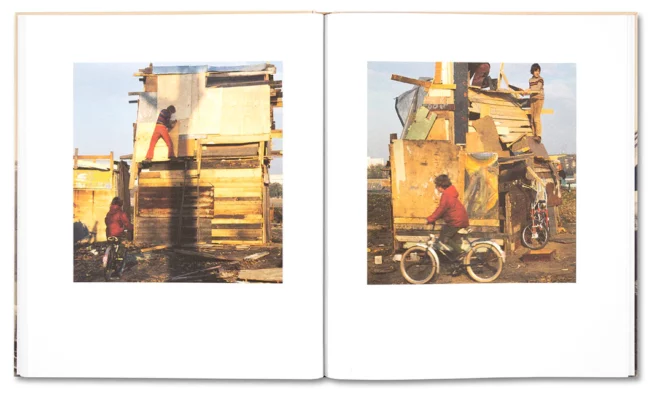
In 1969, when the architectural photographer Ursula Schulz-Dornburg moved to Düsseldorf with her two young children, she discovered Jongensland the other side of the border from Germany’s strictly regulated playgrounds. Fascinated by the improvised buildings where her children would play, she made extensive photographs capturing them being constructed, used, demolished, and reshaped. Her images capture an intuitive architectural intelligence and capture a genre of vernacular construction with its own conventions and innovations, one which illuminates the role of imagination in defining a building’s identity and purpose.
This book presents Schulz-Dornburg’s largely unseen series alongside an extended alongside an extended essay by architectural historian Tom Wilkinson reflecting on the architectural themes and lessons Jongensland continues to offer.
| Poids | 650 g |
|---|---|
| Dimensions | 23 × 26 cm |
Produits similaires
25,00 €
"It was april and cherry blossom time was just over"
-20%

Livre Photo
Le prix initial était : 20,00 €.16,00 €Le prix actuel est : 16,00 €.
Ayline Olukman marche, roule, fait des rencontres
Livre Photo
15,00 €
akaBB – tribute to Roni Horn is not a photographic diary, and neither is it a simple hommage to Roni Horn’s book.
Livre Photo
17,00 €
l'intimité d'un couple français entre 1959 et 1978.

Livre paysage
25,00 €
Les Climats II (Japon), premier livre de Lola Reboud, a pour fil conducteur la relation que nous entretenons aux Climats.

Livre d'artiste
8,00 €
Le pectus excavatum, « thorax en entonnoir » est une malformation du thorax congénitale.
Livre Photo
20,00 €
SKKS est une partie du code que l’on retrouve sur les plaques d’immatriculation en Slovaquie.

Dits & Écrits d'artistes
25,00 €
Aboukaïev est d’abord atteint de mélancolie comme certains oiseaux enivrés et dont le coeur ne veut plus s’arrêter de voler, de capituler face à l’horizon.