

-
×
 Poétique d'une introspection visuelle - Jean-Charles Andrieu de Levis, Alex Barbier
2 × 12,00 €
Poétique d'une introspection visuelle - Jean-Charles Andrieu de Levis, Alex Barbier
2 × 12,00 € -
×
 Tomber dans l'escalier - Jasper Sebastian Stürup
1 × 12,00 €
Tomber dans l'escalier - Jasper Sebastian Stürup
1 × 12,00 € -
×
 La beauté d'une musique qui ne compte pas - Kenneth Gaburo
1 × 15,00 €
La beauté d'une musique qui ne compte pas - Kenneth Gaburo
1 × 15,00 € -
×
 Je ne peux pas ne pas - Geneviève Romang
1 × 24,00 €
Je ne peux pas ne pas - Geneviève Romang
1 × 24,00 € -
×
 Le dos des choses - Guillaume Goutal
2 × 13,00 €
Le dos des choses - Guillaume Goutal
2 × 13,00 € -
×
 Mökki n°2
1 × 10,00 €
Mökki n°2
1 × 10,00 € -
×
 Sans titre - Chris Kiss
1 × 12,00 €
Sans titre - Chris Kiss
1 × 12,00 € -
×
 Saint Julien l'hospitalier Tome 3 - Claire Pedot
2 × 25,00 €
Saint Julien l'hospitalier Tome 3 - Claire Pedot
2 × 25,00 € -
×
 Saint Julien l'hospitalier Tome 1 - Claire Pedot
2 × 25,00 €
Saint Julien l'hospitalier Tome 1 - Claire Pedot
2 × 25,00 € -
×
 Radio-Art - Tetsuo Kogawa
1 × 20,00 €
Radio-Art - Tetsuo Kogawa
1 × 20,00 € -
×
 Aristide n°4
2 × 13,50 €
Aristide n°4
2 × 13,50 € -
×
 Gruppen n°13 - Collectif
1 × 15,00 €
Gruppen n°13 - Collectif
1 × 15,00 € -
×
 Hello tomato - Marion Caron & Camille Trimardeau
1 × 25,00 €
Hello tomato - Marion Caron & Camille Trimardeau
1 × 25,00 € -
×
 WREK The Algorithm! - Aarnoud Rommens, Olivier Deprez
2 × 10,00 €
WREK The Algorithm! - Aarnoud Rommens, Olivier Deprez
2 × 10,00 € -
×
 Bambi # 4 - Collectif
1 × 12,00 €
Bambi # 4 - Collectif
1 × 12,00 € -
×
 Papier magazine n°06 - Coupe du monde
1 × 20,00 €
Papier magazine n°06 - Coupe du monde
1 × 20,00 € -
×
 Dessins pour Rugir - Virginie Rochetti
1 × 10,00 €
Dessins pour Rugir - Virginie Rochetti
1 × 10,00 € -
×
 Le chateau enchanté - Atelier Mclane
1 × 20,00 €
Le chateau enchanté - Atelier Mclane
1 × 20,00 € -
×
 La prise - Florian Javet
1 × 24,00 €
La prise - Florian Javet
1 × 24,00 € -
×
 Eros negro n°3 - Démoniak
1 × 5,00 €
Eros negro n°3 - Démoniak
1 × 5,00 € -
×
 The Shelf - Journal 3
1 × 20,00 €
The Shelf - Journal 3
1 × 20,00 € -
×
 Critique d'art n°54
1 × 16,00 €
Critique d'art n°54
1 × 16,00 € -
×
 Titanic Orchestra - Julien Mauve
1 × 25,00 €
Titanic Orchestra - Julien Mauve
1 × 25,00 € -
×
 Pénurie - Zivo, Jérôme Meizoz
1 × 30,00 €
Pénurie - Zivo, Jérôme Meizoz
1 × 30,00 € -
×
 Délié - Baptiste Oberson
1 × 24,00 €
Délié - Baptiste Oberson
1 × 24,00 € -
×
 Gros Gris n°4 - Duel
1 × 12,80 €
Gros Gris n°4 - Duel
1 × 12,80 € -
×
 Jardín de mi padre - Luis Carlos Tovar
1 × 46,00 €
Jardín de mi padre - Luis Carlos Tovar
1 × 46,00 € -
×
 Gruppen n°14 - Collectif
1 × 15,00 €
Gruppen n°14 - Collectif
1 × 15,00 € -
×
 Revue Brute #6 Jacques Lennep - OR BOR
2 × 10,00 €
Revue Brute #6 Jacques Lennep - OR BOR
2 × 10,00 € -
×
 Critique d'art n°56
1 × 16,00 €
Critique d'art n°56
1 × 16,00 € -
×
 L'Abeille de Saint-Simon - Alice Brière-Haquet / Mai Li Bernard
1 × 9,00 €
L'Abeille de Saint-Simon - Alice Brière-Haquet / Mai Li Bernard
1 × 9,00 € -
×
 Philonimo - Le Corbeau d’Épictète - Alice Brière-Haquet, Csil
1 × 9,00 €
Philonimo - Le Corbeau d’Épictète - Alice Brière-Haquet, Csil
1 × 9,00 € -
×
 Saint Julien l'hospitalier Tome 2 - Claire Pedot
1 × 25,00 €
Saint Julien l'hospitalier Tome 2 - Claire Pedot
1 × 25,00 € -
×
 Les Climats II (Japon) - Lola Reboud, Mariko Takeuchi
1 × 25,00 €
Les Climats II (Japon) - Lola Reboud, Mariko Takeuchi
1 × 25,00 € -
×
 Philonimo - Le Papillon de Tchouang-Tseu - Alice Brière-Haquet, Raphaële Enjary
1 × 9,00 €
Philonimo - Le Papillon de Tchouang-Tseu - Alice Brière-Haquet, Raphaële Enjary
1 × 9,00 € -
×
 Strates & Archipels - Pierre Merle
1 × 25,00 €
Strates & Archipels - Pierre Merle
1 × 25,00 € -
×
 Grilles - Zelda Mauger
1 × 12,00 €
Grilles - Zelda Mauger
1 × 12,00 € -
×
 Good Company - Paul Van der Eerden
1 × 15,00 €
Good Company - Paul Van der Eerden
1 × 15,00 € -
×
 Deep state - Mathieu Desjardins
1 × 20,00 €
Deep state - Mathieu Desjardins
1 × 20,00 € -
×
 Slanted 24 - Istanbul
1 × 21,00 €
Slanted 24 - Istanbul
1 × 21,00 € -
×
 Imagos - Noémie Lothe
1 × 20,00 €
Imagos - Noémie Lothe
1 × 20,00 €


Flower Smuggler – Diana Tamane


30,00 €
« close to a narration on something as large as the European transformations that took place during the last 30 years. »
Plus que 1 en stock
If we look briefly at what makes good art, it is of course to work with what is in front of us.
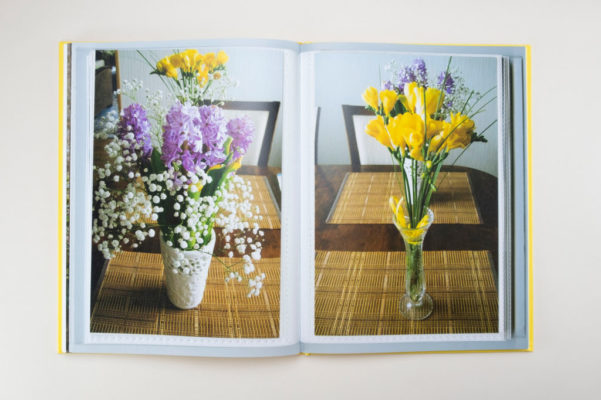
Inventions are good, but if the point of escape into the unknown is the known, even better. Certainly nothing is more readily available than one’s own family. It is a matrix we will never leave, and if we escape it, we inevitably escape in relation to it. Diana worked with the image material her family generated on many formal and technical layers, visually formulating such larger questions as: who sees whom in which way, and smaller questions, such as: What is one doing when the camera is turned off? To what extent is a skin really our last boundary, and what happens when one dies? Diana exploits every possible representation of (her) family, and transforms it with a sharp eye into an art that is entirely its own. She uses the whole repertoire of the contemporary photo-filmic infrastructure, from the mobile phone to the memory stick of her father’s product palette from the last 10 years, to the dashcam of her truck-driving mother, to email, also in order to fulfill yet subvert every possible cliché about the East one could imagine. We should not forget the proper art historical knowledge sleeping behind her approach, which she luckily applies in a very liberating, un-academic and free manner. You wouldn’t need a reference with the simple function of affirming the position of her work, as it is with a lot of art these days. In the end, Diana uses something as personal as family to say something public, close to a narration on something as large as the European transformations that took place during the last 30 years. (Martin Germann)
| Poids | 350 g |
|---|---|
| Dimensions | 22,5 × 30 cm |
Vous aimerez peut-être aussi…

Produits similaires

Livre Photo
32,00 €
Des silhouettes solitaires en attente d’un départ.

Livre Photo
35,00 €
Patrick Messina est un amateur de la forme urbaine dans ce qu’elle contient de hasards et d’hypothèses.

Livre architecture, design & urbanisme
28,00 €
Le livre de Laurent Chardon Dédale regroupe différentes séries de photographies prises au cours des années 2003 à 2013 et documente un Paris et ses alentours en transformation.

Livre d'artiste
38,00 €
Marie Mons a passé trois mois d’hiver dans un petit village des fjords de l’est de Islande où elle est devenue Aurore Colbert

Livre Photo
12,00 €
Derrière la couverture d’In The Navy de Julien Kedryna – beau leurre minimaliste – se cache une suite d’images-nuggets grasses et gaies.

25,00 €
"It was april and cherry blossom time was just over"

Livre Photo
19,00 €
L'image révèle autant l’artifice que la fascination qu’il exerce.

Livre Photo
25,00 €
Ces images ne sont ni fenêtres, ni miroirs.