

-
×
 moj’am al arabeia - Farah Khelil & antoine lefebvre editions
1 × 20,00 €
moj’am al arabeia - Farah Khelil & antoine lefebvre editions
1 × 20,00 € -
×
 Saint Julien l'hospitalier Tome 1 - Claire Pedot
1 × 25,00 €
Saint Julien l'hospitalier Tome 1 - Claire Pedot
1 × 25,00 € -
×
 Burning Images, A History of Effigy Protests - Florian Göttke
1 × 26,50 €
Burning Images, A History of Effigy Protests - Florian Göttke
1 × 26,50 € -
×
 Le Patou, la pomme et son jus - Robin Garnier-Wenisch
1 × 8,00 €
Le Patou, la pomme et son jus - Robin Garnier-Wenisch
1 × 8,00 € -
×
 S ! Imperfect shapes, #38 - Baltic Comics Magazine
1 × 10,00 €
S ! Imperfect shapes, #38 - Baltic Comics Magazine
1 × 10,00 € -
×
 Ventoline 5 - Coll.
1 × 7,00 €
Ventoline 5 - Coll.
1 × 7,00 € -
×
 Inframince et hyperlié - Philippe Lipcare
1 × 12,00 €
Inframince et hyperlié - Philippe Lipcare
1 × 12,00 € -
×
 Optical Sound 3
1 × 15,00 €
Optical Sound 3
1 × 15,00 € -
×
 Lili, la rozell et le marimba / revue n°2
1 × 15,00 €
Lili, la rozell et le marimba / revue n°2
1 × 15,00 € -
×
 Graphic Design Is (…) Not Innocent - Ingo Offermanns
1 × 25,00 €
Graphic Design Is (…) Not Innocent - Ingo Offermanns
1 × 25,00 € -
×
 Machiavel chez les babouins - Tim Ingold
1 × 22,00 €
Machiavel chez les babouins - Tim Ingold
1 × 22,00 € -
×
 Party Studies – Vol. 1 – Home gatherings, flat events, festive pedagogy and refiguring the hangover
1 × 18,00 €
Party Studies – Vol. 1 – Home gatherings, flat events, festive pedagogy and refiguring the hangover
1 × 18,00 € -
×
 Holy etc. - Fabienne Radi
1 × 12,00 €
Holy etc. - Fabienne Radi
1 × 12,00 € -
×
 Fluent - Laëticia Donval
1 × 17,00 €
Fluent - Laëticia Donval
1 × 17,00 € -
×
 I Am Not I - Boris Mikhailov
1 × 60,00 €
I Am Not I - Boris Mikhailov
1 × 60,00 € -
×
 Keywording (Post) Contemporary Art - Greta Rusttt
1 × 20,00 €
Keywording (Post) Contemporary Art - Greta Rusttt
1 × 20,00 € -
×
 Titanic Orchestra - Julien Mauve
1 × 25,00 €
Titanic Orchestra - Julien Mauve
1 × 25,00 € -
×
 Comment quitter la terre ? - Jill Gasparina, Christophe Kihm, Anne-Lyse Renon
1 × 10,00 €
Comment quitter la terre ? - Jill Gasparina, Christophe Kihm, Anne-Lyse Renon
1 × 10,00 € -
×
 Les voiles de Sainte-Marthe - Christian Rosset
1 × 18,00 €
Les voiles de Sainte-Marthe - Christian Rosset
1 × 18,00 € -
×
 Anderlecht — Molenbeek - Pierre Blondel
1 × 18,00 €
Anderlecht — Molenbeek - Pierre Blondel
1 × 18,00 € -
×
 Tanière de lune - Maria-Mercé Marçal
1 × 13,00 €
Tanière de lune - Maria-Mercé Marçal
1 × 13,00 € -
×
 La prise - Florian Javet
1 × 24,00 €
La prise - Florian Javet
1 × 24,00 € -
×
 Le déclin du professeur de tennis - Fabienne Radi
1 × 8,00 €
Le déclin du professeur de tennis - Fabienne Radi
1 × 8,00 € -
×
 Cuadernos - Henry Deletra
1 × 15,00 €
Cuadernos - Henry Deletra
1 × 15,00 € -
×
 Le Choix du peuple - Nicolas Savary, Tilo Steireif
1 × 25,00 €
Le Choix du peuple - Nicolas Savary, Tilo Steireif
1 × 25,00 € -
×
 Slanted 24 - Istanbul
1 × 21,00 €
Slanted 24 - Istanbul
1 × 21,00 € -
×
 Anémochorie - Antonin Detemple
1 × 12,00 €
Anémochorie - Antonin Detemple
1 × 12,00 € -
×
 Acteurs d'un film gravé. Docteur A. Infirmier O. - Annabelle Dupret, Olivier Deprez et Adolpho Avril
1 × 9,00 €
Acteurs d'un film gravé. Docteur A. Infirmier O. - Annabelle Dupret, Olivier Deprez et Adolpho Avril
1 × 9,00 € -
×
 Marcel Proust en cinq minutes — Jackson B. Smith
1 × 16,00 €
Marcel Proust en cinq minutes — Jackson B. Smith
1 × 16,00 € -
×
 IBM – Graphic Design Guide from 1969 to 1987
1 × 50,00 €
IBM – Graphic Design Guide from 1969 to 1987
1 × 50,00 € -
×
 America - Ayline Olukman, Hélène Gaudy
1 × 16,00 €
America - Ayline Olukman, Hélène Gaudy
1 × 16,00 €


Masken – Michael Etzensperger


27,00 €
The book Masken (Masks) is at once a reflection on the transcultural phenomenon of masks and their impact on 20th century art.
Rupture de stock
Historically, one of the most significant, if largely overlooked, uses of photography is the
reproduction of artworks and other cultural artefacts. Disciplines like art history and anthropology were re-shaped by the increasing availability of photographic reproductions in the late 19th century. The examination of this photographic genre has been an on-going concern for Swiss artist Michael Etzensperger in the past few years. Whilst doing research for his series Normal Viewpoint, No Other than Frontal View which focused on the photographic reproduction of sculptures, he became aware of the impact of images of masks from traditional cultures, both Western and non-Western, had on the early modernist artists, in particular on the cubists and surrealists. Significantly, they mostly encountered these reproductions in books, for example in Carl Einstein’s eponymous Negro Sculpture (1915).
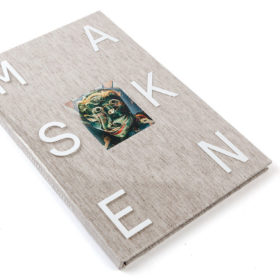
Struck by this art-historical phenomenon, Etzensperger began to hunt for images of masks in a variety of illustrated books, ranging from anthropological studies to coffee-table books, published throughout the 20th century and the early 21st century. Beyond the motifs of the photographic plates, he became increasingly fascinated by the changing surface qualities of the reproductions that were determined by printing techniques, photographic stock, camera optics, and other factors. Etzensperger then began to use the mask images he had collected as starting points for new images by making double exposures of the reproductions. In these composite pictures, two masks merge into a new hallucinatory face effigy, whilst the overlay of the different surface qualities produces painterly effects. The masks – said to subsume the identity of the wearer in traditional cultures – become non-identical themselves in the newly created image. Consequently, Etzensperger transposed these images, created from the book plates, back into book form, thus coming full circle. The book Masken (Masks) is at once a reflection on the transcultural phenomenon of masks and their impact on 20th century art, on the history of illustrated books and reproduction technologies, as well as a delirious visual delight.
Martin Jaeggi
72 pp;
51 color photographs; Hardcover;
210×320 mm; 600 copies; Text by Kay Heymer;
Graphic Design by Christof Nüssli;
Published by cpress, Zurich; 978-3-9524710-3-6
| Poids | 354 g |
|---|---|
| Dimensions | 21 × 32 cm |
Vous aimerez peut-être aussi…

Livre d'artiste
Lazy Painter – Angela Gjergjaj, Jordi Bucher and Mirco Petrini
22,00 €
Pictures by a robot vacuum cleaner

Livre d'artiste
38,00 €
Marie Mons a passé trois mois d’hiver dans un petit village des fjords de l’est de Islande où elle est devenue Aurore Colbert
Produits similaires
-20%

Livre art contemporain
Le prix initial était : 16,00 €.12,80 €Le prix actuel est : 12,80 €.
Combats polymorphes, divertissants, déraisonnables ou nécessaires

Livre Photo
25,00 €
Ces images ne sont ni fenêtres, ni miroirs.

Livre Photo
35,00 €
Patrick Messina est un amateur de la forme urbaine dans ce qu’elle contient de hasards et d’hypothèses.


Livre Photo
15,00 €
akaBB – tribute to Roni Horn is not a photographic diary, and neither is it a simple hommage to Roni Horn’s book.

Livre paysage
25,00 €
Les Climats II (Japon), premier livre de Lola Reboud, a pour fil conducteur la relation que nous entretenons aux Climats.

Livre Photo
20,00 €
SKKS est une partie du code que l’on retrouve sur les plaques d’immatriculation en Slovaquie.

25,00 €
"It was april and cherry blossom time was just over"