

-
×
 America - Ayline Olukman, Hélène Gaudy
1 × 16,00 €
America - Ayline Olukman, Hélène Gaudy
1 × 16,00 € -
×
 Photographic Fields - Joël Van Audenhaege
1 × 25,00 €
Photographic Fields - Joël Van Audenhaege
1 × 25,00 € -
×
 Before Science - Gilles Pourtier, Anne-Claire Broc'h
1 × 17,00 €
Before Science - Gilles Pourtier, Anne-Claire Broc'h
1 × 17,00 € -
×
 La peinture c'est comme les pépites - Pierre Yves-Hélou + Tirage
1 × 15,00 €
La peinture c'est comme les pépites - Pierre Yves-Hélou + Tirage
1 × 15,00 € -
×
 Revue La Ronde n°14
1 × 3,00 €
Revue La Ronde n°14
1 × 3,00 € -
×
 Poétique d'une introspection visuelle - Jean-Charles Andrieu de Levis, Alex Barbier
1 × 12,00 €
Poétique d'une introspection visuelle - Jean-Charles Andrieu de Levis, Alex Barbier
1 × 12,00 € -
×
 movement in squares - Stefanie Leinhos
1 × 18,00 €
movement in squares - Stefanie Leinhos
1 × 18,00 € -
×
 In The Navy - Julien Kedryna
1 × 12,00 €
In The Navy - Julien Kedryna
1 × 12,00 € -
×
 Le singe et le bijoux - Roxane Lumeret
1 × 15,00 €
Le singe et le bijoux - Roxane Lumeret
1 × 15,00 € -
×
 Morph - Camilo García A.
1 × 20,00 €
Morph - Camilo García A.
1 × 20,00 € -
×
 interférence - 2 - maycec
1 × 12,00 €
interférence - 2 - maycec
1 × 12,00 € -
×
 Assembly - Sam Porritt
1 × 22,00 €
Assembly - Sam Porritt
1 × 22,00 € -
×
 Le corps travesti - Michel Journiac
1 × 35,00 €
Le corps travesti - Michel Journiac
1 × 35,00 € -
×
 WREK The Algorithm! - Aarnoud Rommens, Olivier Deprez
1 × 10,00 €
WREK The Algorithm! - Aarnoud Rommens, Olivier Deprez
1 × 10,00 € -
×
 Sillo n°3 - Le Fauve
1 × 12,00 €
Sillo n°3 - Le Fauve
1 × 12,00 € -
×
 Pectus Excavatum - Quentin Yvelin
1 × 8,00 €
Pectus Excavatum - Quentin Yvelin
1 × 8,00 € -
×
 Optical Sound 3
1 × 15,00 €
Optical Sound 3
1 × 15,00 € -
×
 Eros negro #2 - Demoniak
1 × 5,00 €
Eros negro #2 - Demoniak
1 × 5,00 € -
×
 moj’am al arabeia - Farah Khelil & antoine lefebvre editions
1 × 20,00 €
moj’am al arabeia - Farah Khelil & antoine lefebvre editions
1 × 20,00 € -
×
 Rue Englelab, La révolution par les livres - Iran 1979 - 1983 - Hannah Darabi
1 × 48,00 €
Rue Englelab, La révolution par les livres - Iran 1979 - 1983 - Hannah Darabi
1 × 48,00 € -
×
 Collective Design : Alison & Peter Smithson
1 × 30,00 €
Collective Design : Alison & Peter Smithson
1 × 30,00 € -
×
 16 x 421 - Lorraine Druon
1 × 3,00 €
16 x 421 - Lorraine Druon
1 × 3,00 € -
×
 Saveurs imprévues et secrètes - Gilbert Lascault
1 × 17,00 €
Saveurs imprévues et secrètes - Gilbert Lascault
1 × 17,00 € -
×
 Strates & Archipels - Pierre Merle
1 × 25,00 €
Strates & Archipels - Pierre Merle
1 × 25,00 € -
×
 Échec et scotome - Jean Otth
1 × 14,00 €
Échec et scotome - Jean Otth
1 × 14,00 € -
×
 La traversée - Magali Brueder
1 × 20,00 €
La traversée - Magali Brueder
1 × 20,00 € -
×
 How Many - Nathalie Du Pasquier
1 × 28,00 €
How Many - Nathalie Du Pasquier
1 × 28,00 € -
×
 Revue Les Saisons n°3
1 × 20,00 €
Revue Les Saisons n°3
1 × 20,00 € -
×
 Keywording (Post) Contemporary Art - Greta Rusttt
1 × 20,00 €
Keywording (Post) Contemporary Art - Greta Rusttt
1 × 20,00 € -
×
 Hobo Nickel - Damien Sauvage
1 × 20,00 €
Hobo Nickel - Damien Sauvage
1 × 20,00 € -
×
 Sans titre - Benjamin Hartmann
1 × 12,00 €
Sans titre - Benjamin Hartmann
1 × 12,00 € -
×
 Stéréo couleurs - Atelier Bingo
1 × 22,00 €
Stéréo couleurs - Atelier Bingo
1 × 22,00 € -
×
 Strange Design - Ed. Jehanne Dautrey et Emanuele Quinz.
1 × 24,00 €
Strange Design - Ed. Jehanne Dautrey et Emanuele Quinz.
1 × 24,00 € -
×
 Good Company - Paul Van der Eerden
1 × 15,00 €
Good Company - Paul Van der Eerden
1 × 15,00 € -
×
 Slanted 24 - Istanbul
1 × 21,00 €
Slanted 24 - Istanbul
1 × 21,00 € -
×
 Mission Control - Emir Karyo & Jan Wojda
1 × 10,00 €
Mission Control - Emir Karyo & Jan Wojda
1 × 10,00 € -
×
 Entretiens – Jérôme Dupeyrat
1 × 25,00 €
Entretiens – Jérôme Dupeyrat
1 × 25,00 € -
×
 Rasclose - Geoffroy Mathieu
1 × 17,00 €
Rasclose - Geoffroy Mathieu
1 × 17,00 €


Masken – Michael Etzensperger


27,00 €
The book Masken (Masks) is at once a reflection on the transcultural phenomenon of masks and their impact on 20th century art.
Rupture de stock
Historically, one of the most significant, if largely overlooked, uses of photography is the
reproduction of artworks and other cultural artefacts. Disciplines like art history and anthropology were re-shaped by the increasing availability of photographic reproductions in the late 19th century. The examination of this photographic genre has been an on-going concern for Swiss artist Michael Etzensperger in the past few years. Whilst doing research for his series Normal Viewpoint, No Other than Frontal View which focused on the photographic reproduction of sculptures, he became aware of the impact of images of masks from traditional cultures, both Western and non-Western, had on the early modernist artists, in particular on the cubists and surrealists. Significantly, they mostly encountered these reproductions in books, for example in Carl Einstein’s eponymous Negro Sculpture (1915).
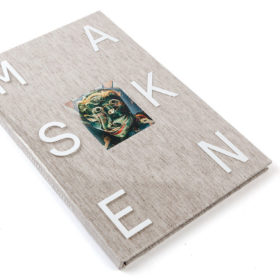
Struck by this art-historical phenomenon, Etzensperger began to hunt for images of masks in a variety of illustrated books, ranging from anthropological studies to coffee-table books, published throughout the 20th century and the early 21st century. Beyond the motifs of the photographic plates, he became increasingly fascinated by the changing surface qualities of the reproductions that were determined by printing techniques, photographic stock, camera optics, and other factors. Etzensperger then began to use the mask images he had collected as starting points for new images by making double exposures of the reproductions. In these composite pictures, two masks merge into a new hallucinatory face effigy, whilst the overlay of the different surface qualities produces painterly effects. The masks – said to subsume the identity of the wearer in traditional cultures – become non-identical themselves in the newly created image. Consequently, Etzensperger transposed these images, created from the book plates, back into book form, thus coming full circle. The book Masken (Masks) is at once a reflection on the transcultural phenomenon of masks and their impact on 20th century art, on the history of illustrated books and reproduction technologies, as well as a delirious visual delight.
Martin Jaeggi
72 pp;
51 color photographs; Hardcover;
210×320 mm; 600 copies; Text by Kay Heymer;
Graphic Design by Christof Nüssli;
Published by cpress, Zurich; 978-3-9524710-3-6
| Poids | 354 g |
|---|---|
| Dimensions | 21 × 32 cm |
Vous aimerez peut-être aussi…

Livre d'artiste
Lazy Painter – Angela Gjergjaj, Jordi Bucher and Mirco Petrini
22,00 €
Pictures by a robot vacuum cleaner

Livre d'artiste
38,00 €
Marie Mons a passé trois mois d’hiver dans un petit village des fjords de l’est de Islande où elle est devenue Aurore Colbert
Produits similaires
Livre Photo
20,00 €
Une traversée entre Marseille et la Corse entre mer et terre
17,00 €
Dans la vallée de l’Agly, Gilles Pourtier et Anne-Claire Broc’h ont observé la géologie du terrain, au plus près du cours du fleuve.
Livre Photo
35,00 €
Choisir de regarder Michel Journiac en travesti

Livre architecture, design & urbanisme
28,00 €
Le livre de Laurent Chardon Dédale regroupe différentes séries de photographies prises au cours des années 2003 à 2013 et documente un Paris et ses alentours en transformation.

Livre Photo
19,00 €
L'image révèle autant l’artifice que la fascination qu’il exerce.
Livre Photo
12,00 €
Derrière la couverture d’In The Navy de Julien Kedryna – beau leurre minimaliste – se cache une suite d’images-nuggets grasses et gaies.

Livre Photo
25,00 €
Titanic Orchestra est une réaction instinctive à la vague de violence qui a frappé Paris en 2015.
-20%

Livre Photo
Le prix initial était : 38,00 €.30,40 €Le prix actuel est : 30,40 €.
Loose amid unique landscapes in a timeless bubble