

-
×
 Dédale - Laurent Chardon
1 × 28,00 €
Dédale - Laurent Chardon
1 × 28,00 € -
×
 Talweg 6 - La distance
1 × 25,00 €
Talweg 6 - La distance
1 × 25,00 € -
×
 Tomber dans l'escalier - Jasper Sebastian Stürup
1 × 12,00 €
Tomber dans l'escalier - Jasper Sebastian Stürup
1 × 12,00 € -
×
 SKKS - Gilles Pourtier
1 × 20,00 €
SKKS - Gilles Pourtier
1 × 20,00 € -
×
 Rois de la forêt - Alain Garlan
1 × 13,50 €
Rois de la forêt - Alain Garlan
1 × 13,50 € -
×
 Berlin Design Digest
1 × 30,00 €
Berlin Design Digest
1 × 30,00 € -
×
 Assembly - Sam Porritt
1 × 22,00 €
Assembly - Sam Porritt
1 × 22,00 € -
×
 WREK The Algorithm! - Aarnoud Rommens, Olivier Deprez
1 × 10,00 €
WREK The Algorithm! - Aarnoud Rommens, Olivier Deprez
1 × 10,00 € -
×
 Sans titre - Chris Kiss
1 × 12,00 €
Sans titre - Chris Kiss
1 × 12,00 € -
×
 America - Ayline Olukman, Hélène Gaudy
1 × 16,00 €
America - Ayline Olukman, Hélène Gaudy
1 × 16,00 € -
×
 De tels baisers - Jul Gordon
1 × 5,00 €
De tels baisers - Jul Gordon
1 × 5,00 € -
×
 Le Gabion - Théo Robine-Langlois
1 × 16,00 €
Le Gabion - Théo Robine-Langlois
1 × 16,00 € -
×
 La traversée - Magali Brueder
1 × 20,00 €
La traversée - Magali Brueder
1 × 20,00 € -
×
 Mission Control - Emir Karyo & Jan Wojda
1 × 10,00 €
Mission Control - Emir Karyo & Jan Wojda
1 × 10,00 € -
×
 Jérôme LeGlatin (avec Mel Crawford) - Le Crash
1 × 5,00 €
Jérôme LeGlatin (avec Mel Crawford) - Le Crash
1 × 5,00 € -
×
 Saint Julien l'hospitalier Tome 1 - Claire Pedot
1 × 25,00 €
Saint Julien l'hospitalier Tome 1 - Claire Pedot
1 × 25,00 € -
×
 Pénurie - Zivo, Jérôme Meizoz
1 × 30,00 €
Pénurie - Zivo, Jérôme Meizoz
1 × 30,00 € -
×
 Gros Gris n°4 - Duel
1 × 12,80 €
Gros Gris n°4 - Duel
1 × 12,80 € -
×
 La peinture c'est comme les pépites - Pierre Yves-Hélou + Tirage
1 × 15,00 €
La peinture c'est comme les pépites - Pierre Yves-Hélou + Tirage
1 × 15,00 € -
×
 Le corps travesti - Michel Journiac
1 × 35,00 €
Le corps travesti - Michel Journiac
1 × 35,00 € -
×
 Photographic Fields - Joël Van Audenhaege
1 × 25,00 €
Photographic Fields - Joël Van Audenhaege
1 × 25,00 € -
×
 Dessins pour Rugir - Virginie Rochetti
1 × 10,00 €
Dessins pour Rugir - Virginie Rochetti
1 × 10,00 € -
×
 Migrant Mother, Migrant Gender - Sally Stein
1 × 8,00 €
Migrant Mother, Migrant Gender - Sally Stein
1 × 8,00 € -
×
 ARTZINES #1, Paris issue
1 × 10,00 €
ARTZINES #1, Paris issue
1 × 10,00 € -
×
 Holyhood, vol. 1 — Guadalupe, California - Alessandro Mercuri
1 × 12,00 €
Holyhood, vol. 1 — Guadalupe, California - Alessandro Mercuri
1 × 12,00 € -
×
 ICCMHW - Atelier Choque Le Goff
1 × 15,00 €
ICCMHW - Atelier Choque Le Goff
1 × 15,00 € -
×
 La Typographie post-binaire au delà de l'écriture inclusive - Camille Circlude
1 × 24,00 €
La Typographie post-binaire au delà de l'écriture inclusive - Camille Circlude
1 × 24,00 € -
×
 Gruppen n°14 - Collectif
1 × 15,00 €
Gruppen n°14 - Collectif
1 × 15,00 € -
×
 Roven n°4
1 × 18,00 €
Roven n°4
1 × 18,00 € -
×
 Shanghai Cosmetic - Leslie Moquin
1 × 19,00 €
Shanghai Cosmetic - Leslie Moquin
1 × 19,00 €


couverture souple
80 pages I format 23,5 x 32 cm
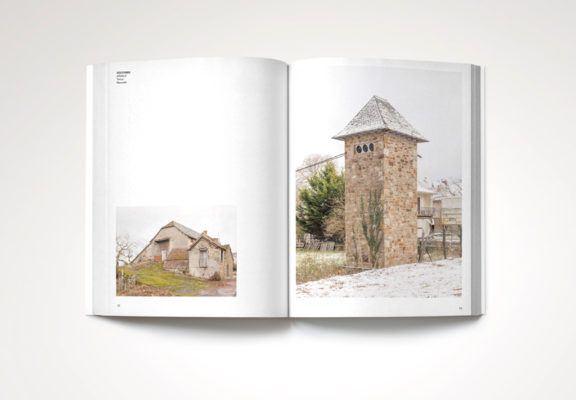
Faisant suite à l’Atlas of Forms, Poursuite publie Électricité de France, premier livre issu de l’Atlas des Régions Naturelles. En 75 photographies, Eric Tabuchi y dresse une typologie des postes de distribution – ces bâtiments qui servent à transformer le courant électrique haute-tension en courant basse-tension – et met en évidence la relation qu’entretient le géant du service public avec l’architecture régionale.
Ces constructions techniques, auxquelles nous ne prêtons guère attention tant elles font partie de notre environnement, prennent en effet, quand on les observe, des apparences très variées. Si elles sont majoritairement en béton et avant tout fonctionnelles, nombre d’entre elles, pour se fondre dans le décor, ont copié par le choix des matériaux ou la forme des toitures l’architecture des régions dans lesquelles elles prennent place. Ainsi trouve-t-on par exemple des transformateurs simulant les colombages en Normandie quand d’autres sont bâtis en granit rose dans le Trégor.
En mettant en vis-à-vis une habitation et un poste de distribution, c’est à la mise en correspondance de l’architecture locale avec une infrastructure nationale que se livre non sans humour Électricité de France.
Following the Atlas of Forms, Poursuite is publishing Électricité de France, the first book from the project Atlas des Régions Naturelles. Through a series of 75 photographs, Eric Tabuchi establishes a typology of power distribution stations – those buildings that transform high-voltage electricity into low-voltage current – and highlights the relation between the public service giant and regional architecture.
We usually don’t notice these technical buildings since they’re part of our everyday environment. However, they come in many different forms, if one takes time to observe them. Although many are made out of concrete and are primarily functional, a large number of them copy the architecture of the regions where they’re erected through the choice of construction material or the form of their roofs. For example, one may find transformers simulating the Normandie half-timbering whereas others are built out of the Trégor region’s pink granite.
By pairing houses and distribution stations, Électricité de France correlates local architecture and the national infrastructure, with a touch of humour.
| Poids | 540 g |
|---|---|
| Dimensions | 23 × 32 cm |
Produits similaires

Livre Photo
12,00 €
Derrière la couverture d’In The Navy de Julien Kedryna – beau leurre minimaliste – se cache une suite d’images-nuggets grasses et gaies.

Livre Photo
25,00 €
Titanic Orchestra est une réaction instinctive à la vague de violence qui a frappé Paris en 2015.

Collage
20,00 €
Apparaissent des restes épars et altérés de photographies, cartes, paysages, empreintes, visages, corps et fossiles.

Livre Photo
15,00 €
akaBB – tribute to Roni Horn is not a photographic diary, and neither is it a simple hommage to Roni Horn’s book.

Livre Photo
35,00 €
Patrick Messina est un amateur de la forme urbaine dans ce qu’elle contient de hasards et d’hypothèses.

Dits & Écrits d'artistes
25,00 €
Aboukaïev est d’abord atteint de mélancolie comme certains oiseaux enivrés et dont le coeur ne veut plus s’arrêter de voler, de capituler face à l’horizon.
Livre Photo
20,00 €
SKKS est une partie du code que l’on retrouve sur les plaques d’immatriculation en Slovaquie.
Livre Photo
20,00 €
Une traversée entre Marseille et la Corse entre mer et terre