

-
×
 Titanic Orchestra - Julien Mauve
1 × 25,00 €
Titanic Orchestra - Julien Mauve
1 × 25,00 € -
×
 Rasclose - Geoffroy Mathieu
2 × 17,00 €
Rasclose - Geoffroy Mathieu
2 × 17,00 € -
×
 Savoir Revivre - Jacques Massacrier
1 × 29,90 €
Savoir Revivre - Jacques Massacrier
1 × 29,90 € -
×
 Hérésie Étiologique - coll.
1 × 28,00 €
Hérésie Étiologique - coll.
1 × 28,00 € -
×
 Le chateau enchanté - Atelier Mclane
1 × 20,00 €
Le chateau enchanté - Atelier Mclane
1 × 20,00 € -
×
 Wayfaring - Patrick Messina, André S. Labarthe
1 × 35,00 €
Wayfaring - Patrick Messina, André S. Labarthe
1 × 35,00 € -
×
 Gruppen n°13 - Collectif
1 × 15,00 €
Gruppen n°13 - Collectif
1 × 15,00 € -
×
 Critique d'art n°55
1 × 16,00 €
Critique d'art n°55
1 × 16,00 € -
×
 Deep state - Mathieu Desjardins
1 × 20,00 €
Deep state - Mathieu Desjardins
1 × 20,00 € -
×
 De lave et de fer - Laurent Feynerou
1 × 22,00 €
De lave et de fer - Laurent Feynerou
1 × 22,00 € -
×
 WREK The Algorithm! - Aarnoud Rommens, Olivier Deprez
1 × 10,00 €
WREK The Algorithm! - Aarnoud Rommens, Olivier Deprez
1 × 10,00 € -
×
 L'atelier partagé avec Géraldine Trubert
1 × 20,00 €
L'atelier partagé avec Géraldine Trubert
1 × 20,00 € -
×
 il y avait une ville - Laeticia L'Heureux
2 × 20,00 €
il y avait une ville - Laeticia L'Heureux
2 × 20,00 € -
×
 Critique d'art n°56
1 × 16,00 €
Critique d'art n°56
1 × 16,00 € -
×
 Cuadernos - Henry Deletra
1 × 15,00 €
Cuadernos - Henry Deletra
1 × 15,00 € -
×
 L'œuvre des matières - Ivry Serres
1 × 20,00 €
L'œuvre des matières - Ivry Serres
1 × 20,00 € -
×
 Hiver sur les continents cernés - F.J. OSSANG
1 × 13,00 €
Hiver sur les continents cernés - F.J. OSSANG
1 × 13,00 € -
×
 Prose postérieure - Les commissaires anonymes
1 × 15,00 €
Prose postérieure - Les commissaires anonymes
1 × 15,00 € -
×
 Mökki n°4
1 × 10,00 €
Mökki n°4
1 × 10,00 € -
×
 Pectus Excavatum - Quentin Yvelin
1 × 8,00 €
Pectus Excavatum - Quentin Yvelin
1 × 8,00 € -
×
 Grilles - Zelda Mauger
1 × 12,00 €
Grilles - Zelda Mauger
1 × 12,00 € -
×
 Le corps travesti - Michel Journiac
1 × 35,00 €
Le corps travesti - Michel Journiac
1 × 35,00 € -
×
 Aristide n°4
1 × 13,50 €
Aristide n°4
1 × 13,50 € -
×
 Les Mains sales - Collectif
1 × 35,00 €
Les Mains sales - Collectif
1 × 35,00 € -
×
 Photographic Fields - Joël Van Audenhaege
1 × 25,00 €
Photographic Fields - Joël Van Audenhaege
1 × 25,00 € -
×
 Piano - Joseph Charroy
1 × 12,00 €
Piano - Joseph Charroy
1 × 12,00 € -
×
 La peinture c'est comme les pépites - Pierre Yves-Hélou + Tirage
1 × 15,00 €
La peinture c'est comme les pépites - Pierre Yves-Hélou + Tirage
1 × 15,00 € -
×
 L'inventaire des destructions - Éric Watier
2 × 12,00 €
L'inventaire des destructions - Éric Watier
2 × 12,00 € -
×
 interférence - 3 - maycec
1 × 12,00 €
interférence - 3 - maycec
1 × 12,00 € -
×
 Je ne peux pas ne pas - Geneviève Romang
1 × 24,00 €
Je ne peux pas ne pas - Geneviève Romang
1 × 24,00 € -
×
 Artzines # 10 - Show & Tell #2 NY Special
1 × 10,00 €
Artzines # 10 - Show & Tell #2 NY Special
1 × 10,00 € -
×
 Zoom Age - Julien Auregan
1 × 17,00 €
Zoom Age - Julien Auregan
1 × 17,00 € -
×
 America - Ayline Olukman, Hélène Gaudy
1 × 16,00 €
America - Ayline Olukman, Hélène Gaudy
1 × 16,00 € -
×
 Aurore Colbert - Marie Mons
1 × 38,00 €
Aurore Colbert - Marie Mons
1 × 38,00 € -
×
 Délié - Baptiste Oberson
1 × 24,00 €
Délié - Baptiste Oberson
1 × 24,00 € -
×
 Étrangement seuls - Jean-Pascal Princiaux
1 × 12,00 €
Étrangement seuls - Jean-Pascal Princiaux
1 × 12,00 € -
×
 Prendre l’image, Le graphisme comme situation politique - Olivier Huz
1 × 10,00 €
Prendre l’image, Le graphisme comme situation politique - Olivier Huz
1 × 10,00 € -
×
 Bande Annonce - Cinéma & Bande Dessinée - Coll.
1 × 20,00 €
Bande Annonce - Cinéma & Bande Dessinée - Coll.
1 × 20,00 € -
×
 Matriochka - Fanette Mellier (3ème ed.)
1 × 20,00 €
Matriochka - Fanette Mellier (3ème ed.)
1 × 20,00 € -
×
 Entretiens – Jérôme Dupeyrat
1 × 25,00 €
Entretiens – Jérôme Dupeyrat
1 × 25,00 € -
×
 9 octobre 1977 - Roberto Varlez
1 × 5,00 €
9 octobre 1977 - Roberto Varlez
1 × 5,00 € -
×
 Les Grands Ensembles - Léo Guy-Denarcy
1 × 8,00 €
Les Grands Ensembles - Léo Guy-Denarcy
1 × 8,00 € -
×
 Philonimo - Le Loup de Hobbes - Alice Brière-Haquet, Herbéra
1 × 9,00 €
Philonimo - Le Loup de Hobbes - Alice Brière-Haquet, Herbéra
1 × 9,00 € -
×
 Ludmilla Cerveny - Work
1 × 16,00 €
Ludmilla Cerveny - Work
1 × 16,00 € -
×
 La mémoire en acte - Quarente ans de création musicale
1 × 15,00 €
La mémoire en acte - Quarente ans de création musicale
1 × 15,00 € -
×
 Der Erste Rotkehlchen - Le livre
1 × 17,00 €
Der Erste Rotkehlchen - Le livre
1 × 17,00 €


Afterlife – Vasantha Yogananthan


50,00 €
Afterlife is the sixth chapter of Vasantha Yogananthan’s long-term project A Myth of Two Souls inspired by the epic tale The Ramayana.
Rupture de stock
Afterlife is the sixth chapter of Vasantha Yogananthan’s long-term project A Myth of Two Souls inspired by the epic tale The Ramayana. Drawing inspiration from the imagery associated with this myth and its pervasiveness in everyday Indian life, Vasantha Yogananthan has retraced the legendary route from north to south India. A Myth of Two Souls is informed by the notion of a journey in time and space and offers a modern retelling of the tale.
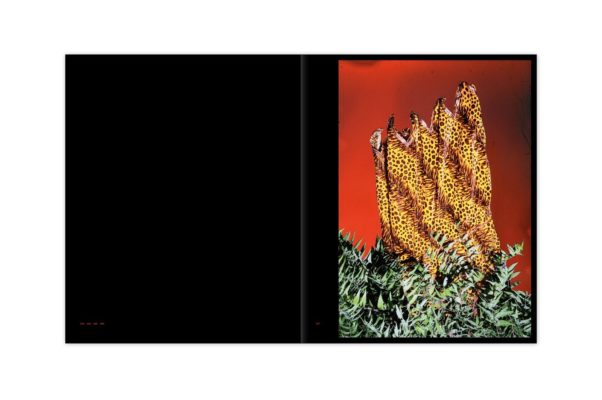
Afterlife is centered around the bloody war between the army of Ravana and the army of Rama. As its title suggests, the chapter deals with death and reincarnation. With Rama’s cruelty finally revealed, the series can be read as a visual exploration of one man’s descent into the darkness of the soul. Although the pictures were shot in Rajasthan and Tamil Nadu over two editions of Dussehra — the Indian festival celebrating the victory of good over evil — they do not document the festivities. They focus on the trance people try to reach night after night, as if during one week they were allowed to escape their bodies to become somebody else.
Back to his studio, Yogananthan did collages by mixing several pictures together to put the viewer in a state of disorientation. The Ramayana has been continuously rewritten and reinterpreted through time, and for Yogananthan’s Afterlife has been retold by Indian writer Meena Kandasamy. Amma — the seventh and last chapter of A Myth of Two Souls — will be published next year and will mark the end of the project (2013-2021).
Photographs and collages: Vasantha Yogananthan
Poem: Meena Kandasamy
Hardcover with tip-in
24,5 x 30 cm
80 photographs
136 pages (40 shorter pages 20 x 30 cm)
English
| Poids | 450 g |
|---|---|
| Dimensions | 24,5 × 30 cm |
Produits similaires
-20%
Livre Photo
Le prix initial était : 20,00 €.16,00 €Le prix actuel est : 16,00 €.
Ayline Olukman marche, roule, fait des rencontres

Dits & Écrits d'artistes
25,00 €
Aboukaïev est d’abord atteint de mélancolie comme certains oiseaux enivrés et dont le coeur ne veut plus s’arrêter de voler, de capituler face à l’horizon.
-20%

Livre art contemporain
Le prix initial était : 16,00 €.12,80 €Le prix actuel est : 12,80 €.
Combats polymorphes, divertissants, déraisonnables ou nécessaires

Livre architecture, design & urbanisme
28,00 €
Le livre de Laurent Chardon Dédale regroupe différentes séries de photographies prises au cours des années 2003 à 2013 et documente un Paris et ses alentours en transformation.
Livre Photo
25,00 €
Titanic Orchestra est une réaction instinctive à la vague de violence qui a frappé Paris en 2015.
Livre Photo
35,00 €
Patrick Messina est un amateur de la forme urbaine dans ce qu’elle contient de hasards et d’hypothèses.
Livre Photo
35,00 €
Choisir de regarder Michel Journiac en travesti

Livre Photo
12,00 €
Derrière la couverture d’In The Navy de Julien Kedryna – beau leurre minimaliste – se cache une suite d’images-nuggets grasses et gaies.