

-
×
 Imagos - Noémie Lothe
2 × 20,00 €
Imagos - Noémie Lothe
2 × 20,00 € -
×
 Gros Gris n°4 - Duel
1 × 12,80 €
Gros Gris n°4 - Duel
1 × 12,80 € -
×
 Je ne peux pas ne pas - Geneviève Romang
1 × 24,00 €
Je ne peux pas ne pas - Geneviève Romang
1 × 24,00 € -
×
 Editer l’art – Leszek Brogowski
1 × 33,00 €
Editer l’art – Leszek Brogowski
1 × 33,00 € -
×
 interférence - 3 - maycec
1 × 12,00 €
interférence - 3 - maycec
1 × 12,00 € -
×
 Dear Paul - Paul Van der Eerden
1 × 20,00 €
Dear Paul - Paul Van der Eerden
1 × 20,00 € -
×
 L'inventaire des destructions - Éric Watier
1 × 12,00 €
L'inventaire des destructions - Éric Watier
1 × 12,00 € -
×
 Poétique d'une introspection visuelle - Jean-Charles Andrieu de Levis, Alex Barbier
2 × 12,00 €
Poétique d'une introspection visuelle - Jean-Charles Andrieu de Levis, Alex Barbier
2 × 12,00 € -
×
 Le corps travesti - Michel Journiac
1 × 35,00 €
Le corps travesti - Michel Journiac
1 × 35,00 € -
×
 Objets Minces - Collectif
1 × 30,00 €
Objets Minces - Collectif
1 × 30,00 € -
×
 Philonimo - Le Chien de Diogène - Alice Brière-Haquet, Kazuko Matt
2 × 9,00 €
Philonimo - Le Chien de Diogène - Alice Brière-Haquet, Kazuko Matt
2 × 9,00 € -
×
 moj’am al arabeia - Farah Khelil & antoine lefebvre editions
1 × 20,00 €
moj’am al arabeia - Farah Khelil & antoine lefebvre editions
1 × 20,00 € -
×
 Pureté et impureté de l’art. Michel Journiac et le sida Antoine Idier
1 × 8,00 €
Pureté et impureté de l’art. Michel Journiac et le sida Antoine Idier
1 × 8,00 € -
×
 Holyhood, vol. 1 — Guadalupe, California - Alessandro Mercuri
1 × 12,00 €
Holyhood, vol. 1 — Guadalupe, California - Alessandro Mercuri
1 × 12,00 € -
×
 Saint Julien l'hospitalier Tome 3 - Claire Pedot
1 × 25,00 €
Saint Julien l'hospitalier Tome 3 - Claire Pedot
1 × 25,00 € -
×
 Hmm ! - C. de Trogoff
1 × 10,00 €
Hmm ! - C. de Trogoff
1 × 10,00 € -
×
 Illusive prosody - Alex Beaurain
1 × 30,40 €
Illusive prosody - Alex Beaurain
1 × 30,40 € -
×
 La beauté d'une musique qui ne compte pas - Kenneth Gaburo
1 × 15,00 €
La beauté d'une musique qui ne compte pas - Kenneth Gaburo
1 × 15,00 € -
×
 Les Climats II (Japon) - Lola Reboud, Mariko Takeuchi
1 × 25,00 €
Les Climats II (Japon) - Lola Reboud, Mariko Takeuchi
1 × 25,00 € -
×
 Holy etc. - Fabienne Radi
1 × 12,00 €
Holy etc. - Fabienne Radi
1 × 12,00 € -
×
 La mémoire de l’ordre. Les paradoxes du sens dans l’architecture moderne. - José Ignacio Linazasoro
1 × 18,00 €
La mémoire de l’ordre. Les paradoxes du sens dans l’architecture moderne. - José Ignacio Linazasoro
1 × 18,00 €


Tropism – Nhu Xuan Hua


43,00 €
Exploring the effect of dissipation generated by time passing and driven by the forces of an inherited memory.
Plus que 1 en stock
Nhu Xuan Hua delved into the power of memories in a piece of work titled “Tropism, Consequences of a Displaced Memory.”The work gives a face to those tropisms that describe spontaneous and automatic reactions initiated by vivid emotions in response to primarily needs or past events in life. Based on archival pictures from her family, the digital intervention interprets these memories through a new angle, exploring the effect of dissipation generated by time passing and driven by the forces of an inherited memory.
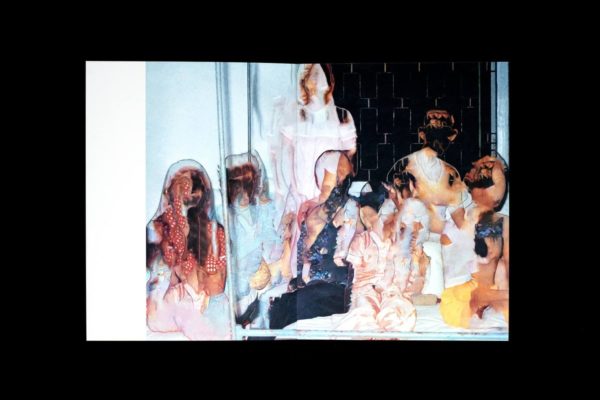
This study is an invitation for a treasure hunt on paper, where the images map a route connecting past and present. Places and people merge: he, she, they, here, there become one after having been separate for so long. In this imaginary bi-dimensional city, the elements from the photographs lose themselves and disappear, leaving behind them the mere and haunting presence of nostalgia.
| Poids | 650 g |
|---|---|
| Dimensions | 20,5 × 26,5 cm |
Vous aimerez peut-être aussi…

livre Dessin
57,00 €
Україна Yelena Yemchuk is like a daydream unfolding backwards
Produits similaires

Collage
20,00 €
Apparaissent des restes épars et altérés de photographies, cartes, paysages, empreintes, visages, corps et fossiles.

Livre Photo
19,00 €
L'image révèle autant l’artifice que la fascination qu’il exerce.

Livre Photo
15,00 €
akaBB – tribute to Roni Horn is not a photographic diary, and neither is it a simple hommage to Roni Horn’s book.

Livre d'artiste
8,00 €
Le pectus excavatum, « thorax en entonnoir » est une malformation du thorax congénitale.

25,00 €
La démarche photographique de Nicolas Savary et Tilo Steireif porte sur la représentation du politicien en tant que figure dans le système politique « de milice », en Suisse.

17,00 €
Dans la vallée de l’Agly, Gilles Pourtier et Anne-Claire Broc’h ont observé la géologie du terrain, au plus près du cours du fleuve.

Livre Photo
17,00 €
Raclose de Geoffroy Mathieu est la première des trois résidences initiées par Lumière d’Encre ↗ autour des fleuves côtiers des Pyrénées-Orientales