

-
×
 16 x 421 - Lorraine Druon
1 × 3,00 €
16 x 421 - Lorraine Druon
1 × 3,00 € -
×
 Jean-Jacques a dit - Angèle Douche
1 × 5,00 €
Jean-Jacques a dit - Angèle Douche
1 × 5,00 € -
×
 Der Erste Rotkehlchen - Le livre
1 × 17,00 €
Der Erste Rotkehlchen - Le livre
1 × 17,00 € -
×
 Wayfaring - Patrick Messina, André S. Labarthe
1 × 35,00 €
Wayfaring - Patrick Messina, André S. Labarthe
1 × 35,00 € -
×
 Sans titre - Chris Kiss
1 × 12,00 €
Sans titre - Chris Kiss
1 × 12,00 € -
×
 Poétique d'une introspection visuelle - Jean-Charles Andrieu de Levis, Alex Barbier
1 × 12,00 €
Poétique d'une introspection visuelle - Jean-Charles Andrieu de Levis, Alex Barbier
1 × 12,00 € -
×
 In The Navy - Julien Kedryna
1 × 12,00 €
In The Navy - Julien Kedryna
1 × 12,00 € -
×
 Dédale - Laurent Chardon
1 × 28,00 €
Dédale - Laurent Chardon
1 × 28,00 € -
×
 Rasclose - Geoffroy Mathieu
1 × 17,00 €
Rasclose - Geoffroy Mathieu
1 × 17,00 € -
×
 Critique d'art n°54
1 × 16,00 €
Critique d'art n°54
1 × 16,00 € -
×
 Tchat - Gary Colin
1 × 12,00 €
Tchat - Gary Colin
1 × 12,00 € -
×
 Roven n°4
1 × 18,00 €
Roven n°4
1 × 18,00 € -
×
 Pectus Excavatum - Quentin Yvelin
1 × 8,00 €
Pectus Excavatum - Quentin Yvelin
1 × 8,00 € -
×
 L'arum tacheté de J-M. Bertoyas
1 × 20,00 €
L'arum tacheté de J-M. Bertoyas
1 × 20,00 € -
×
 Tanière de lune - Maria-Mercé Marçal
1 × 13,00 €
Tanière de lune - Maria-Mercé Marçal
1 × 13,00 € -
×
 Piano - Joseph Charroy
1 × 12,00 €
Piano - Joseph Charroy
1 × 12,00 € -
×
 America - Ayline Olukman, Hélène Gaudy
1 × 16,00 €
America - Ayline Olukman, Hélène Gaudy
1 × 16,00 € -
×
 Pénurie - Zivo, Jérôme Meizoz
1 × 30,00 €
Pénurie - Zivo, Jérôme Meizoz
1 × 30,00 € -
×
 Assembly - Sam Porritt
1 × 22,00 €
Assembly - Sam Porritt
1 × 22,00 €


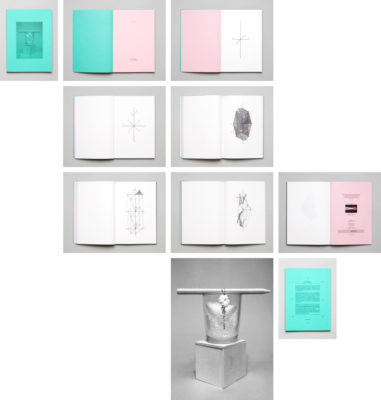
As you see on the front cover of this issue, one can easily grow one’s own salt crystal at home, using a glass of salted water and a string attached to a pencil. Within few days the evaporation of water induces a shifting of matter from the water to the string as the less energetic way for sodium chloride to reorganise itself.
After discovering the principle of natural salt crystallisation near Salzburg were miners used to offer to tourists dry branches
covered with a shining deposit of crystals, French writer Stendhal in his essay ‘On Love’ (1822) used it as a metaphor to describe the ‘birth of love’ in human relationships.
According to Stendhal, the mental process when one sees flattering illusions in a new love, hiding the unattractive characteristics of this person, is quite similar to the sparkly diamonds covering a leafless piece of wood after the natural crystallisation of the salt.
Exploring the same phenomenon, Fabio Parizzi intended in this book to describe this chemical reaction with 50 sketches.
This visual attempt to understand the basic structure of matter in space and its physical behaviour embracies the fascination of mankind for the primary form of solid structure first described by Plato more than 2.300 years ago.
SALT CRYSTAL
Edited by
Philippe Desarzens
Crystal drawings and tattooed arm
Fabio Parizzi
148,5 / 204 mm, 53 pages
Xerox printed
Book edges printed in black
| Poids | 300 g |
|---|---|
| Dimensions | 14 × 20 cm |
Vous aimerez peut-être aussi…
Livre d'artiste
22,00 €
Cast of Characters A selection of 100 faces by artist Sam Porritt.


Livre d'artiste
Lazy Painter – Angela Gjergjaj, Jordi Bucher and Mirco Petrini
22,00 €
Pictures by a robot vacuum cleaner
Produits similaires
Livre d'artiste
8,00 €
Le pectus excavatum, « thorax en entonnoir » est une malformation du thorax congénitale.


-20%

Littérature
Le prix initial était : 25,00 €.20,00 €Le prix actuel est : 20,00 €.
In the book “Le vieux père”, Laurent Kropf presents a selection of reproductions from his archive of group photographs.

Dits & Écrits d'artistes
25,00 €
Perspectives contemporaines sur les publications d’artistes

Essai art / Histoire de l'art
33,00 €
Le livre d’artiste et l’histoire du livre.

Livre d'artiste
15,00 €
Des cartels d’expositions à côté des objets les plus triviaux que renferme le musée dans lequel ils ont été extorqués.

Dits & Écrits d'artistes
Catalogue Art Guys – That’s painting productions, Bernard Brunon
10,00 €
Documentation de Bernard P. Brunon