

-
×
 Sights - Henry McCausland
1 × 40,00 €
Sights - Henry McCausland
1 × 40,00 € -
×
 Konrad Becker - Dictionnaire de réalité stratégique
1 × 20,00 €
Konrad Becker - Dictionnaire de réalité stratégique
1 × 20,00 € -
×
 Gros Gris n°4 - Duel
1 × 12,80 €
Gros Gris n°4 - Duel
1 × 12,80 € -
×
 Le corps travesti - Michel Journiac
1 × 35,00 €
Le corps travesti - Michel Journiac
1 × 35,00 € -
×
 Poèmes - Yvonne Rainer
1 × 14,00 €
Poèmes - Yvonne Rainer
1 × 14,00 € -
×
 Le chateau enchanté - Atelier Mclane
1 × 20,00 €
Le chateau enchanté - Atelier Mclane
1 × 20,00 € -
×
 Lili, la rozell et le marimba / revue n°2
1 × 15,00 €
Lili, la rozell et le marimba / revue n°2
1 × 15,00 € -
×
 Bruits - Emmanuel Madec
1 × 15,00 €
Bruits - Emmanuel Madec
1 × 15,00 € -
×
 Sans titre - Chris Kiss
1 × 12,00 €
Sans titre - Chris Kiss
1 × 12,00 € -
×
 Comment quitter la terre ? - Jill Gasparina, Christophe Kihm, Anne-Lyse Renon
1 × 10,00 €
Comment quitter la terre ? - Jill Gasparina, Christophe Kihm, Anne-Lyse Renon
1 × 10,00 € -
×
 UP8 — Pour une pédagogie de l'architecture
1 × 20,00 €
UP8 — Pour une pédagogie de l'architecture
1 × 20,00 € -
×
 Je ne peux pas ne pas - Geneviève Romang
1 × 24,00 €
Je ne peux pas ne pas - Geneviève Romang
1 × 24,00 € -
×
 America - Ayline Olukman, Hélène Gaudy
1 × 16,00 €
America - Ayline Olukman, Hélène Gaudy
1 × 16,00 € -
×
 À partir de n°3 - Collectif
2 × 15,00 €
À partir de n°3 - Collectif
2 × 15,00 € -
×
 Teddy et le Grand Terrible - Orian Mariat.
1 × 13,00 €
Teddy et le Grand Terrible - Orian Mariat.
1 × 13,00 € -
×
 Pilote - Mathilde Sauzay
1 × 12,00 €
Pilote - Mathilde Sauzay
1 × 12,00 € -
×
 In The Navy - Julien Kedryna
1 × 12,00 €
In The Navy - Julien Kedryna
1 × 12,00 € -
×
 Marcel Proust en cinq minutes — Jackson B. Smith
1 × 16,00 €
Marcel Proust en cinq minutes — Jackson B. Smith
1 × 16,00 € -
×
 How to Become the Daughters of Darkness - Coll.
1 × 20,00 €
How to Become the Daughters of Darkness - Coll.
1 × 20,00 € -
×
 Talweg 6 - La distance
1 × 25,00 €
Talweg 6 - La distance
1 × 25,00 € -
×
 Le dos des choses - Guillaume Goutal
2 × 13,00 €
Le dos des choses - Guillaume Goutal
2 × 13,00 € -
×
 Le blanc nez - Fouss Daniel
1 × 20,00 €
Le blanc nez - Fouss Daniel
1 × 20,00 € -
×
 Tchat - Gary Colin
1 × 12,00 €
Tchat - Gary Colin
1 × 12,00 € -
×
 Critique & création - L.L. de Mars
1 × 5,00 €
Critique & création - L.L. de Mars
1 × 5,00 € -
×
 Papier magazine n°06 - Coupe du monde
1 × 20,00 €
Papier magazine n°06 - Coupe du monde
1 × 20,00 € -
×
 Oxymores - Philippe Weisbecker
1 × 16,00 €
Oxymores - Philippe Weisbecker
1 × 16,00 € -
×
 Before Science - Gilles Pourtier, Anne-Claire Broc'h
1 × 17,00 €
Before Science - Gilles Pourtier, Anne-Claire Broc'h
1 × 17,00 € -
×
 Bambi # 4 - Collectif
1 × 12,00 €
Bambi # 4 - Collectif
1 × 12,00 € -
×
 Ventoline 5 - Coll.
1 × 7,00 €
Ventoline 5 - Coll.
1 × 7,00 € -
×
 ARTZINES #7 - Berlin issue
1 × 10,00 €
ARTZINES #7 - Berlin issue
1 × 10,00 € -
×
 Feminist Art Activisms and Artivisms - Katy Deepwell (ed.)
1 × 29,00 €
Feminist Art Activisms and Artivisms - Katy Deepwell (ed.)
1 × 29,00 € -
×
 Burning Images, A History of Effigy Protests - Florian Göttke
1 × 26,50 €
Burning Images, A History of Effigy Protests - Florian Göttke
1 × 26,50 € -
×
 Saint Julien l'hospitalier Tome 2 - Claire Pedot
1 × 25,00 €
Saint Julien l'hospitalier Tome 2 - Claire Pedot
1 × 25,00 € -
×
 Le Parfum du Silence - Bonnie Colin
1 × 29,00 €
Le Parfum du Silence - Bonnie Colin
1 × 29,00 € -
×
 AARC – Alter Architecture Research Collective n° 01
1 × 10,00 €
AARC – Alter Architecture Research Collective n° 01
1 × 10,00 € -
×
 Le Choix du peuple - Nicolas Savary, Tilo Steireif
2 × 25,00 €
Le Choix du peuple - Nicolas Savary, Tilo Steireif
2 × 25,00 € -
×
 akaBB - tribute to Roni horn
2 × 15,00 €
akaBB - tribute to Roni horn
2 × 15,00 € -
×
 Optical Sound 2
1 × 15,00 €
Optical Sound 2
1 × 15,00 € -
×
 Poster Tribune # 11
1 × 12,00 €
Poster Tribune # 11
1 × 12,00 € -
×
 ADBC du Dessin - Jacques Floret
1 × 10,00 €
ADBC du Dessin - Jacques Floret
1 × 10,00 € -
×
 Blaclywall by Sihab Baik - Claude Closky
1 × 25,00 €
Blaclywall by Sihab Baik - Claude Closky
1 × 25,00 € -
×
 Titanic Orchestra - Julien Mauve
1 × 25,00 €
Titanic Orchestra - Julien Mauve
1 × 25,00 € -
×
 Rasclose - Geoffroy Mathieu
1 × 17,00 €
Rasclose - Geoffroy Mathieu
1 × 17,00 € -
×
 Radio-Art - Tetsuo Kogawa
1 × 20,00 €
Radio-Art - Tetsuo Kogawa
1 × 20,00 € -
×
 La France de tête - Lot de 4 numéros
1 × 12,00 €
La France de tête - Lot de 4 numéros
1 × 12,00 € -
×
 Der Erste Rotkehlchen - Le livre
1 × 17,00 €
Der Erste Rotkehlchen - Le livre
1 × 17,00 € -
×
 ARTZINES #1, Paris issue
1 × 10,00 €
ARTZINES #1, Paris issue
1 × 10,00 € -
×
 Pas vu Pas pris - Collectif, Olivier Deloignon, Guillaume Dégé
1 × 25,00 €
Pas vu Pas pris - Collectif, Olivier Deloignon, Guillaume Dégé
1 × 25,00 € -
×
 Editer l’art – Leszek Brogowski
1 × 33,00 €
Editer l’art – Leszek Brogowski
1 × 33,00 € -
×
 Dessins pour Rugir - Virginie Rochetti
1 × 10,00 €
Dessins pour Rugir - Virginie Rochetti
1 × 10,00 € -
×
 Dialogue de dessins 7 - Jochen Gerner, Guillaume Chauchat
1 × 35,00 €
Dialogue de dessins 7 - Jochen Gerner, Guillaume Chauchat
1 × 35,00 € -
×
 Ellipse - Ismail Alaoui-Fdili
1 × 9,90 €
Ellipse - Ismail Alaoui-Fdili
1 × 9,90 € -
×
 Illusive prosody - Alex Beaurain
1 × 30,40 €
Illusive prosody - Alex Beaurain
1 × 30,40 € -
×
 Hmm ! - C. de Trogoff
1 × 10,00 €
Hmm ! - C. de Trogoff
1 × 10,00 € -
×
 Après la révolution – numéro 1
1 × 30,00 €
Après la révolution – numéro 1
1 × 30,00 € -
×
 Aurore Colbert - Marie Mons
1 × 38,00 €
Aurore Colbert - Marie Mons
1 × 38,00 €


People of the Mud – Luis Alberto Rodriguez


55,00 €
People of the Mud is a powerful new series by Luis Alberto Rodriguez, made collaboratively amongst the communities of County Wexford in Ireland, where ancient tradition and modern life rub shoulders daily.
Rupture de stock
People of the Mud is a powerful new series by Berlin-based US-Dominican artist Luis Alberto Rodriguez, made collaboratively amongst the communities of County Wexford in Ireland, where ancient tradition and modern life rub shoulders daily.
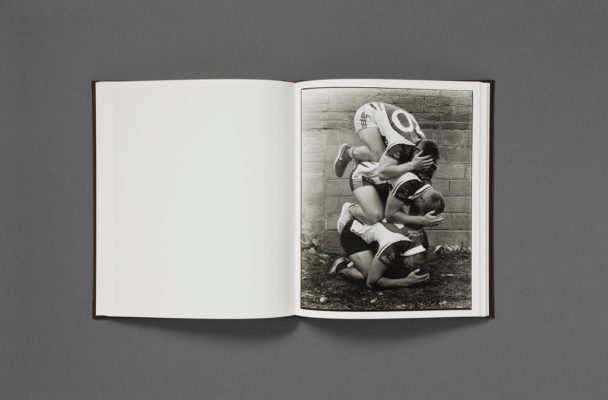
With a background in professional dance, Rodriguez’s work pays tribute to the metaphorical weight of centuries of physical labour behind cultivating the landscape and maintaining cultural heritage. Images of scarred limbs and hands, weathered faces and choreographed bodies appear as a cartography of this labour, reflecting how culture both shapes and is shaped by individuals. Elsewhere, we see the exaggerated glamour of modern female Irish dancers taken out of the glitzy ballrooms and into the fields, creating a rupture across time and space.
While in Wexford, Rodriguez was struck by the intense physicality of the sport of hurling. Considered to be the fastest sport on grass, while watching slow-motion footage of hurling Rodriguez saw that within seconds the players would go through pushing, shoving, grabbing, hugging, knocking each other down and then lifting one another up. Rodriguez worked with players to reform these gestures: creating sculptures out of bodies, directing and literally layering players upon one another.
At the outset of his project, Rodriguez wanted to create a large family photograph, an idea that was quickly surpassed by other strands of enquiry. However, with a step backwards we can see People of the Mud as just that – a collective community portrait of all the different elements that construct modern, rural Irish identities. Just like any family portrait, it is at times dysfunctional and contradictory; it gathers all the ruptures and continuities between the past and present in modern Ireland, while being held in a landscape and moment in time. This moment is both still – posed and paused – and in perpetual motion, looking towards the future.
| Poids | 700 g |
|---|---|
| Dimensions | 23 × 27,5 cm |
Vous aimerez peut-être aussi…

Livre architecture, design & urbanisme
28,00 €
Le livre de Laurent Chardon Dédale regroupe différentes séries de photographies prises au cours des années 2003 à 2013 et documente un Paris et ses alentours en transformation.
Produits similaires
Livre Photo
35,00 €
Choisir de regarder Michel Journiac en travesti

Livre Photo
17,00 €
Fluent de Laëtitia Donval est la deuxième des trois résidences initiées par Lumière d’Encre ↗ autour des fleuves côtiers des Pyrénées-Orientales
-20%
Livre Photo
Le prix initial était : 20,00 €.16,00 €Le prix actuel est : 16,00 €.
Ayline Olukman marche, roule, fait des rencontres

Livre Photo
20,00 €
SKKS est une partie du code que l’on retrouve sur les plaques d’immatriculation en Slovaquie.

Livre Photo
17,00 €
Raclose de Geoffroy Mathieu est la première des trois résidences initiées par Lumière d’Encre ↗ autour des fleuves côtiers des Pyrénées-Orientales
Livre d'artiste
38,00 €
Marie Mons a passé trois mois d’hiver dans un petit village des fjords de l’est de Islande où elle est devenue Aurore Colbert

Livre Photo
25,00 €
Ces images ne sont ni fenêtres, ni miroirs.