

-
×
 Party Studies – Vol. 2 – Underground clubs, parallel structures and second cultures
1 × 18,00 €
Party Studies – Vol. 2 – Underground clubs, parallel structures and second cultures
1 × 18,00 € -
×
 Critique & création - L.L. de Mars
1 × 5,00 €
Critique & création - L.L. de Mars
1 × 5,00 € -
×
 Deep state - Mathieu Desjardins
1 × 20,00 €
Deep state - Mathieu Desjardins
1 × 20,00 € -
×
 Der Erste Rotkehlchen - Le livre
1 × 17,00 €
Der Erste Rotkehlchen - Le livre
1 × 17,00 € -
×
 Tomber dans l'escalier - Jasper Sebastian Stürup
1 × 12,00 €
Tomber dans l'escalier - Jasper Sebastian Stürup
1 × 12,00 € -
×
 Saint Julien l'hospitalier Tome 2 - Claire Pedot
1 × 25,00 €
Saint Julien l'hospitalier Tome 2 - Claire Pedot
1 × 25,00 € -
×
 Eros negro n°3 - Démoniak
1 × 5,00 €
Eros negro n°3 - Démoniak
1 × 5,00 € -
×
 La Typographie post-binaire au delà de l'écriture inclusive - Camille Circlude
1 × 24,00 €
La Typographie post-binaire au delà de l'écriture inclusive - Camille Circlude
1 × 24,00 € -
×
 Pureté et impureté de l’art. Michel Journiac et le sida Antoine Idier
1 × 8,00 €
Pureté et impureté de l’art. Michel Journiac et le sida Antoine Idier
1 × 8,00 € -
×
 Dear Paul - Paul Van der Eerden
2 × 20,00 €
Dear Paul - Paul Van der Eerden
2 × 20,00 € -
×
![Économies silencieuses et audaces approximatives - Guy Chevalier [& coll.]](https://i0.wp.com/librairie-lame.com/wp-content/uploads/2019/03/PPT_Elastic01_couv.jpg?fit=250%2C353&ssl=1) Économies silencieuses et audaces approximatives - Guy Chevalier [& coll.]
1 × 18,00 €
Économies silencieuses et audaces approximatives - Guy Chevalier [& coll.]
1 × 18,00 € -
×
 SKKS - Gilles Pourtier
1 × 20,00 €
SKKS - Gilles Pourtier
1 × 20,00 € -
×
 Le corps travesti - Michel Journiac
1 × 35,00 €
Le corps travesti - Michel Journiac
1 × 35,00 € -
×
 Keywording (Post) Contemporary Art - Greta Rusttt
1 × 20,00 €
Keywording (Post) Contemporary Art - Greta Rusttt
1 × 20,00 € -
×
 Le dos des choses - Guillaume Goutal
1 × 13,00 €
Le dos des choses - Guillaume Goutal
1 × 13,00 € -
×
 Pectus Excavatum - Quentin Yvelin
1 × 8,00 €
Pectus Excavatum - Quentin Yvelin
1 × 8,00 € -
×
 16 x 421 - Lorraine Druon
1 × 3,00 €
16 x 421 - Lorraine Druon
1 × 3,00 € -
×
 Gros Gris n°4 - Duel
1 × 12,80 €
Gros Gris n°4 - Duel
1 × 12,80 € -
×
 Matriochka - Fanette Mellier (3ème ed.)
1 × 20,00 €
Matriochka - Fanette Mellier (3ème ed.)
1 × 20,00 € -
×
 Désolation - Verity Spott
1 × 12,00 €
Désolation - Verity Spott
1 × 12,00 € -
×
 9 octobre 1977 - Roberto Varlez
1 × 5,00 €
9 octobre 1977 - Roberto Varlez
1 × 5,00 € -
×
 Lisa Zordan . one-shot the end
1 × 18,00 €
Lisa Zordan . one-shot the end
1 × 18,00 € -
×
 Le style anthropocène - Philippe Rahm
1 × 10,00 €
Le style anthropocène - Philippe Rahm
1 × 10,00 € -
×
 Avec ce qu'il resterait à dire - Anne Maurel
1 × 13,00 €
Avec ce qu'il resterait à dire - Anne Maurel
1 × 13,00 € -
×
 Farandole - Jérémie Fischer
1 × 15,00 €
Farandole - Jérémie Fischer
1 × 15,00 € -
×
 Vacuité 9090 - Jérémy Piningre
1 × 10,00 €
Vacuité 9090 - Jérémy Piningre
1 × 10,00 € -
×
 Rois de la forêt - Alain Garlan
1 × 13,50 €
Rois de la forêt - Alain Garlan
1 × 13,50 € -
×
 Le singe et le bijoux - Roxane Lumeret
1 × 15,00 €
Le singe et le bijoux - Roxane Lumeret
1 × 15,00 € -
×
 Critique d'art n°56
1 × 16,00 €
Critique d'art n°56
1 × 16,00 € -
×
 Aurore Colbert - Marie Mons
1 × 38,00 €
Aurore Colbert - Marie Mons
1 × 38,00 € -
×
 La Couleur du Geste - Héloïse Bariol
1 × 29,00 €
La Couleur du Geste - Héloïse Bariol
1 × 29,00 € -
×
 Citrus maxima xparadisi - coll.
1 × 15,00 €
Citrus maxima xparadisi - coll.
1 × 15,00 € -
×
 Trous gris - Michel Vachey
1 × 10,00 €
Trous gris - Michel Vachey
1 × 10,00 € -
×
 Délié - Baptiste Oberson
1 × 24,00 €
Délié - Baptiste Oberson
1 × 24,00 € -
×
 In The Navy - Julien Kedryna
1 × 12,00 €
In The Navy - Julien Kedryna
1 × 12,00 €


People of the Mud – Luis Alberto Rodriguez


55,00 €
People of the Mud is a powerful new series by Luis Alberto Rodriguez, made collaboratively amongst the communities of County Wexford in Ireland, where ancient tradition and modern life rub shoulders daily.
Rupture de stock
People of the Mud is a powerful new series by Berlin-based US-Dominican artist Luis Alberto Rodriguez, made collaboratively amongst the communities of County Wexford in Ireland, where ancient tradition and modern life rub shoulders daily.
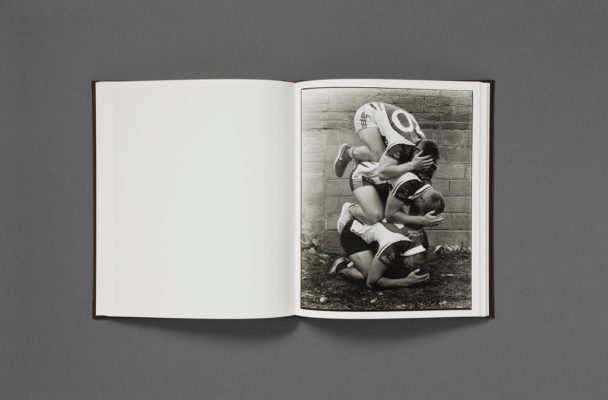
With a background in professional dance, Rodriguez’s work pays tribute to the metaphorical weight of centuries of physical labour behind cultivating the landscape and maintaining cultural heritage. Images of scarred limbs and hands, weathered faces and choreographed bodies appear as a cartography of this labour, reflecting how culture both shapes and is shaped by individuals. Elsewhere, we see the exaggerated glamour of modern female Irish dancers taken out of the glitzy ballrooms and into the fields, creating a rupture across time and space.
While in Wexford, Rodriguez was struck by the intense physicality of the sport of hurling. Considered to be the fastest sport on grass, while watching slow-motion footage of hurling Rodriguez saw that within seconds the players would go through pushing, shoving, grabbing, hugging, knocking each other down and then lifting one another up. Rodriguez worked with players to reform these gestures: creating sculptures out of bodies, directing and literally layering players upon one another.
At the outset of his project, Rodriguez wanted to create a large family photograph, an idea that was quickly surpassed by other strands of enquiry. However, with a step backwards we can see People of the Mud as just that – a collective community portrait of all the different elements that construct modern, rural Irish identities. Just like any family portrait, it is at times dysfunctional and contradictory; it gathers all the ruptures and continuities between the past and present in modern Ireland, while being held in a landscape and moment in time. This moment is both still – posed and paused – and in perpetual motion, looking towards the future.
| Poids | 700 g |
|---|---|
| Dimensions | 23 × 27,5 cm |
Vous aimerez peut-être aussi…

Livre architecture, design & urbanisme
28,00 €
Le livre de Laurent Chardon Dédale regroupe différentes séries de photographies prises au cours des années 2003 à 2013 et documente un Paris et ses alentours en transformation.
Produits similaires

Livre Photo
15,00 €
akaBB – tribute to Roni Horn is not a photographic diary, and neither is it a simple hommage to Roni Horn’s book.

25,00 €
La démarche photographique de Nicolas Savary et Tilo Steireif porte sur la représentation du politicien en tant que figure dans le système politique « de milice », en Suisse.
-20%
Livre art contemporain
Le prix initial était : 16,00 €.12,80 €Le prix actuel est : 12,80 €.
Combats polymorphes, divertissants, déraisonnables ou nécessaires

Livre Photo
17,00 €
Raclose de Geoffroy Mathieu est la première des trois résidences initiées par Lumière d’Encre ↗ autour des fleuves côtiers des Pyrénées-Orientales

25,00 €
"It was april and cherry blossom time was just over"

Livre Photo
35,00 €
Patrick Messina est un amateur de la forme urbaine dans ce qu’elle contient de hasards et d’hypothèses.
Livre Photo
12,00 €
Derrière la couverture d’In The Navy de Julien Kedryna – beau leurre minimaliste – se cache une suite d’images-nuggets grasses et gaies.
Livre d'artiste
8,00 €
Le pectus excavatum, « thorax en entonnoir » est une malformation du thorax congénitale.