

-
×
 Le Choix du peuple - Nicolas Savary, Tilo Steireif
1 × 25,00 €
Le Choix du peuple - Nicolas Savary, Tilo Steireif
1 × 25,00 € -
×
 Le corps travesti - Michel Journiac
1 × 35,00 €
Le corps travesti - Michel Journiac
1 × 35,00 € -
×
 Talk Soon - Erik Kessels & Thomas Sauvin
1 × 39,95 €
Talk Soon - Erik Kessels & Thomas Sauvin
1 × 39,95 € -
×
 La traversée - Magali Brueder
1 × 20,00 €
La traversée - Magali Brueder
1 × 20,00 € -
×
 Pénurie - Zivo, Jérôme Meizoz
1 × 30,00 €
Pénurie - Zivo, Jérôme Meizoz
1 × 30,00 € -
×
 Copy This Book - Eric Schrijver
1 × 17,00 €
Copy This Book - Eric Schrijver
1 × 17,00 € -
×
 Comic Book (Untitled) - Stéphanie Leinhos
1 × 7,00 €
Comic Book (Untitled) - Stéphanie Leinhos
1 × 7,00 € -
×
 Before Science - Gilles Pourtier, Anne-Claire Broc'h
1 × 17,00 €
Before Science - Gilles Pourtier, Anne-Claire Broc'h
1 × 17,00 € -
×
 Dernier royaume - Quentin Derouet
1 × 24,00 €
Dernier royaume - Quentin Derouet
1 × 24,00 € -
×
 Roven n°4
2 × 18,00 €
Roven n°4
2 × 18,00 € -
×
 Gros Gris n°4 - Duel
2 × 12,80 €
Gros Gris n°4 - Duel
2 × 12,80 € -
×
 Roven n°5
1 × 18,00 €
Roven n°5
1 × 18,00 € -
×
 fil·le·s de polypropylène bleu - coll.
1 × 15,00 €
fil·le·s de polypropylène bleu - coll.
1 × 15,00 € -
×
 Saint Julien l'hospitalier Tome 2 - Claire Pedot
2 × 25,00 €
Saint Julien l'hospitalier Tome 2 - Claire Pedot
2 × 25,00 € -
×
 Konrad Becker - Dictionnaire de réalité stratégique
1 × 20,00 €
Konrad Becker - Dictionnaire de réalité stratégique
1 × 20,00 € -
×
 Délié - Baptiste Oberson
1 × 24,00 €
Délié - Baptiste Oberson
1 × 24,00 € -
×
 Superbemarché - Coll.
1 × 25,00 €
Superbemarché - Coll.
1 × 25,00 € -
×
 La tour Tatline - Georgi Stanishev
1 × 13,00 €
La tour Tatline - Georgi Stanishev
1 × 13,00 € -
×
 Musée des Beaux-Arts - Pierre Martel
1 × 15,00 €
Musée des Beaux-Arts - Pierre Martel
1 × 15,00 € -
×
 The Shelf - Journal 3
1 × 20,00 €
The Shelf - Journal 3
1 × 20,00 € -
×
 Piano - Joseph Charroy
1 × 12,00 €
Piano - Joseph Charroy
1 × 12,00 € -
×
 Future Book(s) Sharing Ideas on Books and (Art) Publishing - dir. Pia Pol, Astrid Vorstermans
1 × 29,00 €
Future Book(s) Sharing Ideas on Books and (Art) Publishing - dir. Pia Pol, Astrid Vorstermans
1 × 29,00 € -
×
 À partir de n°1 - Coll.
3 × 15,00 €
À partir de n°1 - Coll.
3 × 15,00 € -
×
 In The Navy - Julien Kedryna
1 × 12,00 €
In The Navy - Julien Kedryna
1 × 12,00 € -
×
 Comment quitter la terre ? - Jill Gasparina, Christophe Kihm, Anne-Lyse Renon
1 × 10,00 €
Comment quitter la terre ? - Jill Gasparina, Christophe Kihm, Anne-Lyse Renon
1 × 10,00 € -
×
 Pas vu Pas pris - Collectif, Olivier Deloignon, Guillaume Dégé
1 × 25,00 €
Pas vu Pas pris - Collectif, Olivier Deloignon, Guillaume Dégé
1 × 25,00 € -
×
 16 x 421 - Lorraine Druon
1 × 3,00 €
16 x 421 - Lorraine Druon
1 × 3,00 € -
×
 Tomber dans l'escalier - Jasper Sebastian Stürup
1 × 12,00 €
Tomber dans l'escalier - Jasper Sebastian Stürup
1 × 12,00 € -
×
 Schindler Manifesto
1 × 15,00 €
Schindler Manifesto
1 × 15,00 € -
×
 Lili, la rozell et le marimba / revue n°2
1 × 15,00 €
Lili, la rozell et le marimba / revue n°2
1 × 15,00 € -
×
 Good Company - Paul Van der Eerden
1 × 15,00 €
Good Company - Paul Van der Eerden
1 × 15,00 € -
×
 Le blanc nez - Fouss Daniel
1 × 20,00 €
Le blanc nez - Fouss Daniel
1 × 20,00 € -
×
 La typographie des Penguin Classics - Andrew Barker
1 × 16,00 €
La typographie des Penguin Classics - Andrew Barker
1 × 16,00 € -
×
 Le dos des choses - Guillaume Goutal
1 × 13,00 €
Le dos des choses - Guillaume Goutal
1 × 13,00 € -
×
 Critique & création - L.L. de Mars
1 × 5,00 €
Critique & création - L.L. de Mars
1 × 5,00 € -
×
 America - Ayline Olukman, Hélène Gaudy
1 × 16,00 €
America - Ayline Olukman, Hélène Gaudy
1 × 16,00 € -
×
 Shanghai Cosmetic - Leslie Moquin
1 × 19,00 €
Shanghai Cosmetic - Leslie Moquin
1 × 19,00 € -
×
 Fluent - Laëticia Donval
1 × 17,00 €
Fluent - Laëticia Donval
1 × 17,00 € -
×
 Grilles - Zelda Mauger
1 × 12,00 €
Grilles - Zelda Mauger
1 × 12,00 € -
×
 Documents relatifs à l'édition pirate du Traité du style de Louis Aragon par Gérard Berréby
1 × 13,00 €
Documents relatifs à l'édition pirate du Traité du style de Louis Aragon par Gérard Berréby
1 × 13,00 € -
×
 Berlin Design Digest
1 × 30,00 €
Berlin Design Digest
1 × 30,00 € -
×
 Tempête après tempête - Rebekka Deubner
1 × 30,00 €
Tempête après tempête - Rebekka Deubner
1 × 30,00 €


A Sensitive Education – Francesca Todde


35,00 €
« Tristan Plot is a bird educator; he prepares them to work with human beings. »
Rupture de stock
“Yet it can happen, suddenly, unexpectedly, and most frequently in the half-light-of-glimpses, that we catch sight of another visible order which intersects with ours and has nothing to do with it.[…] We come upon a part of the visible which wasn’t destined for us. Perhaps it was destined for night-birds, reindeer, ferrets, eels, whales…” John Berger
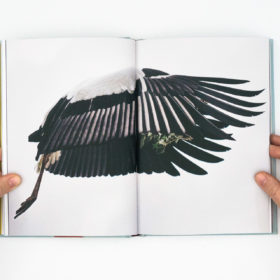
Tristan Plot is a bird educator; he prepares them to work with human beings in theatrical and dance shows or film documentaries and develops with them some “ornithotherapy” sessions with prisoners and people in distress. When he was a child, in the forest behind his parents’ house in the Touraine, Tristan noticed that, if he remained still for a long time, the animals came out of the vegetation and it was possible to observe them. Even today, this practice of slow approach, respecting the rhythm of nature, remains essential to his educational method. Since he studied ecology, biology and ethology at the university, he developed an educational technique at the intersection of imprinting, traditional training and « positive training”.
His method is a set of observation and predisposition of mind in harmony with the environment, according to the sensitivity of the other and in relation to expression and behaviour codes which are different from the human ones. Tristan, through the intuition of animality as something delicate, subtle and minimal, defines the relationship with birds as an exclusive bond able to reconcile the rhythm of the species with the individual one. His research is based on the understanding of the sensitivity of birds and aims to recover that ability, which got lost over the course of evolution, of perceiving the minimal variations and micro movements that are the expressive world of animals.
96 pages + 16
| Poids | 500 g |
|---|---|
| Dimensions | 14,8 × 21 cm |
Vous aimerez peut-être aussi…

Livre architecture, design & urbanisme
28,00 €
Le livre de Laurent Chardon Dédale regroupe différentes séries de photographies prises au cours des années 2003 à 2013 et documente un Paris et ses alentours en transformation.
Produits similaires
-20%
Livre art contemporain
Le prix initial était : 16,00 €.12,80 €Le prix actuel est : 12,80 €.
Combats polymorphes, divertissants, déraisonnables ou nécessaires

Livre d'artiste
38,00 €
Marie Mons a passé trois mois d’hiver dans un petit village des fjords de l’est de Islande où elle est devenue Aurore Colbert
Livre Photo
19,00 €
L'image révèle autant l’artifice que la fascination qu’il exerce.

Livre d'artiste
8,00 €
Le pectus excavatum, « thorax en entonnoir » est une malformation du thorax congénitale.

Livre Photo
20,00 €
SKKS est une partie du code que l’on retrouve sur les plaques d’immatriculation en Slovaquie.
Livre Photo
35,00 €
Choisir de regarder Michel Journiac en travesti

Livre Photo
35,00 €
Où qu’on se déporte et quels que soient les moyens mis en œuvre, l’inquiétant silence devient assourdissant, juste interrompu çà et là par les tonitruantes débilités de quelque leader mondial.