

-
×
 Musée des Beaux-Arts - Pierre Martel
1 × 15,00 €
Musée des Beaux-Arts - Pierre Martel
1 × 15,00 € -
×
 Strange Design - Ed. Jehanne Dautrey et Emanuele Quinz.
1 × 24,00 €
Strange Design - Ed. Jehanne Dautrey et Emanuele Quinz.
1 × 24,00 € -
×
 Tools #04 – Couper / To Cut
1 × 25,00 €
Tools #04 – Couper / To Cut
1 × 25,00 € -
×
 Editer l’art – Leszek Brogowski
1 × 33,00 €
Editer l’art – Leszek Brogowski
1 × 33,00 € -
×
 Yerevan 1996/1997 - Ursula Schulz-Dornburg
1 × 25,00 €
Yerevan 1996/1997 - Ursula Schulz-Dornburg
1 × 25,00 € -
×
 Anémochorie - Antonin Detemple
1 × 12,00 €
Anémochorie - Antonin Detemple
1 × 12,00 € -
×
 Tupera Tupera Postcard Book
1 × 20,00 €
Tupera Tupera Postcard Book
1 × 20,00 € -
×
 Délié - Baptiste Oberson
1 × 24,00 €
Délié - Baptiste Oberson
1 × 24,00 € -
×
 A book (untitled) - Maya Strobbe
1 × 35,00 €
A book (untitled) - Maya Strobbe
1 × 35,00 € -
×
 9 octobre 1977 - Roberto Varlez
1 × 5,00 €
9 octobre 1977 - Roberto Varlez
1 × 5,00 € -
×
 Rue Englelab, La révolution par les livres - Iran 1979 - 1983 - Hannah Darabi
1 × 48,00 €
Rue Englelab, La révolution par les livres - Iran 1979 - 1983 - Hannah Darabi
1 × 48,00 € -
×
 America - Ayline Olukman, Hélène Gaudy
1 × 16,00 €
America - Ayline Olukman, Hélène Gaudy
1 × 16,00 € -
×
 Imagos - Noémie Lothe
1 × 20,00 €
Imagos - Noémie Lothe
1 × 20,00 € -
×
 Good Company - Paul Van der Eerden
1 × 15,00 €
Good Company - Paul Van der Eerden
1 × 15,00 € -
×
 Slanted 24 - Istanbul
1 × 21,00 €
Slanted 24 - Istanbul
1 × 21,00 € -
×
 Amos Gitai et l'enjeu des archives - Jean-Michel Frodon
1 × 14,00 €
Amos Gitai et l'enjeu des archives - Jean-Michel Frodon
1 × 14,00 € -
×
 PRISON MUSEUM - Nicolò Degiorgis
1 × 40,00 €
PRISON MUSEUM - Nicolò Degiorgis
1 × 40,00 € -
×
 Dictionary - Claude Closky
1 × 20,00 €
Dictionary - Claude Closky
1 × 20,00 € -
×
 Photographic Fields - Joël Van Audenhaege
1 × 25,00 €
Photographic Fields - Joël Van Audenhaege
1 × 25,00 € -
×
 Acteurs d'un film gravé. Docteur A. Infirmier O. - Annabelle Dupret, Olivier Deprez et Adolpho Avril
1 × 9,00 €
Acteurs d'un film gravé. Docteur A. Infirmier O. - Annabelle Dupret, Olivier Deprez et Adolpho Avril
1 × 9,00 €


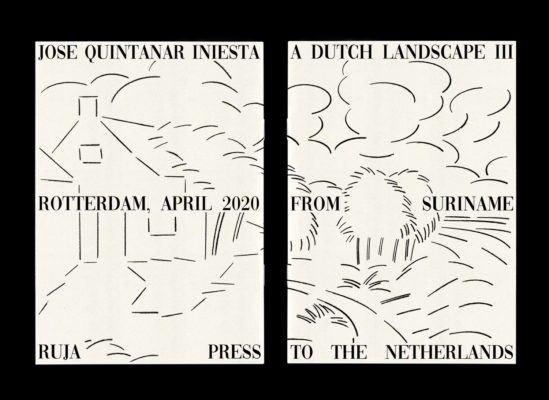
A Dutch Landscape III- From Suriname to The Netherlands – José Quintanar


8,00 €
From Suriname to The Netherlands
Rupture de stock
Highlighting the significance of the landscape in Dutch culture, José’s project is not only observatory by nature, but also investigatory. He notes how the Dutch landscape was “built by people in an artificial way,” as man-made interventions connected ground to sea more easily. “Hence it is understood that the golden age of landscape painting was not a representation of the landscape, but the representation of an illusion.”
The book is built from two landscapes, that of Suriname’s – an old Dutch colony – and the Netherland’s. “Each landscape is drawn over and over again,” says José of the 20 page, Risograph-printed volume , “building a series of ten drawings each. In each drawing, the rules of the game have been progressively altered so that each drawing of the same landscape is always different.” Interestingly, the rules used in landscape A are the same rules applied in landscape B but inverted. And in this way, “A and B only make sense when they are connected within the temporary space format of the book.” As a result, the concept of the publication, drawn from geometric patterns of circles that grow in each drawing, in turn, also becomes the narrative of the work.
20 pages.
| Poids | 64 g |
|---|---|
| Dimensions | 29,7 × 21 cm |
Produits similaires

livre Dessin
25,00 €
Sédimentaire ou volcanique, sur terre ou dans les airs, en long ou en large.

Livre d'artiste
24,00 €
Regardant ces pages tracées dehors, on ne peut rien situer, ou pas grand chose.

livre Dessin
25,00 €
Une épopée chevaleresque et graphique


