

-
×
 Comment quitter la terre ? - Jill Gasparina, Christophe Kihm, Anne-Lyse Renon
1 × 10,00 €
Comment quitter la terre ? - Jill Gasparina, Christophe Kihm, Anne-Lyse Renon
1 × 10,00 € -
×
 Imagos - Noémie Lothe
1 × 20,00 €
Imagos - Noémie Lothe
1 × 20,00 € -
×
 Saint Julien l'hospitalier Tome 3 - Claire Pedot
1 × 25,00 €
Saint Julien l'hospitalier Tome 3 - Claire Pedot
1 × 25,00 € -
×
 Entretiens – Jérôme Dupeyrat
1 × 25,00 €
Entretiens – Jérôme Dupeyrat
1 × 25,00 € -
×
 Wayfaring - Patrick Messina, André S. Labarthe
1 × 35,00 €
Wayfaring - Patrick Messina, André S. Labarthe
1 × 35,00 € -
×
 Eurob0ys Crysis - Massimiliano Bomba, Leon Sadler, Yannick Val Gesto
1 × 6,00 €
Eurob0ys Crysis - Massimiliano Bomba, Leon Sadler, Yannick Val Gesto
1 × 6,00 € -
×
 America - Ayline Olukman, Hélène Gaudy
1 × 16,00 €
America - Ayline Olukman, Hélène Gaudy
1 × 16,00 € -
×
 La traversée - Magali Brueder
1 × 20,00 €
La traversée - Magali Brueder
1 × 20,00 € -
×
 Pectus Excavatum - Quentin Yvelin
2 × 8,00 €
Pectus Excavatum - Quentin Yvelin
2 × 8,00 € -
×
 Keywording (Post) Contemporary Art - Greta Rusttt
1 × 20,00 €
Keywording (Post) Contemporary Art - Greta Rusttt
1 × 20,00 € -
×
 Goodbye - Hsia-Fei Chang, Sofia Eliza Bouratsis, Medhi Brit, Enrico Lunghi
1 × 28,00 €
Goodbye - Hsia-Fei Chang, Sofia Eliza Bouratsis, Medhi Brit, Enrico Lunghi
1 × 28,00 € -
×
 SKKS - Gilles Pourtier
1 × 20,00 €
SKKS - Gilles Pourtier
1 × 20,00 € -
×
 Shanghai Cosmetic - Leslie Moquin
1 × 19,00 €
Shanghai Cosmetic - Leslie Moquin
1 × 19,00 € -
×
 Gruppen n°13 - Collectif
1 × 15,00 €
Gruppen n°13 - Collectif
1 × 15,00 € -
×
 Le blanc nez - Fouss Daniel
1 × 20,00 €
Le blanc nez - Fouss Daniel
1 × 20,00 € -
×
 Recto Versu - Bill Noir
1 × 15,00 €
Recto Versu - Bill Noir
1 × 15,00 € -
×
 Gnose & Gnose & Gnose - Aymeric Vergnon-d'Alençon
1 × 25,00 €
Gnose & Gnose & Gnose - Aymeric Vergnon-d'Alençon
1 × 25,00 € -
×
 Bienvenue à Colomeri ! - Hécate Vergopoulo,
1 × 18,00 €
Bienvenue à Colomeri ! - Hécate Vergopoulo,
1 × 18,00 € -
×
 Denver Mosaic 1961 - René Heyvaert
1 × 29,00 €
Denver Mosaic 1961 - René Heyvaert
1 × 29,00 € -
×
 Spécimen Typographique : No Ko - Loris Pernoux
1 × 25,00 €
Spécimen Typographique : No Ko - Loris Pernoux
1 × 25,00 € -
×
 Rasclose - Geoffroy Mathieu
1 × 17,00 €
Rasclose - Geoffroy Mathieu
1 × 17,00 € -
×
 La tour Tatline - Georgi Stanishev
1 × 13,00 €
La tour Tatline - Georgi Stanishev
1 × 13,00 € -
×
 Pas vu Pas pris - Collectif, Olivier Deloignon, Guillaume Dégé
1 × 25,00 €
Pas vu Pas pris - Collectif, Olivier Deloignon, Guillaume Dégé
1 × 25,00 € -
×
 Ar(t)chitectures situées - Étienne Delprat
1 × 29,00 €
Ar(t)chitectures situées - Étienne Delprat
1 × 29,00 € -
×
 Piano - Joseph Charroy
1 × 12,00 €
Piano - Joseph Charroy
1 × 12,00 € -
×
 Hérésie Étiologique - coll.
1 × 28,00 €
Hérésie Étiologique - coll.
1 × 28,00 € -
×
 Critique d'art n°54
1 × 16,00 €
Critique d'art n°54
1 × 16,00 €


Siam’s guy – Tiane Doan na Champassak


35,00 €
Collage de photographies érotiques sur magasine thaïlandais des 70’s
Rupture de stock
Artiste Français d’origine asiatique, Tiane Doan na Champassak mène en parallèle à son travail photographique une réflexion sur les images anonymes qu’il collectionne via diverses sources telles qu’internet, les albums de famille ou les coupures de magazines. Il consacre une grande partie de sa pratique aux livres et a publié à ce jour une quinzaine d’ouvrages. Siam’s Guy est le premier dans lequel il associe à sa photographie, son travail de réappropriation.
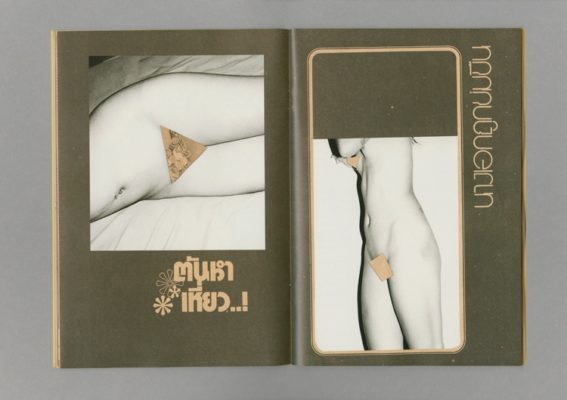
Le livre Siam’s Guy emprunte son nom à une revue érotique thaïlandaise des années 1960-70 que collectionne Tiane Doan na Champassak. Bien que censurée celle-ci a toujours été en vente libre. Pour cet ouvrage l’artiste a sélectionnés 68 pages originales parmi plus de 100 magazines sur lesquels il vient superposer ses propres photographies de nus féminins. L’esthétique très contemporaine des images de Champassak se substitue donc à une photographie plus datée. Le recours à la surimpression, tout en conservant l’acte de censure sur les parties génitales et les seins, rend hommage au design exceptionnel de l’époque.
Parallel to his personal photographic practice, Tiane Doan na Champassak, a French artist of Asian origin, explores the theme of anonymity, collecting source material from a variety of sources including the Internet, family albums and magazine excerpts. Although his work often translates into bookmaking, having already released over a dozen publications; Siam’s Guy is the first to apply his own photography and use of re-appropriation to bookmaking.
The book borrows its title from one of Tiane Doan na Champassak’s collected items, Siam’s Guy, a Thai erotic magazine from the 1960s and 1970s that remained available over the counter in spite of censorship. For this project, the artist selected 68 original pages from 100 issues of the magazine, superimposing them with his own female nude photographs and thereby injecting his contemporary esthetic into the somewhat dated images. Preserving the original use of censorship on the breasts and genitals through his act of superimposition, Champassak pays tribute to the exceptional, original design of the period.
72 pages
| Poids | 301 g |
|---|---|
| Dimensions | 18 × 26 cm |
Produits similaires

Livre d'artiste
20,00 €
Revue bilingue français/anglais sur l’art et le design des livre


Livre d'artiste
22,00 €
Cast of Characters A selection of 100 faces by artist Sam Porritt.

Livre d'artiste
25,00 €
Un cycle lunaire aux formes simples et épurées. En combinant 8 encres de couleur, Fanette Mellier propose une avancée sensible dans la lunaison.

Dits & Écrits d'artistes
15,00 €
Prose postérieure, une extraction brute de la boîte email d'une professeure d'aérobic

Livre d'artiste
30,00 €
Une publication de la Houle en plusieurs parties qui rassemble les interventions de différents artistes ou auteurs sur un même format – une feuille de papier au format A3.
28,00 €
Goodbye est la première monographie consacrée au travail de Hsia-Fei Chang, artiste taïwanaise vivant en France.