

-
×
 Gros Gris n°4 - Duel
1 × 12,80 €
Gros Gris n°4 - Duel
1 × 12,80 € -
×
 Carnivore - Grow
1 × 10,00 €
Carnivore - Grow
1 × 10,00 € -
×
 The life of Ruben - Bernardo Sousa Santos
1 × 33,00 €
The life of Ruben - Bernardo Sousa Santos
1 × 33,00 € -
×
 Betty Tompkins - Raw Material
1 × 25,00 €
Betty Tompkins - Raw Material
1 × 25,00 € -
×
 Oblikvaj 2 - L'amour à la maison - Yannis La Macchia, Ensemble Battida
1 × 10,00 €
Oblikvaj 2 - L'amour à la maison - Yannis La Macchia, Ensemble Battida
1 × 10,00 € -
×
 MENU メニュー - Wataru Tominaga
1 × 20,00 €
MENU メニュー - Wataru Tominaga
1 × 20,00 € -
×
 Une idéologie pour survivre – Débats féministes sur violence et genre au Japon - Ueno Chizuko
1 × 25,00 €
Une idéologie pour survivre – Débats féministes sur violence et genre au Japon - Ueno Chizuko
1 × 25,00 € -
×
 Le dos des choses - Guillaume Goutal
1 × 13,00 €
Le dos des choses - Guillaume Goutal
1 × 13,00 € -
×
 Le singe et le bijoux - Roxane Lumeret
1 × 15,00 €
Le singe et le bijoux - Roxane Lumeret
1 × 15,00 € -
×
 Anthologie Douteuses (2010—2020) - Élodie Petit & Marguerin Le Louvier
1 × 22,00 €
Anthologie Douteuses (2010—2020) - Élodie Petit & Marguerin Le Louvier
1 × 22,00 € -
×
 Une histoire russe - Claude Grétillat
1 × 8,00 €
Une histoire russe - Claude Grétillat
1 × 8,00 € -
×
 Awakening at the inn of the birds - Aymeric Vergnon
1 × 13,50 €
Awakening at the inn of the birds - Aymeric Vergnon
1 × 13,50 €


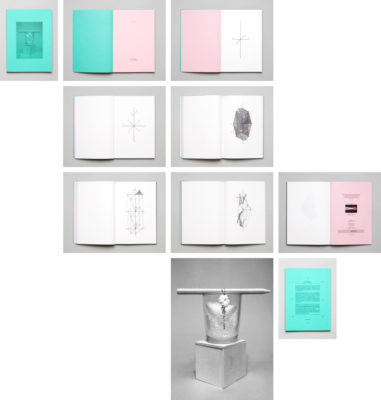
As you see on the front cover of this issue, one can easily grow one’s own salt crystal at home, using a glass of salted water and a string attached to a pencil. Within few days the evaporation of water induces a shifting of matter from the water to the string as the less energetic way for sodium chloride to reorganise itself.
After discovering the principle of natural salt crystallisation near Salzburg were miners used to offer to tourists dry branches
covered with a shining deposit of crystals, French writer Stendhal in his essay ‘On Love’ (1822) used it as a metaphor to describe the ‘birth of love’ in human relationships.
According to Stendhal, the mental process when one sees flattering illusions in a new love, hiding the unattractive characteristics of this person, is quite similar to the sparkly diamonds covering a leafless piece of wood after the natural crystallisation of the salt.
Exploring the same phenomenon, Fabio Parizzi intended in this book to describe this chemical reaction with 50 sketches.
This visual attempt to understand the basic structure of matter in space and its physical behaviour embracies the fascination of mankind for the primary form of solid structure first described by Plato more than 2.300 years ago.
SALT CRYSTAL
Edited by
Philippe Desarzens
Crystal drawings and tattooed arm
Fabio Parizzi
148,5 / 204 mm, 53 pages
Xerox printed
Book edges printed in black
| Poids | 300 g |
|---|---|
| Dimensions | 14 × 20 cm |
Vous aimerez peut-être aussi…


Livre d'artiste
Lazy Painter – Angela Gjergjaj, Jordi Bucher and Mirco Petrini
22,00 €
Pictures by a robot vacuum cleaner

Livre d'artiste
22,00 €
Cast of Characters A selection of 100 faces by artist Sam Porritt.
Produits similaires
-20%

Littérature
Le prix initial était : 25,00 €.20,00 €Le prix actuel est : 20,00 €.
In the book “Le vieux père”, Laurent Kropf presents a selection of reproductions from his archive of group photographs.

Livre d'artiste
20,00 €
Une redéfinition financière et capitaliste de mots commun

Essai art / Histoire de l'art
33,00 €
Le livre d’artiste et l’histoire du livre.

Livre d'artiste
La peinture c’est comme les pépites – Pierre Yves-Hélou + Tirage
15,00 €
on fait son barbecue comme on se couche...
13,50 €
Végétation, voyage et prospection - le souvenir


Livre d'artiste
15,00 €
Des cartels d’expositions à côté des objets les plus triviaux que renferme le musée dans lequel ils ont été extorqués.
