

-
×
 Roven n°4
1 × 18,00 €
Roven n°4
1 × 18,00 € -
×
 La France de tête #04
1 × 3,00 €
La France de tête #04
1 × 3,00 € -
×
 Le Choix du peuple - Nicolas Savary, Tilo Steireif
1 × 25,00 €
Le Choix du peuple - Nicolas Savary, Tilo Steireif
1 × 25,00 € -
×
 Assembly - Sam Porritt
1 × 22,00 €
Assembly - Sam Porritt
1 × 22,00 € -
×
 Un cahier - Michel Quarez
1 × 12,00 €
Un cahier - Michel Quarez
1 × 12,00 € -
×
 Critique d'art n°56
1 × 16,00 €
Critique d'art n°56
1 × 16,00 € -
×
 Mökki n°2
1 × 10,00 €
Mökki n°2
1 × 10,00 € -
×
 Bacon le Cannibale - Perrine Le Querrec
1 × 15,00 €
Bacon le Cannibale - Perrine Le Querrec
1 × 15,00 € -
×
 Regards croisés — Gekreutze Blicke - Yeloyolo
1 × 35,00 €
Regards croisés — Gekreutze Blicke - Yeloyolo
1 × 35,00 € -
×
 Prose postérieure - Les commissaires anonymes
1 × 15,00 €
Prose postérieure - Les commissaires anonymes
1 × 15,00 € -
×
 Philonimo - Le Corbeau d’Épictète - Alice Brière-Haquet, Csil
1 × 9,00 €
Philonimo - Le Corbeau d’Épictète - Alice Brière-Haquet, Csil
1 × 9,00 € -
×
 Catalogue Art Guys - That's painting productions, Bernard Brunon
1 × 10,00 €
Catalogue Art Guys - That's painting productions, Bernard Brunon
1 × 10,00 € -
×
 Before Science - Gilles Pourtier, Anne-Claire Broc'h
2 × 17,00 €
Before Science - Gilles Pourtier, Anne-Claire Broc'h
2 × 17,00 € -
×
 Anthologie Douteuses (2010—2020) - Élodie Petit & Marguerin Le Louvier
1 × 22,00 €
Anthologie Douteuses (2010—2020) - Élodie Petit & Marguerin Le Louvier
1 × 22,00 € -
×
 Poétique d'une introspection visuelle - Jean-Charles Andrieu de Levis, Alex Barbier
1 × 12,00 €
Poétique d'une introspection visuelle - Jean-Charles Andrieu de Levis, Alex Barbier
1 × 12,00 € -
×
 Keywording (Post) Contemporary Art - Greta Rusttt
1 × 20,00 €
Keywording (Post) Contemporary Art - Greta Rusttt
1 × 20,00 € -
×
 Critique & création - L.L. de Mars
1 × 5,00 €
Critique & création - L.L. de Mars
1 × 5,00 € -
×
 16 x 421 - Lorraine Druon
1 × 3,00 €
16 x 421 - Lorraine Druon
1 × 3,00 € -
×
 Flower finds - Orianne Jeanselme
1 × 19,00 €
Flower finds - Orianne Jeanselme
1 × 19,00 € -
×
 Poèmes - Yvonne Rainer
1 × 14,00 €
Poèmes - Yvonne Rainer
1 × 14,00 € -
×
 The life of Ruben - Bernardo Sousa Santos
1 × 33,00 €
The life of Ruben - Bernardo Sousa Santos
1 × 33,00 € -
×
 Rupture (fragments) - Benjamin Monti, Jean-Charles Andrieu de Levis
1 × 20,00 €
Rupture (fragments) - Benjamin Monti, Jean-Charles Andrieu de Levis
1 × 20,00 € -
×
 Dédale - Laurent Chardon
1 × 28,00 €
Dédale - Laurent Chardon
1 × 28,00 € -
×
 Les glaciers - Lorraine Druon
1 × 10,00 €
Les glaciers - Lorraine Druon
1 × 10,00 € -
×
 Aurore Colbert - Marie Mons
1 × 38,00 €
Aurore Colbert - Marie Mons
1 × 38,00 € -
×
 Pureté et impureté de l’art. Michel Journiac et le sida Antoine Idier
1 × 8,00 €
Pureté et impureté de l’art. Michel Journiac et le sida Antoine Idier
1 × 8,00 € -
×
 Amos Gitai et l'enjeu des archives - Jean-Michel Frodon
1 × 14,00 €
Amos Gitai et l'enjeu des archives - Jean-Michel Frodon
1 × 14,00 € -
×
 Comment réparer : La maternité et ses fantômes - Iman Mersal
1 × 15,00 €
Comment réparer : La maternité et ses fantômes - Iman Mersal
1 × 15,00 € -
×
 Rue Englelab, La révolution par les livres - Iran 1979 - 1983 - Hannah Darabi
1 × 48,00 €
Rue Englelab, La révolution par les livres - Iran 1979 - 1983 - Hannah Darabi
1 × 48,00 € -
×
 Modern Instances, The Craft of Photography - Stephen Shore
1 × 38,00 €
Modern Instances, The Craft of Photography - Stephen Shore
1 × 38,00 € -
×
 Cf. - Pierre Olivier Arnaud
1 × 18,00 €
Cf. - Pierre Olivier Arnaud
1 × 18,00 € -
×
 Buiding a wall - A book by Roméo Julien
1 × 17,00 €
Buiding a wall - A book by Roméo Julien
1 × 17,00 € -
×
 Les Grands Ensembles - Léo Guy-Denarcy
1 × 8,00 €
Les Grands Ensembles - Léo Guy-Denarcy
1 × 8,00 € -
×
 Wayfaring - Patrick Messina, André S. Labarthe
1 × 35,00 €
Wayfaring - Patrick Messina, André S. Labarthe
1 × 35,00 € -
×
 À partir de n°1 - Coll.
1 × 15,00 €
À partir de n°1 - Coll.
1 × 15,00 € -
×
 ARTZINES #1, Paris issue
1 × 10,00 €
ARTZINES #1, Paris issue
1 × 10,00 € -
×
 Après la révolution – Numéro 2
1 × 20,00 €
Après la révolution – Numéro 2
1 × 20,00 € -
×
 Rasclose - Geoffroy Mathieu
1 × 17,00 €
Rasclose - Geoffroy Mathieu
1 × 17,00 €


People of the Mud – Luis Alberto Rodriguez


55,00 €
People of the Mud is a powerful new series by Luis Alberto Rodriguez, made collaboratively amongst the communities of County Wexford in Ireland, where ancient tradition and modern life rub shoulders daily.
Rupture de stock
People of the Mud is a powerful new series by Berlin-based US-Dominican artist Luis Alberto Rodriguez, made collaboratively amongst the communities of County Wexford in Ireland, where ancient tradition and modern life rub shoulders daily.
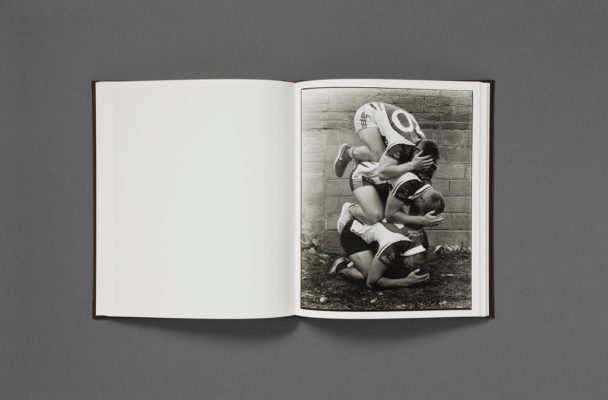
With a background in professional dance, Rodriguez’s work pays tribute to the metaphorical weight of centuries of physical labour behind cultivating the landscape and maintaining cultural heritage. Images of scarred limbs and hands, weathered faces and choreographed bodies appear as a cartography of this labour, reflecting how culture both shapes and is shaped by individuals. Elsewhere, we see the exaggerated glamour of modern female Irish dancers taken out of the glitzy ballrooms and into the fields, creating a rupture across time and space.
While in Wexford, Rodriguez was struck by the intense physicality of the sport of hurling. Considered to be the fastest sport on grass, while watching slow-motion footage of hurling Rodriguez saw that within seconds the players would go through pushing, shoving, grabbing, hugging, knocking each other down and then lifting one another up. Rodriguez worked with players to reform these gestures: creating sculptures out of bodies, directing and literally layering players upon one another.
At the outset of his project, Rodriguez wanted to create a large family photograph, an idea that was quickly surpassed by other strands of enquiry. However, with a step backwards we can see People of the Mud as just that – a collective community portrait of all the different elements that construct modern, rural Irish identities. Just like any family portrait, it is at times dysfunctional and contradictory; it gathers all the ruptures and continuities between the past and present in modern Ireland, while being held in a landscape and moment in time. This moment is both still – posed and paused – and in perpetual motion, looking towards the future.
| Poids | 700 g |
|---|---|
| Dimensions | 23 × 27,5 cm |
Vous aimerez peut-être aussi…
Livre architecture, design & urbanisme
28,00 €
Le livre de Laurent Chardon Dédale regroupe différentes séries de photographies prises au cours des années 2003 à 2013 et documente un Paris et ses alentours en transformation.
Produits similaires

Livre Photo
20,00 €
SKKS est une partie du code que l’on retrouve sur les plaques d’immatriculation en Slovaquie.
Livre d'artiste
38,00 €
Marie Mons a passé trois mois d’hiver dans un petit village des fjords de l’est de Islande où elle est devenue Aurore Colbert

Collage
20,00 €
Apparaissent des restes épars et altérés de photographies, cartes, paysages, empreintes, visages, corps et fossiles.

Livre Photo
32,00 €
Des silhouettes solitaires en attente d’un départ.

Livre Photo
20,00 €
Une traversée entre Marseille et la Corse entre mer et terre
-20%

Livre paysage
Le prix initial était : 25,00 €.20,00 €Le prix actuel est : 20,00 €.
La poésie et le beauté des rivages
17,00 €
Dans la vallée de l’Agly, Gilles Pourtier et Anne-Claire Broc’h ont observé la géologie du terrain, au plus près du cours du fleuve.

25,00 €
"It was april and cherry blossom time was just over"