

-
×
 In The Navy - Julien Kedryna
1 × 12,00 €
In The Navy - Julien Kedryna
1 × 12,00 € -
×
 movement in squares - Stefanie Leinhos
1 × 18,00 €
movement in squares - Stefanie Leinhos
1 × 18,00 € -
×
 La traversée - Magali Brueder
1 × 20,00 €
La traversée - Magali Brueder
1 × 20,00 € -
×
 Humoral Fortuities - Francesco Albano’s
1 × 12,00 €
Humoral Fortuities - Francesco Albano’s
1 × 12,00 € -
×
 Holy Mountain - Maia Matches, Knuckles & Notch
1 × 12,00 €
Holy Mountain - Maia Matches, Knuckles & Notch
1 × 12,00 € -
×
 Critique & création - L.L. de Mars
1 × 5,00 €
Critique & création - L.L. de Mars
1 × 5,00 € -
×
 Harry Thaler's Pressed Chair
1 × 11,50 €
Harry Thaler's Pressed Chair
1 × 11,50 € -
×
 How Many - Nathalie Du Pasquier
1 × 28,00 €
How Many - Nathalie Du Pasquier
1 × 28,00 € -
×
 Musée des Beaux-Arts - Pierre Martel
1 × 15,00 €
Musée des Beaux-Arts - Pierre Martel
1 × 15,00 € -
×
 Éclats III - Athanor
1 × 10,00 €
Éclats III - Athanor
1 × 10,00 € -
×
 Le chateau enchanté - Atelier Mclane
1 × 20,00 €
Le chateau enchanté - Atelier Mclane
1 × 20,00 € -
×
 Le déclin du professeur de tennis - Fabienne Radi
1 × 8,00 €
Le déclin du professeur de tennis - Fabienne Radi
1 × 8,00 € -
×
 Blaclywall by Sihab Baik - Claude Closky
1 × 25,00 €
Blaclywall by Sihab Baik - Claude Closky
1 × 25,00 € -
×
 L'inventaire des destructions - Éric Watier
2 × 12,00 €
L'inventaire des destructions - Éric Watier
2 × 12,00 € -
×
 Feminist Art Activisms and Artivisms - Katy Deepwell (ed.)
1 × 29,00 €
Feminist Art Activisms and Artivisms - Katy Deepwell (ed.)
1 × 29,00 € -
×
 Goodbye - Hsia-Fei Chang, Sofia Eliza Bouratsis, Medhi Brit, Enrico Lunghi
1 × 28,00 €
Goodbye - Hsia-Fei Chang, Sofia Eliza Bouratsis, Medhi Brit, Enrico Lunghi
1 × 28,00 € -
×
 La France de tête #04
1 × 3,00 €
La France de tête #04
1 × 3,00 € -
×
 Konrad Becker - Dictionnaire de réalité stratégique
1 × 20,00 €
Konrad Becker - Dictionnaire de réalité stratégique
1 × 20,00 € -
×
 Eldorado maximum - Les commissaires anonymes
1 × 14,00 €
Eldorado maximum - Les commissaires anonymes
1 × 14,00 € -
×
 Notre condition. Essai sur le salaire au travail artistique – Aurélien Catin
1 × 10,00 €
Notre condition. Essai sur le salaire au travail artistique – Aurélien Catin
1 × 10,00 € -
×
 Crise de foie - Christine Demias
1 × 10,00 €
Crise de foie - Christine Demias
1 × 10,00 € -
×
 Temps d'arrêt - Etienne Buyse
1 × 32,00 €
Temps d'arrêt - Etienne Buyse
1 × 32,00 € -
×
 Donne des racines au loup-garou & fais courir l'arbre la nuit - Pauline Barzilaï
1 × 20,00 €
Donne des racines au loup-garou & fais courir l'arbre la nuit - Pauline Barzilaï
1 × 20,00 € -
×
 Mökki n°4
1 × 10,00 €
Mökki n°4
1 × 10,00 € -
×
 Fluent - Laëticia Donval
1 × 17,00 €
Fluent - Laëticia Donval
1 × 17,00 € -
×
 Piano - Joseph Charroy
1 × 12,00 €
Piano - Joseph Charroy
1 × 12,00 € -
×
 Dernier royaume - Quentin Derouet
1 × 24,00 €
Dernier royaume - Quentin Derouet
1 × 24,00 € -
×
 America - Ayline Olukman, Hélène Gaudy
1 × 16,00 €
America - Ayline Olukman, Hélène Gaudy
1 × 16,00 € -
×
 Catalogue Art Guys - That's painting productions, Bernard Brunon
1 × 10,00 €
Catalogue Art Guys - That's painting productions, Bernard Brunon
1 × 10,00 € -
×
 Lili, la rozell et le marimba / revue n°2
1 × 15,00 €
Lili, la rozell et le marimba / revue n°2
1 × 15,00 € -
×
 Do insects play ? - Johanna Tagada Hoffbeck
1 × 25,00 €
Do insects play ? - Johanna Tagada Hoffbeck
1 × 25,00 € -
×
 Gnose & Gnose & Gnose - Aymeric Vergnon-d'Alençon
1 × 25,00 €
Gnose & Gnose & Gnose - Aymeric Vergnon-d'Alençon
1 × 25,00 € -
×
 Aurore Colbert - Marie Mons
1 × 38,00 €
Aurore Colbert - Marie Mons
1 × 38,00 € -
×
 L’Écureuil de James - Alice Brière-Haquet, Liuna Virardi
1 × 9,00 €
L’Écureuil de James - Alice Brière-Haquet, Liuna Virardi
1 × 9,00 € -
×
 Flower finds - Orianne Jeanselme
1 × 19,00 €
Flower finds - Orianne Jeanselme
1 × 19,00 € -
×
 Sillo n°3 - Le Fauve
1 × 12,00 €
Sillo n°3 - Le Fauve
1 × 12,00 € -
×
 Revue Les Saisons n°3
1 × 20,00 €
Revue Les Saisons n°3
1 × 20,00 € -
×
 Tomber dans l'escalier - Jasper Sebastian Stürup
1 × 12,00 €
Tomber dans l'escalier - Jasper Sebastian Stürup
1 × 12,00 € -
×
 La mémoire en acte - Quarente ans de création musicale
1 × 15,00 €
La mémoire en acte - Quarente ans de création musicale
1 × 15,00 € -
×
 The Shelf - Journal 3
1 × 20,00 €
The Shelf - Journal 3
1 × 20,00 € -
×
 Wayfaring - Patrick Messina, André S. Labarthe
1 × 35,00 €
Wayfaring - Patrick Messina, André S. Labarthe
1 × 35,00 € -
×
 Imagos - Noémie Lothe
1 × 20,00 €
Imagos - Noémie Lothe
1 × 20,00 € -
×
 Dédale - Laurent Chardon
1 × 28,00 €
Dédale - Laurent Chardon
1 × 28,00 €


People of the Mud – Luis Alberto Rodriguez


55,00 €
People of the Mud is a powerful new series by Luis Alberto Rodriguez, made collaboratively amongst the communities of County Wexford in Ireland, where ancient tradition and modern life rub shoulders daily.
Rupture de stock
People of the Mud is a powerful new series by Berlin-based US-Dominican artist Luis Alberto Rodriguez, made collaboratively amongst the communities of County Wexford in Ireland, where ancient tradition and modern life rub shoulders daily.
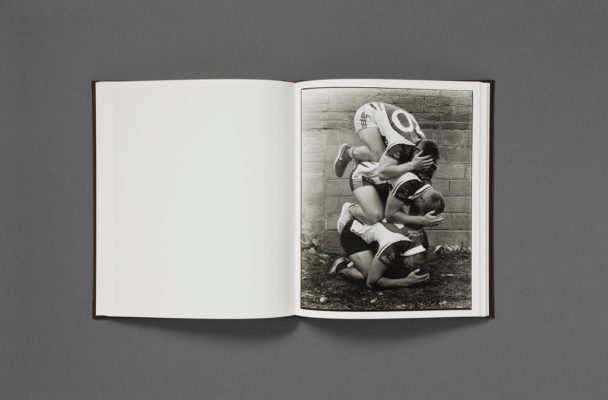
With a background in professional dance, Rodriguez’s work pays tribute to the metaphorical weight of centuries of physical labour behind cultivating the landscape and maintaining cultural heritage. Images of scarred limbs and hands, weathered faces and choreographed bodies appear as a cartography of this labour, reflecting how culture both shapes and is shaped by individuals. Elsewhere, we see the exaggerated glamour of modern female Irish dancers taken out of the glitzy ballrooms and into the fields, creating a rupture across time and space.
While in Wexford, Rodriguez was struck by the intense physicality of the sport of hurling. Considered to be the fastest sport on grass, while watching slow-motion footage of hurling Rodriguez saw that within seconds the players would go through pushing, shoving, grabbing, hugging, knocking each other down and then lifting one another up. Rodriguez worked with players to reform these gestures: creating sculptures out of bodies, directing and literally layering players upon one another.
At the outset of his project, Rodriguez wanted to create a large family photograph, an idea that was quickly surpassed by other strands of enquiry. However, with a step backwards we can see People of the Mud as just that – a collective community portrait of all the different elements that construct modern, rural Irish identities. Just like any family portrait, it is at times dysfunctional and contradictory; it gathers all the ruptures and continuities between the past and present in modern Ireland, while being held in a landscape and moment in time. This moment is both still – posed and paused – and in perpetual motion, looking towards the future.
| Poids | 700 g |
|---|---|
| Dimensions | 23 × 27,5 cm |
Vous aimerez peut-être aussi…
Livre architecture, design & urbanisme
28,00 €
Le livre de Laurent Chardon Dédale regroupe différentes séries de photographies prises au cours des années 2003 à 2013 et documente un Paris et ses alentours en transformation.
Produits similaires
Livre Photo
12,00 €
Derrière la couverture d’In The Navy de Julien Kedryna – beau leurre minimaliste – se cache une suite d’images-nuggets grasses et gaies.

Livre Photo
17,00 €
l'intimité d'un couple français entre 1959 et 1978.
Livre Photo
35,00 €
Patrick Messina est un amateur de la forme urbaine dans ce qu’elle contient de hasards et d’hypothèses.

Livre Photo
25,00 €
Titanic Orchestra est une réaction instinctive à la vague de violence qui a frappé Paris en 2015.
-20%
Livre Photo
Le prix initial était : 20,00 €.16,00 €Le prix actuel est : 16,00 €.
Ayline Olukman marche, roule, fait des rencontres
-20%

Livre art contemporain
Le prix initial était : 16,00 €.12,80 €Le prix actuel est : 12,80 €.
Combats polymorphes, divertissants, déraisonnables ou nécessaires
Collage
20,00 €
Apparaissent des restes épars et altérés de photographies, cartes, paysages, empreintes, visages, corps et fossiles.
Livre Photo
24,00 €
La région de Bugarach est aux sources de multiples récits et légendes populaires.