

-
×
 ICCMHW - Atelier Choque Le Goff
1 × 15,00 €
ICCMHW - Atelier Choque Le Goff
1 × 15,00 € -
×
 Mapping Bookbinding Poster- Simon Ruault
1 × 10,00 €
Mapping Bookbinding Poster- Simon Ruault
1 × 10,00 € -
×
 How to Become the Daughters of Darkness - Coll.
1 × 20,00 €
How to Become the Daughters of Darkness - Coll.
1 × 20,00 € -
×
 Stéréo couleurs - Atelier Bingo
1 × 22,00 €
Stéréo couleurs - Atelier Bingo
1 × 22,00 € -
×
 Pectus Excavatum - Quentin Yvelin
1 × 8,00 €
Pectus Excavatum - Quentin Yvelin
1 × 8,00 € -
×
 Une livre - Christine Demias
1 × 18,00 €
Une livre - Christine Demias
1 × 18,00 € -
×
 In the presence of being absent... Arrgh. - Stéphanie Leinhos
1 × 15,00 €
In the presence of being absent... Arrgh. - Stéphanie Leinhos
1 × 15,00 € -
×
 Email Diamant - Fabienne Radi
1 × 14,00 €
Email Diamant - Fabienne Radi
1 × 14,00 € -
×
 Manuel d'écologie urbaine - Audrey Muratet, François Chiron
1 × 15,00 €
Manuel d'écologie urbaine - Audrey Muratet, François Chiron
1 × 15,00 € -
×
 Critique d'art n°56
1 × 16,00 €
Critique d'art n°56
1 × 16,00 € -
×
 Theatre - Dan Graham
1 × 19,00 €
Theatre - Dan Graham
1 × 19,00 € -
×
 interférence - 3 - maycec
1 × 12,00 €
interférence - 3 - maycec
1 × 12,00 € -
×
 Sans titre - Chris Kiss
1 × 12,00 €
Sans titre - Chris Kiss
1 × 12,00 € -
×
 Le chateau enchanté - Atelier Mclane
1 × 20,00 €
Le chateau enchanté - Atelier Mclane
1 × 20,00 € -
×
 Poétique d'une introspection visuelle - Jean-Charles Andrieu de Levis, Alex Barbier
1 × 12,00 €
Poétique d'une introspection visuelle - Jean-Charles Andrieu de Levis, Alex Barbier
1 × 12,00 € -
×
 the Ghost of Weaving - Coll.
1 × 13,60 €
the Ghost of Weaving - Coll.
1 × 13,60 € -
×
 Philippe Marien - OR BOR #4
1 × 10,00 €
Philippe Marien - OR BOR #4
1 × 10,00 € -
×
 La mémoire de l’ordre. Les paradoxes du sens dans l’architecture moderne. - José Ignacio Linazasoro
1 × 18,00 €
La mémoire de l’ordre. Les paradoxes du sens dans l’architecture moderne. - José Ignacio Linazasoro
1 × 18,00 € -
×
 16 x 421 - Lorraine Druon
1 × 3,00 €
16 x 421 - Lorraine Druon
1 × 3,00 € -
×
 Watch out - Anne-Émilie-Philippe
1 × 9,00 €
Watch out - Anne-Émilie-Philippe
1 × 9,00 € -
×
 Les Climats II (Japon) - Lola Reboud, Mariko Takeuchi
1 × 25,00 €
Les Climats II (Japon) - Lola Reboud, Mariko Takeuchi
1 × 25,00 € -
×
 Temps d'arrêt - Etienne Buyse
1 × 32,00 €
Temps d'arrêt - Etienne Buyse
1 × 32,00 €


Outburst – Vincent Levrat


35,00 €
The images featured in this publication are the result of many days and nights enjoying a wasteland.
Rupture de stock
Wasteland, as a result of their emptiness and lack of purpose reveal themselves to be nonconforming to social norms. They thus represent locations for freedom and are conducive to the imagination. From this observation is born a desire to undergo a life experience in a waste ground, turning this location into a kingdom, an open-air studio. It becomes a playground where one may celebrate materiality and physical experimentation, a territory where one may escape the virtual and technological world. Wanting to operate a return to a form of simplicity, the naive desire to undergo a kind of « tabula rasa » is not without recollecting a kind of rebellion.
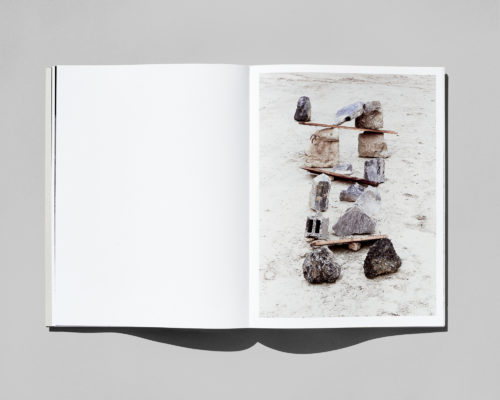
Constructing in order to destroy – all of which is bound to physical and intuitive experiences, which is somewhat absurd, yet resolutely childlike. From this emptiness which waste grounds can evoke, they are in reality a reserve of shapes and impoverished materials. An economy of means which, when nourished by the virtue of a childlike naivety, allow us to envisage these materials as the essence of various games and constructions.
64 pages, 23×30cm
Offset printing
Silkscreen cover
| Poids | 320 g |
|---|
Produits similaires

Livre Photo
17,00 €
Fluent de Laëtitia Donval est la deuxième des trois résidences initiées par Lumière d’Encre ↗ autour des fleuves côtiers des Pyrénées-Orientales

Livre Photo
19,00 €
L'image révèle autant l’artifice que la fascination qu’il exerce.

Collage
20,00 €
Apparaissent des restes épars et altérés de photographies, cartes, paysages, empreintes, visages, corps et fossiles.

Livre Photo
17,00 €
Raclose de Geoffroy Mathieu est la première des trois résidences initiées par Lumière d’Encre ↗ autour des fleuves côtiers des Pyrénées-Orientales

Livre Photo
12,00 €
Derrière la couverture d’In The Navy de Julien Kedryna – beau leurre minimaliste – se cache une suite d’images-nuggets grasses et gaies.
-20%

Livre Photo
Le prix initial était : 38,00 €.30,40 €Le prix actuel est : 30,40 €.
Loose amid unique landscapes in a timeless bubble

Livre Photo
25,00 €
Ces images ne sont ni fenêtres, ni miroirs.
Livre paysage
25,00 €
Les Climats II (Japon), premier livre de Lola Reboud, a pour fil conducteur la relation que nous entretenons aux Climats.