

-
×
 Délié - Baptiste Oberson
1 × 24,00 €
Délié - Baptiste Oberson
1 × 24,00 € -
×
 WREK The Algorithm! - Aarnoud Rommens, Olivier Deprez
1 × 10,00 €
WREK The Algorithm! - Aarnoud Rommens, Olivier Deprez
1 × 10,00 € -
×
 Paysageur n°3 - Mobiles
1 × 16,00 €
Paysageur n°3 - Mobiles
1 × 16,00 € -
×
 On the Soft Edge of Space - Marleen Sleeuwits
1 × 28,00 €
On the Soft Edge of Space - Marleen Sleeuwits
1 × 28,00 € -
×
 Design sous artifice : la création au risque du machine learning - Anthony Masure
1 × 10,00 €
Design sous artifice : la création au risque du machine learning - Anthony Masure
1 × 10,00 € -
×
 Saint Julien l'hospitalier Tome 1 - Claire Pedot
2 × 25,00 €
Saint Julien l'hospitalier Tome 1 - Claire Pedot
2 × 25,00 € -
×
 SKKS - Gilles Pourtier
1 × 20,00 €
SKKS - Gilles Pourtier
1 × 20,00 € -
×
 Le Choix du peuple - Nicolas Savary, Tilo Steireif
1 × 25,00 €
Le Choix du peuple - Nicolas Savary, Tilo Steireif
1 × 25,00 € -
×
 Catalogue Art Guys - That's painting productions, Bernard Brunon
1 × 10,00 €
Catalogue Art Guys - That's painting productions, Bernard Brunon
1 × 10,00 € -
×
 Critique d'art n°54
1 × 16,00 €
Critique d'art n°54
1 × 16,00 € -
×
 Michael Riedel - Milan Ther
1 × 15,00 €
Michael Riedel - Milan Ther
1 × 15,00 € -
×
 La chasse Galerine - Jéréméy Piningre & Aëla Maï Cabel
1 × 8,00 €
La chasse Galerine - Jéréméy Piningre & Aëla Maï Cabel
1 × 8,00 € -
×
 Link Human / Robot - Collectif dir. Emmanuelle Grangier
1 × 18,00 €
Link Human / Robot - Collectif dir. Emmanuelle Grangier
1 × 18,00 € -
×
 The Shelf - Journal 3
1 × 20,00 €
The Shelf - Journal 3
1 × 20,00 € -
×
 Mâchouiller le feu du cosmos - Adèle Verlinden
1 × 20,00 €
Mâchouiller le feu du cosmos - Adèle Verlinden
1 × 20,00 € -
×
 Entretiens – Jérôme Dupeyrat
1 × 25,00 €
Entretiens – Jérôme Dupeyrat
1 × 25,00 € -
×
 10 MINUTES Architects and Designers in Conversation
1 × 25,00 €
10 MINUTES Architects and Designers in Conversation
1 × 25,00 € -
×
 Shanghai Cosmetic - Leslie Moquin
1 × 19,00 €
Shanghai Cosmetic - Leslie Moquin
1 × 19,00 € -
×
 Ventoline 5 - Coll.
1 × 7,00 €
Ventoline 5 - Coll.
1 × 7,00 € -
×
 Dear Paul - Paul Van der Eerden
1 × 20,00 €
Dear Paul - Paul Van der Eerden
1 × 20,00 € -
×
 ARTZINES #1, Paris issue
1 × 10,00 €
ARTZINES #1, Paris issue
1 × 10,00 € -
×
 Konrad Becker - Dictionnaire de réalité stratégique
1 × 20,00 €
Konrad Becker - Dictionnaire de réalité stratégique
1 × 20,00 € -
×
 Gros Gris n°4 - Duel
1 × 12,80 €
Gros Gris n°4 - Duel
1 × 12,80 € -
×
 In The Navy - Julien Kedryna
1 × 12,00 €
In The Navy - Julien Kedryna
1 × 12,00 € -
×
 Jean-Marc Bodson - États des lieux
1 × 29,00 €
Jean-Marc Bodson - États des lieux
1 × 29,00 € -
×
 Holy etc. - Fabienne Radi
1 × 12,00 €
Holy etc. - Fabienne Radi
1 × 12,00 € -
×
 To Be Determined: Photography and the Future - Duncan Wooldridge
1 × 13,00 €
To Be Determined: Photography and the Future - Duncan Wooldridge
1 × 13,00 € -
×
 Temps d'arrêt - Etienne Buyse
1 × 32,00 €
Temps d'arrêt - Etienne Buyse
1 × 32,00 € -
×
 Optical Sound 2
1 × 15,00 €
Optical Sound 2
1 × 15,00 €


Masken – Michael Etzensperger


27,00 €
The book Masken (Masks) is at once a reflection on the transcultural phenomenon of masks and their impact on 20th century art.
Rupture de stock
Historically, one of the most significant, if largely overlooked, uses of photography is the
reproduction of artworks and other cultural artefacts. Disciplines like art history and anthropology were re-shaped by the increasing availability of photographic reproductions in the late 19th century. The examination of this photographic genre has been an on-going concern for Swiss artist Michael Etzensperger in the past few years. Whilst doing research for his series Normal Viewpoint, No Other than Frontal View which focused on the photographic reproduction of sculptures, he became aware of the impact of images of masks from traditional cultures, both Western and non-Western, had on the early modernist artists, in particular on the cubists and surrealists. Significantly, they mostly encountered these reproductions in books, for example in Carl Einstein’s eponymous Negro Sculpture (1915).
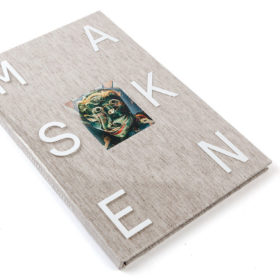
Struck by this art-historical phenomenon, Etzensperger began to hunt for images of masks in a variety of illustrated books, ranging from anthropological studies to coffee-table books, published throughout the 20th century and the early 21st century. Beyond the motifs of the photographic plates, he became increasingly fascinated by the changing surface qualities of the reproductions that were determined by printing techniques, photographic stock, camera optics, and other factors. Etzensperger then began to use the mask images he had collected as starting points for new images by making double exposures of the reproductions. In these composite pictures, two masks merge into a new hallucinatory face effigy, whilst the overlay of the different surface qualities produces painterly effects. The masks – said to subsume the identity of the wearer in traditional cultures – become non-identical themselves in the newly created image. Consequently, Etzensperger transposed these images, created from the book plates, back into book form, thus coming full circle. The book Masken (Masks) is at once a reflection on the transcultural phenomenon of masks and their impact on 20th century art, on the history of illustrated books and reproduction technologies, as well as a delirious visual delight.
Martin Jaeggi
72 pp;
51 color photographs; Hardcover;
210×320 mm; 600 copies; Text by Kay Heymer;
Graphic Design by Christof Nüssli;
Published by cpress, Zurich; 978-3-9524710-3-6
| Poids | 354 g |
|---|---|
| Dimensions | 21 × 32 cm |
Vous aimerez peut-être aussi…

Livre d'artiste
Lazy Painter – Angela Gjergjaj, Jordi Bucher and Mirco Petrini
22,00 €
Pictures by a robot vacuum cleaner

Livre d'artiste
38,00 €
Marie Mons a passé trois mois d’hiver dans un petit village des fjords de l’est de Islande où elle est devenue Aurore Colbert
Produits similaires

Livre Photo
17,00 €
Raclose de Geoffroy Mathieu est la première des trois résidences initiées par Lumière d’Encre ↗ autour des fleuves côtiers des Pyrénées-Orientales

Livre d'artiste
8,00 €
Le pectus excavatum, « thorax en entonnoir » est une malformation du thorax congénitale.
25,00 €
La démarche photographique de Nicolas Savary et Tilo Steireif porte sur la représentation du politicien en tant que figure dans le système politique « de milice », en Suisse.
Livre Photo
12,00 €
Derrière la couverture d’In The Navy de Julien Kedryna – beau leurre minimaliste – se cache une suite d’images-nuggets grasses et gaies.

Collage
20,00 €
Apparaissent des restes épars et altérés de photographies, cartes, paysages, empreintes, visages, corps et fossiles.

Livre Photo
24,00 €
La région de Bugarach est aux sources de multiples récits et légendes populaires.

Livre Photo
35,00 €
Où qu’on se déporte et quels que soient les moyens mis en œuvre, l’inquiétant silence devient assourdissant, juste interrompu çà et là par les tonitruantes débilités de quelque leader mondial.

Livre Photo
35,00 €
Choisir de regarder Michel Journiac en travesti