

-
×
 Piano - Joseph Charroy
1 × 12,00 €
Piano - Joseph Charroy
1 × 12,00 €


Huts, Temples, Castles – Ursula Schulz-Dornburg


45,00 €
In 1969, when the architectural photographer Ursula Schulz-Dornburg moved to Düsseldorf with her two young children
En stock
In the wake of the Second World War, aiming to occupy the children rampaging streets and parks, the City of Amsterdam founded Jongensland, a space where boys (and the occasional, officially disallowed girl) could play, build, create, and destroy, largely without supervision. Located on an island accessible only by rowboat, Jongensland grew into a sprawling settlement built experimentally from scrap materials by its young inhabitants. Here, children would cook food, raise animals, build fires, and trade with each other. Without adult intervention, they relied on shared resourcefulness and collaborative ingenuity.
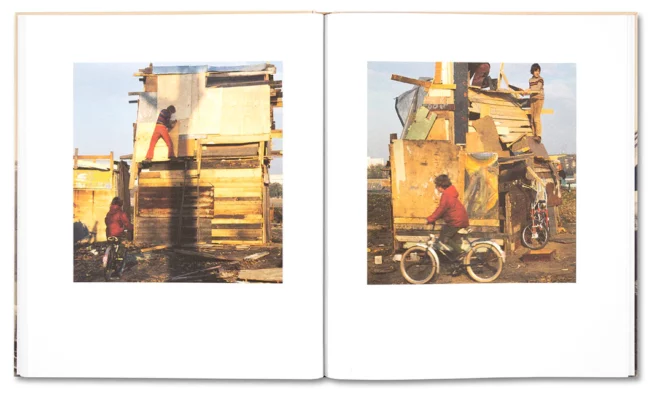
In 1969, when the architectural photographer Ursula Schulz-Dornburg moved to Düsseldorf with her two young children, she discovered Jongensland the other side of the border from Germany’s strictly regulated playgrounds. Fascinated by the improvised buildings where her children would play, she made extensive photographs capturing them being constructed, used, demolished, and reshaped. Her images capture an intuitive architectural intelligence and capture a genre of vernacular construction with its own conventions and innovations, one which illuminates the role of imagination in defining a building’s identity and purpose.
This book presents Schulz-Dornburg’s largely unseen series alongside an extended alongside an extended essay by architectural historian Tom Wilkinson reflecting on the architectural themes and lessons Jongensland continues to offer.
| Poids | 650 g |
|---|---|
| Dimensions | 23 × 26 cm |
Produits similaires

Livre Photo
15,00 €
akaBB – tribute to Roni Horn is not a photographic diary, and neither is it a simple hommage to Roni Horn’s book.

Collage
20,00 €
Apparaissent des restes épars et altérés de photographies, cartes, paysages, empreintes, visages, corps et fossiles.

Livre Photo
25,00 €
Ces images ne sont ni fenêtres, ni miroirs.

Livre d'artiste
38,00 €
Marie Mons a passé trois mois d’hiver dans un petit village des fjords de l’est de Islande où elle est devenue Aurore Colbert

Dits & Écrits d'artistes
25,00 €
Aboukaïev est d’abord atteint de mélancolie comme certains oiseaux enivrés et dont le coeur ne veut plus s’arrêter de voler, de capituler face à l’horizon.

25,00 €
La démarche photographique de Nicolas Savary et Tilo Steireif porte sur la représentation du politicien en tant que figure dans le système politique « de milice », en Suisse.

Livre Photo
17,00 €
l'intimité d'un couple français entre 1959 et 1978.