

-
×
 Flynn zine # 1 - Flynn Maria Bergmann
1 × 20,00 €
Flynn zine # 1 - Flynn Maria Bergmann
1 × 20,00 € -
×
 SKKS - Gilles Pourtier
1 × 20,00 €
SKKS - Gilles Pourtier
1 × 20,00 € -
×
 Oblikvaj 4 - Last minute Shodo - Thomas Perrodin, Ensemble Batida
1 × 10,00 €
Oblikvaj 4 - Last minute Shodo - Thomas Perrodin, Ensemble Batida
1 × 10,00 € -
×
 Pureté et impureté de l’art. Michel Journiac et le sida Antoine Idier
1 × 8,00 €
Pureté et impureté de l’art. Michel Journiac et le sida Antoine Idier
1 × 8,00 € -
×
 Photographic Fields - Joël Van Audenhaege
1 × 25,00 €
Photographic Fields - Joël Van Audenhaege
1 × 25,00 € -
×
 Le dos des choses - Guillaume Goutal
1 × 13,00 €
Le dos des choses - Guillaume Goutal
1 × 13,00 € -
×
 Un essai sur la typographie - Eric Gill
1 × 17,00 €
Un essai sur la typographie - Eric Gill
1 × 17,00 € -
×
 Avec ce qu'il resterait à dire - Anne Maurel
1 × 13,00 €
Avec ce qu'il resterait à dire - Anne Maurel
1 × 13,00 € -
×
 In The Navy - Julien Kedryna
1 × 12,00 €
In The Navy - Julien Kedryna
1 × 12,00 € -
×
 Critique d'art n°56
1 × 16,00 €
Critique d'art n°56
1 × 16,00 € -
×
 Imagos - Noémie Lothe
1 × 20,00 €
Imagos - Noémie Lothe
1 × 20,00 € -
×
 Le vieux père - Laurent Kropf
1 × 20,00 €
Le vieux père - Laurent Kropf
1 × 20,00 € -
×
 Rois de la forêt - Alain Garlan
1 × 13,50 €
Rois de la forêt - Alain Garlan
1 × 13,50 € -
×
 Un peu comme voir dans la nuit - Leif Elggren + CD
1 × 28,00 €
Un peu comme voir dans la nuit - Leif Elggren + CD
1 × 28,00 € -
×
 Amos Gitai et l'enjeu des archives - Jean-Michel Frodon
1 × 14,00 €
Amos Gitai et l'enjeu des archives - Jean-Michel Frodon
1 × 14,00 € -
×
 Alma Mater n°1
1 × 12,00 €
Alma Mater n°1
1 × 12,00 € -
×
 America - Ayline Olukman, Hélène Gaudy
1 × 16,00 €
America - Ayline Olukman, Hélène Gaudy
1 × 16,00 € -
×
 Florina Leinß - Ersatzteillager
1 × 38,00 €
Florina Leinß - Ersatzteillager
1 × 38,00 € -
×
 Dialogue de dessins 7 - Jochen Gerner, Guillaume Chauchat
1 × 35,00 €
Dialogue de dessins 7 - Jochen Gerner, Guillaume Chauchat
1 × 35,00 € -
×
 Temps d'arrêt - Etienne Buyse
1 × 32,00 €
Temps d'arrêt - Etienne Buyse
1 × 32,00 € -
×
 Anderlecht — Molenbeek - Pierre Blondel
1 × 18,00 €
Anderlecht — Molenbeek - Pierre Blondel
1 × 18,00 € -
×
 Halogénure #04
1 × 28,00 €
Halogénure #04
1 × 28,00 € -
×
 Je ne peux pas ne pas - Geneviève Romang
1 × 24,00 €
Je ne peux pas ne pas - Geneviève Romang
1 × 24,00 € -
×
 Diario de Plantas (2 volumes) - Gabriel Orozco
1 × 85,00 €
Diario de Plantas (2 volumes) - Gabriel Orozco
1 × 85,00 € -
×
 Sakae Osugi – Anarchiste japonais – Ville de St-Denis 1923 - Katja Stuke, Oliver Sieber
1 × 18,00 €
Sakae Osugi – Anarchiste japonais – Ville de St-Denis 1923 - Katja Stuke, Oliver Sieber
1 × 18,00 € -
×
 Commentaires sur les sentences de Pierre Lombard - L.L. de Mars
1 × 25,00 €
Commentaires sur les sentences de Pierre Lombard - L.L. de Mars
1 × 25,00 € -
×
 Blaclywall by Sihab Baik - Claude Closky
1 × 25,00 €
Blaclywall by Sihab Baik - Claude Closky
1 × 25,00 € -
×
 Editer l’art – Leszek Brogowski
1 × 33,00 €
Editer l’art – Leszek Brogowski
1 × 33,00 € -
×
 Slow Down Abstractions - Adrien Vescovi
1 × 10,00 €
Slow Down Abstractions - Adrien Vescovi
1 × 10,00 € -
×
![Économies silencieuses et audaces approximatives - Guy Chevalier [& coll.]](https://i0.wp.com/librairie-lame.com/wp-content/uploads/2019/03/PPT_Elastic01_couv.jpg?fit=250%2C353&ssl=1) Économies silencieuses et audaces approximatives - Guy Chevalier [& coll.]
1 × 18,00 €
Économies silencieuses et audaces approximatives - Guy Chevalier [& coll.]
1 × 18,00 € -
×
 Papier magazine n°06 - Coupe du monde
1 × 20,00 €
Papier magazine n°06 - Coupe du monde
1 × 20,00 € -
×
 Jérôme LeGlatin (avec Mel Crawford) - Le Crash
1 × 5,00 €
Jérôme LeGlatin (avec Mel Crawford) - Le Crash
1 × 5,00 € -
×
 Critique d'art n°54
1 × 16,00 €
Critique d'art n°54
1 × 16,00 € -
×
 La Couleur du Geste - Héloïse Bariol
1 × 29,00 €
La Couleur du Geste - Héloïse Bariol
1 × 29,00 € -
×
 Tote Bag - Lucas Burtin x Librairie Lame
1 × 10,00 €
Tote Bag - Lucas Burtin x Librairie Lame
1 × 10,00 € -
×
 D’l’or - Rosanna Puyol Boralevi
1 × 16,00 €
D’l’or - Rosanna Puyol Boralevi
1 × 16,00 € -
×
 Objets Minces - Collectif
1 × 30,00 €
Objets Minces - Collectif
1 × 30,00 € -
×
 Seoul Flowers & Trees - tribute to Lee Friedlander
1 × 25,00 €
Seoul Flowers & Trees - tribute to Lee Friedlander
1 × 25,00 € -
×
 Noces ou les confins sauvages - Hélène David
1 × 50,00 €
Noces ou les confins sauvages - Hélène David
1 × 50,00 € -
×
 ICCMHW - Atelier Choque Le Goff
1 × 15,00 €
ICCMHW - Atelier Choque Le Goff
1 × 15,00 € -
×
 Le Monde en situation - Vanessa Theodoropoulou
1 × 32,00 €
Le Monde en situation - Vanessa Theodoropoulou
1 × 32,00 € -
×
 L'arum tacheté de J-M. Bertoyas
1 × 20,00 €
L'arum tacheté de J-M. Bertoyas
1 × 20,00 € -
×
![[piʃaˈsɐ̃w̃] - antoine lefebvre editions,](https://i0.wp.com/librairie-lame.com/wp-content/uploads/2019/02/pi%CA%83a%CB%88s%C9%90%CC%83w%CC%83-web-1.jpg?fit=250%2C353&ssl=1) [piʃaˈsɐ̃w̃] - antoine lefebvre editions,
1 × 20,00 €
[piʃaˈsɐ̃w̃] - antoine lefebvre editions,
1 × 20,00 € -
×
 Roven n°5
1 × 18,00 €
Roven n°5
1 × 18,00 € -
×
 Eros negro #2 - Demoniak
1 × 5,00 €
Eros negro #2 - Demoniak
1 × 5,00 € -
×
 Dessins pour Rugir - Virginie Rochetti
1 × 10,00 €
Dessins pour Rugir - Virginie Rochetti
1 × 10,00 € -
×
 La peinture c'est comme les pépites - Pierre Yves-Hélou + Tirage
1 × 15,00 €
La peinture c'est comme les pépites - Pierre Yves-Hélou + Tirage
1 × 15,00 € -
×
 De l'objet (comme un parcours) - Collectif, Sandra Chamaret
1 × 20,00 €
De l'objet (comme un parcours) - Collectif, Sandra Chamaret
1 × 20,00 € -
×
 Le voyeur - entretiens - Éric Rondepierre - Julien Milly
1 × 24,00 €
Le voyeur - entretiens - Éric Rondepierre - Julien Milly
1 × 24,00 € -
×
 La Typographie post-binaire au delà de l'écriture inclusive - Camille Circlude
1 × 24,00 €
La Typographie post-binaire au delà de l'écriture inclusive - Camille Circlude
1 × 24,00 € -
×
 Tools #04 – Couper / To Cut
1 × 25,00 €
Tools #04 – Couper / To Cut
1 × 25,00 € -
×
 Inframince et hyperlié - Philippe Lipcare
1 × 12,00 €
Inframince et hyperlié - Philippe Lipcare
1 × 12,00 € -
×
 MP.19 - Matt Paweski, Chris Sharp
1 × 45,00 €
MP.19 - Matt Paweski, Chris Sharp
1 × 45,00 € -
×
 ARTZINES #3 - Tokyo issue
1 × 10,00 €
ARTZINES #3 - Tokyo issue
1 × 10,00 €


Black Case Volume I and II: Return From Exile – Joseph Jarman


17,00 €
La réédition sous forme imprimée des poèmes révolutionnaires et mystiques de 1974 du jazzman membre fondateur de l’Art Ensemble of Chicago.
Plus que 1 en stock
La réédition sous forme imprimée des poèmes révolutionnaires et mystiques de 1974 du jazzman membre fondateur de l’Art Ensemble of Chicago remet en perspective un document essentiel du Black Arts Movement.
Joseph Jarman (1937-2019) était un saxophoniste et multi-instrumentiste américain, membre fondateur du groupe de jazz d’avant-garde emblématique Art Ensemble de Chicago, à l’origine des éléments théâtraux et multimédias de la formation intégrant danse, performance et poésie dans un spectacle total.
Joseph Jarman était marié avec Thulani Davis.
Joseph Jarman était marié avec Thulani Davis.
langue : anglaise
144 pages (ill.)
EN //
Joseph Jarman (1937 – 2019) was a saxophonist and multi-instrumentalist best known as a founding member of trailblazing avant-garde jazz group Art Ensemble of Chicago. Jarman was responsible for the Art Ensemble’s signature face paint and elaborate costumes as well as the pioneering theatrical and multimedia elements of their shamanistic performances, which could include dance, comedy, performance art, surreal pranks, and—notably—the recitation of Jarman’s poetry.
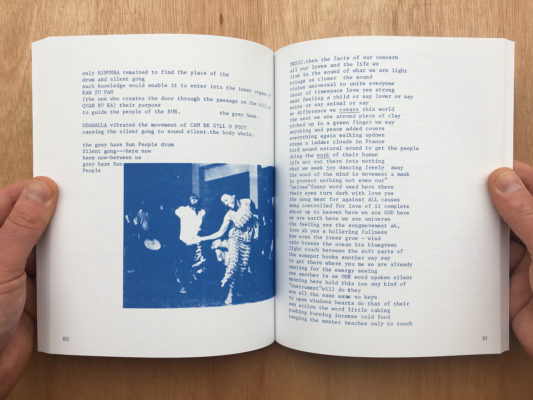
In 1977, Art Ensemble of Chicago Publishing Co. published Jarman’s Black Case Volume I and II: Return From Exile, a collection of writing conceived across America and Europe between 1960 and 1975. Comprised largely of Jarman’s flowing, fiery free verse—influenced by Amus Mor, Henry Dumas, Thulani Davis, and Amiri Baraka—the book also features a manifesto for “GREAT BLACK MUSIC,” notated songs, concert program notes, Jarman’s photos, and impressions of a play by Muhal Richard Abrams, the founder of the Association for the Advancement of Creative Musicians of which Jarman was also an original member. Jarman writes poetry of personal revolutionary intent, aimed at routing his audience’s consciousness towards growth and communication. He speaks with compassionate urgency of the struggles of growing up on Chicago’s South Side, of racist police brutality and profound urban alienation, and of the responsibility he feels as a creative artist to nurture beauty and community through the heliocentric music that he considers the healing force of the universe. A practicing Buddhist and proponent of Aikido since a 1958 awakening saved him from the traumatic mental isolation of his time dropped by the US army into southeast Asia, Jarman sings praise for the self-awareness realization possible through the martial arts. With cosmic breath as its leitmotif, his poetry both encourages and embodies a complete relinquishing of ego. While some of the poems contained within Black Case have already been immortalized via performances on classic records by Jarman and Art Ensemble of Chicago, its republication in print form breathes new life into a forgotten document of the Black Arts Movement.
With a new preface by Thulani Davis and an introduction by Brent Hayes Edwards.
“Joseph Jarman, a musician of rare poetic gifts, was also a remarkable poet. Black Case, a lost treasure of the Black Arts Movement, combines protest against injustice with heart-breaking introspection and fierce commitment to the Great Black Music tradition to which Jarman contributed with gentle yet mighty force.”
—Adam Shatz
“Joseph’s recitation of ‘Non-Cognitive Aspects of the City’ (from Black Case) moved me to set the words of this poem for Baritone Voice and Orchestra and became part of the Art Ensemble of Chicago’s standard repertoire. Joseph had a bold and passionate creative spirit. I feel privileged to have shared the stage with him.”
—Roscoe Mitchell
“‘Though in reality all the words are music themselves’ is the reality to which all poetry aspires, whether in verse or prose, theory or story, criticism or craft. Joseph Jarman always knew that for black musicians, which is to say black speakers, exile is our public holiday. We live through that. We live through that. Black Case is all and everything in this regard. ‘Whats to say,’ he says, is that ‘we sing because/we love you/because we/love you/because/we love/you.’ We are loved beyond judgment by the music, he says, and we say thanks.”
—Fred Moten
| Poids | 420 g |
|---|---|
| Dimensions | 16,5 × 20,5 cm |
Vous aimerez peut-être aussi…

15,00 €
Photographies journaux documents – détritus. Au sol jonché un monde foulé un monde dilaté.

13,00 €
Textes Revue Cée - 77/79 - Archive Ossang Volume 1

Livre Cinéma
15,00 €
Revue pluridisciplinaire : cinéma, musicologie, science sociale, histoire, poésie...
Produits similaires


Dits & Écrits d'artistes
10,00 €
Ce livre est inclassable dans la littérature et la poésie du temps. Il sort des normes puisqu’il se présente sous forme d’un « simple » agenda.

Dits & Écrits d'artistes
30,00 €
Ce volume développent ses conceptions de la grammaire, de la logique des rêves et des expérimentations sonores.

Dits & Écrits d'artistes
10,00 €
2017 Digital print 32p. 100 copies

Dits & Écrits d'artistes
18,00 €
Micro-récits et notes d'Atelier

Dits & Écrits d'artistes
15,00 €
"J’avais des bruits. Je les couchais sur du papier. Du papier de carnet. Beaucoup de carnets.J’étais plutôt heureux. Malgré cela, il y avait des choses à abattre."

Dits & Écrits d'artistes
Paris la Consciencieuse : Paris la Guideuse du monde – Frédéric Bruly Bouabré
35,00 €
Le récit inédit, reproduit en fac-similé, du voyage à Paris de Frédéric Bruly Bouabré (1923-2014)

Dits & Écrits d'artistes
10,00 €
Un bilan ironique, historique et personnel des transformations de l'art dans les années 1950-1960 en quatorze points