

-
×
 Image Canoë - Jérémie Gindre
1 × 8,00 €
Image Canoë - Jérémie Gindre
1 × 8,00 € -
×
 Schindler Manifesto
1 × 15,00 €
Schindler Manifesto
1 × 15,00 € -
×
 Comment quitter la terre ? - Jill Gasparina, Christophe Kihm, Anne-Lyse Renon
1 × 10,00 €
Comment quitter la terre ? - Jill Gasparina, Christophe Kihm, Anne-Lyse Renon
1 × 10,00 € -
×
 Cruiser l'utopie – L'après et ailleurs de l'advenir queer - José Esteban Muñoz
1 × 22,00 €
Cruiser l'utopie – L'après et ailleurs de l'advenir queer - José Esteban Muñoz
1 × 22,00 € -
×
 Le Monde en situation - Vanessa Theodoropoulou
1 × 32,00 €
Le Monde en situation - Vanessa Theodoropoulou
1 × 32,00 € -
×
 Amos Gitai et l'enjeu des archives - Jean-Michel Frodon
1 × 14,00 €
Amos Gitai et l'enjeu des archives - Jean-Michel Frodon
1 × 14,00 € -
×
 Slanted 24 - Istanbul
1 × 21,00 €
Slanted 24 - Istanbul
1 × 21,00 € -
×
 Cuadernos - Henry Deletra
1 × 15,00 €
Cuadernos - Henry Deletra
1 × 15,00 € -
×
 A l'origine - Anne-Émilie-Philippe
1 × 18,00 €
A l'origine - Anne-Émilie-Philippe
1 × 18,00 € -
×
 WREK The Algorithm! - Aarnoud Rommens, Olivier Deprez
1 × 10,00 €
WREK The Algorithm! - Aarnoud Rommens, Olivier Deprez
1 × 10,00 €


A Dutch Landscape III- From Suriname to The Netherlands – José Quintanar


8,00 €
From Suriname to The Netherlands
Rupture de stock
Highlighting the significance of the landscape in Dutch culture, José’s project is not only observatory by nature, but also investigatory. He notes how the Dutch landscape was “built by people in an artificial way,” as man-made interventions connected ground to sea more easily. “Hence it is understood that the golden age of landscape painting was not a representation of the landscape, but the representation of an illusion.”
The book is built from two landscapes, that of Suriname’s – an old Dutch colony – and the Netherland’s. “Each landscape is drawn over and over again,” says José of the 20 page, Risograph-printed volume , “building a series of ten drawings each. In each drawing, the rules of the game have been progressively altered so that each drawing of the same landscape is always different.” Interestingly, the rules used in landscape A are the same rules applied in landscape B but inverted. And in this way, “A and B only make sense when they are connected within the temporary space format of the book.” As a result, the concept of the publication, drawn from geometric patterns of circles that grow in each drawing, in turn, also becomes the narrative of the work.
20 pages.
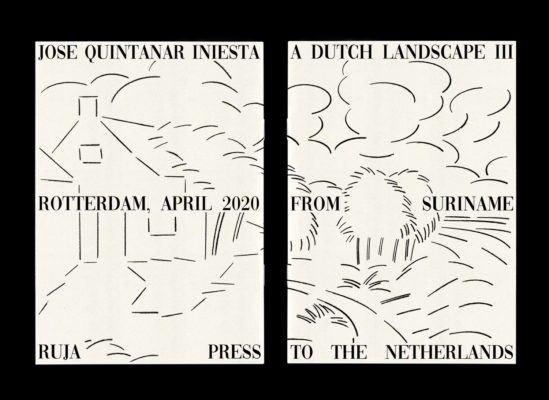
| Poids | 64 g |
|---|---|
| Dimensions | 29,7 × 21 cm |
Produits similaires

12,00 €
Parmi les créatures fantastiques qui peuplent les fictions d’Alex BARBIER, le loup-garou revient sans cesse.

livre Dessin
25,00 €
Sédimentaire ou volcanique, sur terre ou dans les airs, en long ou en large.


livre Dessin
24,00 €
Florian Javet dessine sur les murs, projette ses dessins, déchire ses papiers


livre Dessin
12,00 €
Une épopée fantastique au cœur du rêve
-20%

Livre art contemporain
Le prix initial était : 16,00 €.12,80 €Le prix actuel est : 12,80 €.
Combats polymorphes, divertissants, déraisonnables ou nécessaires