

-
×
 Imagos - Noémie Lothe
1 × 20,00 €
Imagos - Noémie Lothe
1 × 20,00 € -
×
 Pénurie - Zivo, Jérôme Meizoz
1 × 30,00 €
Pénurie - Zivo, Jérôme Meizoz
1 × 30,00 € -
×
 Blanche Endive - Grégoire Motte & Gabriel Mattei
1 × 15,00 €
Blanche Endive - Grégoire Motte & Gabriel Mattei
1 × 15,00 € -
×
 De l'objet (comme un parcours) - Collectif, Sandra Chamaret
1 × 20,00 €
De l'objet (comme un parcours) - Collectif, Sandra Chamaret
1 × 20,00 € -
×
 Lavalse des tambours - Paul Rey
1 × 25,00 €
Lavalse des tambours - Paul Rey
1 × 25,00 € -
×
 Party Studies – Vol. 2 – Underground clubs, parallel structures and second cultures
1 × 18,00 €
Party Studies – Vol. 2 – Underground clubs, parallel structures and second cultures
1 × 18,00 € -
×
 Saint Julien l'hospitalier Tome 3 - Claire Pedot
1 × 25,00 €
Saint Julien l'hospitalier Tome 3 - Claire Pedot
1 × 25,00 € -
×
 Editer l’art – Leszek Brogowski
1 × 33,00 €
Editer l’art – Leszek Brogowski
1 × 33,00 € -
×
 Birds - Damien Poulain
1 × 15,00 €
Birds - Damien Poulain
1 × 15,00 € -
×
 Ce que l'histoire fait au graphisme - Clémence Imbert
1 × 10,00 €
Ce que l'histoire fait au graphisme - Clémence Imbert
1 × 10,00 € -
×
 Voir la Palestine, Contre-champs artistiques - Stefanie Baumann
1 × 10,00 €
Voir la Palestine, Contre-champs artistiques - Stefanie Baumann
1 × 10,00 € -
×
 La grande surface de réparation - Gilles Pourtier
1 × 20,00 €
La grande surface de réparation - Gilles Pourtier
1 × 20,00 € -
×
 Grilles - Zelda Mauger
1 × 12,00 €
Grilles - Zelda Mauger
1 × 12,00 €


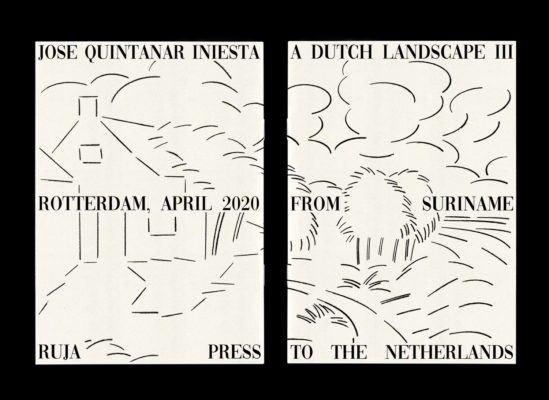
A Dutch Landscape III- From Suriname to The Netherlands – José Quintanar


8,00 €
From Suriname to The Netherlands
Rupture de stock
Highlighting the significance of the landscape in Dutch culture, José’s project is not only observatory by nature, but also investigatory. He notes how the Dutch landscape was “built by people in an artificial way,” as man-made interventions connected ground to sea more easily. “Hence it is understood that the golden age of landscape painting was not a representation of the landscape, but the representation of an illusion.”
The book is built from two landscapes, that of Suriname’s – an old Dutch colony – and the Netherland’s. “Each landscape is drawn over and over again,” says José of the 20 page, Risograph-printed volume , “building a series of ten drawings each. In each drawing, the rules of the game have been progressively altered so that each drawing of the same landscape is always different.” Interestingly, the rules used in landscape A are the same rules applied in landscape B but inverted. And in this way, “A and B only make sense when they are connected within the temporary space format of the book.” As a result, the concept of the publication, drawn from geometric patterns of circles that grow in each drawing, in turn, also becomes the narrative of the work.
20 pages.
| Poids | 64 g |
|---|---|
| Dimensions | 29,7 × 21 cm |
Produits similaires

livre Dessin
12,00 €
Une épopée fantastique au cœur du rêve

Bande Dessinée
10,00 €
The repetition of black squares is WREK’s brilliant running gag.
-20%

Livre art contemporain
Le prix initial était : 16,00 €.12,80 €Le prix actuel est : 12,80 €.
Combats polymorphes, divertissants, déraisonnables ou nécessaires

livre Dessin
15,00 €
Une superbe sélection de dessin de ses carnets réalisés entre 2008-2018


