

-
×
 Rasclose - Geoffroy Mathieu
1 × 17,00 €
Rasclose - Geoffroy Mathieu
1 × 17,00 € -
×
 Instructional Photography: Learning How to Live Now - Carmen Winant
1 × 11,00 €
Instructional Photography: Learning How to Live Now - Carmen Winant
1 × 11,00 € -
×
 Slanted 30 - Athens
1 × 21,00 €
Slanted 30 - Athens
1 × 21,00 € -
×
 Le lacéré anonyme - Jacques Villeglé
1 × 10,00 €
Le lacéré anonyme - Jacques Villeglé
1 × 10,00 € -
×
 interférence - 3 - maycec
1 × 12,00 €
interférence - 3 - maycec
1 × 12,00 € -
×
 Gruppen n°14 - Collectif
1 × 15,00 €
Gruppen n°14 - Collectif
1 × 15,00 € -
×
 La typographie des Penguin Classics - Andrew Barker
1 × 16,00 €
La typographie des Penguin Classics - Andrew Barker
1 × 16,00 € -
×
 Jawa Tengah Combo - Fred Maillard
1 × 30,00 €
Jawa Tengah Combo - Fred Maillard
1 × 30,00 € -
×
 Deep state - Mathieu Desjardins
1 × 20,00 €
Deep state - Mathieu Desjardins
1 × 20,00 €


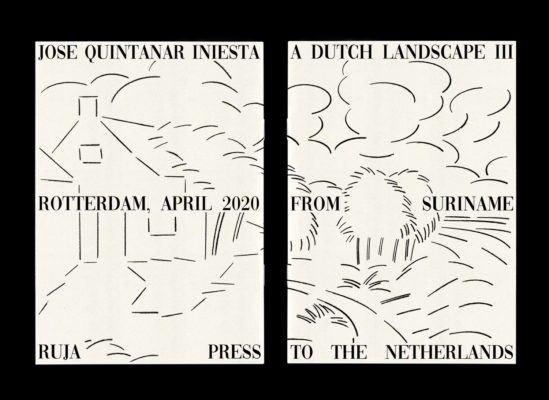
A Dutch Landscape III- From Suriname to The Netherlands – José Quintanar


8,00 €
From Suriname to The Netherlands
Rupture de stock
Highlighting the significance of the landscape in Dutch culture, José’s project is not only observatory by nature, but also investigatory. He notes how the Dutch landscape was “built by people in an artificial way,” as man-made interventions connected ground to sea more easily. “Hence it is understood that the golden age of landscape painting was not a representation of the landscape, but the representation of an illusion.”
The book is built from two landscapes, that of Suriname’s – an old Dutch colony – and the Netherland’s. “Each landscape is drawn over and over again,” says José of the 20 page, Risograph-printed volume , “building a series of ten drawings each. In each drawing, the rules of the game have been progressively altered so that each drawing of the same landscape is always different.” Interestingly, the rules used in landscape A are the same rules applied in landscape B but inverted. And in this way, “A and B only make sense when they are connected within the temporary space format of the book.” As a result, the concept of the publication, drawn from geometric patterns of circles that grow in each drawing, in turn, also becomes the narrative of the work.
20 pages.
| Poids | 64 g |
|---|---|
| Dimensions | 29,7 × 21 cm |
Produits similaires

livre Dessin
13,00 €
Une forme qui aurait un pied dans le design et un autre dans l'onirique.


livre Dessin
25,00 €
Une épopée chevaleresque et graphique
