

-
×
 How Many - Nathalie Du Pasquier
1 × 28,00 €
How Many - Nathalie Du Pasquier
1 × 28,00 € -
×
 Le déclin du professeur de tennis - Fabienne Radi
2 × 8,00 €
Le déclin du professeur de tennis - Fabienne Radi
2 × 8,00 € -
×
 IBM – Graphic Design Guide from 1969 to 1987
1 × 50,00 €
IBM – Graphic Design Guide from 1969 to 1987
1 × 50,00 € -
×
 On-off Tones - Anna Bergquist
1 × 20,00 €
On-off Tones - Anna Bergquist
1 × 20,00 € -
×
 Aurore Colbert - Marie Mons
1 × 38,00 €
Aurore Colbert - Marie Mons
1 × 38,00 € -
×
 Sakae Osugi – Anarchiste japonais – Ville de St-Denis 1923 - Katja Stuke, Oliver Sieber
1 × 18,00 €
Sakae Osugi – Anarchiste japonais – Ville de St-Denis 1923 - Katja Stuke, Oliver Sieber
1 × 18,00 € -
×
 Critique d'art n°55
1 × 16,00 €
Critique d'art n°55
1 × 16,00 € -
×
 Danses d'intérieur - Lotus Eddé Khouri
1 × 22,00 €
Danses d'intérieur - Lotus Eddé Khouri
1 × 22,00 € -
×
 Saint Julien l'hospitalier Tome 2 - Claire Pedot
1 × 25,00 €
Saint Julien l'hospitalier Tome 2 - Claire Pedot
1 × 25,00 € -
×
 Dédale - Laurent Chardon
1 × 28,00 €
Dédale - Laurent Chardon
1 × 28,00 € -
×
 Jardín de mi padre - Luis Carlos Tovar
1 × 46,00 €
Jardín de mi padre - Luis Carlos Tovar
1 × 46,00 € -
×
 La vallée - la brèche - Tania Maria Elisa
1 × 25,00 €
La vallée - la brèche - Tania Maria Elisa
1 × 25,00 € -
×
 Optical Sound 3
1 × 15,00 €
Optical Sound 3
1 × 15,00 € -
×
 Beatmap - Alex Besikian
1 × 22,00 €
Beatmap - Alex Besikian
1 × 22,00 € -
×
 Le chateau enchanté - Atelier Mclane
1 × 20,00 €
Le chateau enchanté - Atelier Mclane
1 × 20,00 € -
×
 L'arum tacheté de J-M. Bertoyas
1 × 20,00 €
L'arum tacheté de J-M. Bertoyas
1 × 20,00 € -
×
 Awakening at the inn of the birds - Aymeric Vergnon
1 × 13,50 €
Awakening at the inn of the birds - Aymeric Vergnon
1 × 13,50 € -
×
 Dessins pour Rugir - Virginie Rochetti
1 × 10,00 €
Dessins pour Rugir - Virginie Rochetti
1 × 10,00 € -
×
 Green (or moles on a golf course) - Aslak Gurholt
2 × 10,00 €
Green (or moles on a golf course) - Aslak Gurholt
2 × 10,00 € -
×
 Pik Nik à Talinn - Thomas Chmp
1 × 12,00 €
Pik Nik à Talinn - Thomas Chmp
1 × 12,00 € -
×
 Les glaciers - Lorraine Druon
1 × 10,00 €
Les glaciers - Lorraine Druon
1 × 10,00 € -
×
 Guten Tag - Pablo Tomek
1 × 42,00 €
Guten Tag - Pablo Tomek
1 × 42,00 € -
×
 écrissa bolossa - Lætitia Paviani
1 × 6,00 €
écrissa bolossa - Lætitia Paviani
1 × 6,00 € -
×
 Notre condition. Essai sur le salaire au travail artistique – Aurélien Catin
1 × 10,00 €
Notre condition. Essai sur le salaire au travail artistique – Aurélien Catin
1 × 10,00 € -
×
 Flynn zine # 1 - Flynn Maria Bergmann
1 × 20,00 €
Flynn zine # 1 - Flynn Maria Bergmann
1 × 20,00 € -
×
 Deep state - Mathieu Desjardins
1 × 20,00 €
Deep state - Mathieu Desjardins
1 × 20,00 € -
×
 Dishes for Dolls - Ruth van Beek
1 × 20,00 €
Dishes for Dolls - Ruth van Beek
1 × 20,00 € -
×
 Sights - Henry McCausland
1 × 40,00 €
Sights - Henry McCausland
1 × 40,00 € -
×
 Gnose & Gnose & Gnose - Aymeric Vergnon-d'Alençon
1 × 25,00 €
Gnose & Gnose & Gnose - Aymeric Vergnon-d'Alençon
1 × 25,00 € -
×
 love forever - Victoria Hespel
1 × 40,00 €
love forever - Victoria Hespel
1 × 40,00 € -
×
 Boundary - Nigel Peake
1 × 19,95 €
Boundary - Nigel Peake
1 × 19,95 € -
×
![twen [1959–1971]](https://i0.wp.com/librairie-lame.com/wp-content/uploads/2024/12/f4.jpg?fit=250%2C373&ssl=1) twen [1959–1971]
1 × 28,00 €
twen [1959–1971]
1 × 28,00 € -
×
 Sous mes semelles - Anaïs Lapel, Gaspard Kasimir
1 × 15,00 €
Sous mes semelles - Anaïs Lapel, Gaspard Kasimir
1 × 15,00 € -
×
 Denver Mosaic 1961 - René Heyvaert
1 × 29,00 €
Denver Mosaic 1961 - René Heyvaert
1 × 29,00 € -
×
 Karbone Magazine n°8 - Parasite
1 × 12,00 €
Karbone Magazine n°8 - Parasite
1 × 12,00 € -
×
 Salt Crystal - Fabio Parizzi
1 × 22,00 €
Salt Crystal - Fabio Parizzi
1 × 22,00 €


Siam’s guy – Tiane Doan na Champassak


35,00 €
Collage de photographies érotiques sur magasine thaïlandais des 70’s
Rupture de stock
Artiste Français d’origine asiatique, Tiane Doan na Champassak mène en parallèle à son travail photographique une réflexion sur les images anonymes qu’il collectionne via diverses sources telles qu’internet, les albums de famille ou les coupures de magazines. Il consacre une grande partie de sa pratique aux livres et a publié à ce jour une quinzaine d’ouvrages. Siam’s Guy est le premier dans lequel il associe à sa photographie, son travail de réappropriation.
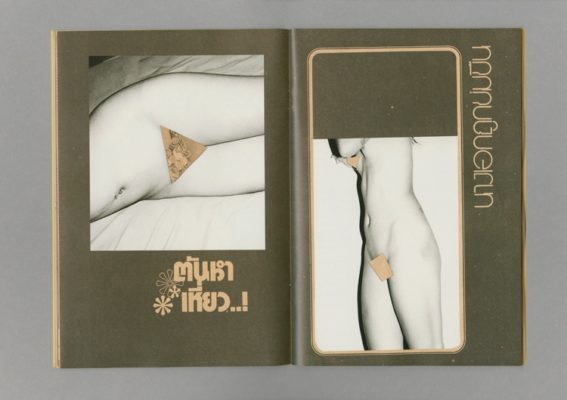
Le livre Siam’s Guy emprunte son nom à une revue érotique thaïlandaise des années 1960-70 que collectionne Tiane Doan na Champassak. Bien que censurée celle-ci a toujours été en vente libre. Pour cet ouvrage l’artiste a sélectionnés 68 pages originales parmi plus de 100 magazines sur lesquels il vient superposer ses propres photographies de nus féminins. L’esthétique très contemporaine des images de Champassak se substitue donc à une photographie plus datée. Le recours à la surimpression, tout en conservant l’acte de censure sur les parties génitales et les seins, rend hommage au design exceptionnel de l’époque.
Parallel to his personal photographic practice, Tiane Doan na Champassak, a French artist of Asian origin, explores the theme of anonymity, collecting source material from a variety of sources including the Internet, family albums and magazine excerpts. Although his work often translates into bookmaking, having already released over a dozen publications; Siam’s Guy is the first to apply his own photography and use of re-appropriation to bookmaking.
The book borrows its title from one of Tiane Doan na Champassak’s collected items, Siam’s Guy, a Thai erotic magazine from the 1960s and 1970s that remained available over the counter in spite of censorship. For this project, the artist selected 68 original pages from 100 issues of the magazine, superimposing them with his own female nude photographs and thereby injecting his contemporary esthetic into the somewhat dated images. Preserving the original use of censorship on the breasts and genitals through his act of superimposition, Champassak pays tribute to the exceptional, original design of the period.
72 pages
| Poids | 301 g |
|---|---|
| Dimensions | 18 × 26 cm |
Produits similaires

Livre d'artiste
22,00 €
Cast of Characters A selection of 100 faces by artist Sam Porritt.

Livre d'artiste
25,00 €
Un cycle lunaire aux formes simples et épurées. En combinant 8 encres de couleur, Fanette Mellier propose une avancée sensible dans la lunaison.

Graphzine
12,00 €
plays with different sizes of paper, modifying the shape of patterns and disturbing the first vision.

Livre d'artiste
12,00 €
Un inventaire des artistes ayant volontairement détruit leurs propres œuvres

Livre d'artiste
8,00 €
Le pectus excavatum, « thorax en entonnoir » est une malformation du thorax congénitale.

Livre d'artiste
24,00 €
Regardant ces pages tracées dehors, on ne peut rien situer, ou pas grand chose.

28,00 €
Goodbye est la première monographie consacrée au travail de Hsia-Fei Chang, artiste taïwanaise vivant en France.
