

-
×
 Pas vu Pas pris - Collectif, Olivier Deloignon, Guillaume Dégé
1 × 25,00 €
Pas vu Pas pris - Collectif, Olivier Deloignon, Guillaume Dégé
1 × 25,00 € -
×
 Le Choix du peuple - Nicolas Savary, Tilo Steireif
1 × 25,00 €
Le Choix du peuple - Nicolas Savary, Tilo Steireif
1 × 25,00 € -
×
 本の本の本 - antoine lefebvre editions,
1 × 10,00 €
本の本の本 - antoine lefebvre editions,
1 × 10,00 € -
×
 Bacon le Cannibale - Perrine Le Querrec
1 × 15,00 €
Bacon le Cannibale - Perrine Le Querrec
1 × 15,00 € -
×
 Oblikvaj 5 - Vingt-deux plongées profondes - Aude Barrio, Ensemble Batida
1 × 10,00 €
Oblikvaj 5 - Vingt-deux plongées profondes - Aude Barrio, Ensemble Batida
1 × 10,00 € -
×
 Acteurs d'un film gravé. Docteur A. Infirmier O. - Annabelle Dupret, Olivier Deprez et Adolpho Avril
1 × 9,00 €
Acteurs d'un film gravé. Docteur A. Infirmier O. - Annabelle Dupret, Olivier Deprez et Adolpho Avril
1 × 9,00 € -
×
 Holy Mountain - Maia Matches, Knuckles & Notch
1 × 12,00 €
Holy Mountain - Maia Matches, Knuckles & Notch
1 × 12,00 € -
×
 Vacuité 9090 - Jérémy Piningre
1 × 10,00 €
Vacuité 9090 - Jérémy Piningre
1 × 10,00 € -
×
 Lazy Painter - Angela Gjergjaj, Jordi Bucher and Mirco Petrini
1 × 22,00 €
Lazy Painter - Angela Gjergjaj, Jordi Bucher and Mirco Petrini
1 × 22,00 € -
×
 Bruits - Emmanuel Madec
1 × 15,00 €
Bruits - Emmanuel Madec
1 × 15,00 € -
×
 Prendre l’image, Le graphisme comme situation politique - Olivier Huz
1 × 10,00 €
Prendre l’image, Le graphisme comme situation politique - Olivier Huz
1 × 10,00 € -
×
 WREK The Algorithm! - Aarnoud Rommens, Olivier Deprez
2 × 10,00 €
WREK The Algorithm! - Aarnoud Rommens, Olivier Deprez
2 × 10,00 € -
×
 Parataxes + CD - Michael Gendreau
1 × 30,00 €
Parataxes + CD - Michael Gendreau
1 × 30,00 € -
×
 Dada à Zurich – Le mot et l’image (1915-1916)Hugo Ball
1 × 9,00 €
Dada à Zurich – Le mot et l’image (1915-1916)Hugo Ball
1 × 9,00 € -
×
 Sans titre - Benjamin Hartmann
1 × 12,00 €
Sans titre - Benjamin Hartmann
1 × 12,00 € -
×
 Marcel Proust en cinq minutes — Jackson B. Smith
1 × 16,00 €
Marcel Proust en cinq minutes — Jackson B. Smith
1 × 16,00 € -
×
 Comment quitter la terre ? - Jill Gasparina, Christophe Kihm, Anne-Lyse Renon
1 × 10,00 €
Comment quitter la terre ? - Jill Gasparina, Christophe Kihm, Anne-Lyse Renon
1 × 10,00 € -
×
 Mökki n°2
1 × 10,00 €
Mökki n°2
1 × 10,00 € -
×
 À partir de n°1 - Coll.
1 × 15,00 €
À partir de n°1 - Coll.
1 × 15,00 € -
×
 Anarchitecte - Olivier Verdique alias Alvar Le Corvanderpius
1 × 15,00 €
Anarchitecte - Olivier Verdique alias Alvar Le Corvanderpius
1 × 15,00 € -
×
 Les Climats II (Japon) - Lola Reboud, Mariko Takeuchi
1 × 25,00 €
Les Climats II (Japon) - Lola Reboud, Mariko Takeuchi
1 × 25,00 € -
×
 Prose postérieure - Les commissaires anonymes
1 × 15,00 €
Prose postérieure - Les commissaires anonymes
1 × 15,00 € -
×
 Slanted 30 - Athens
1 × 21,00 €
Slanted 30 - Athens
1 × 21,00 € -
×
 Farandole - Jérémie Fischer
1 × 15,00 €
Farandole - Jérémie Fischer
1 × 15,00 € -
×
 De lave et de fer - Laurent Feynerou
1 × 22,00 €
De lave et de fer - Laurent Feynerou
1 × 22,00 € -
×
 Retour d'y voir - n° 3 & 4 - Mamco
1 × 15,00 €
Retour d'y voir - n° 3 & 4 - Mamco
1 × 15,00 € -
×
 Zoom Age - Julien Auregan
1 × 17,00 €
Zoom Age - Julien Auregan
1 × 17,00 € -
×
 š! #39 'The End' - coll.
1 × 10,00 €
š! #39 'The End' - coll.
1 × 10,00 € -
×
 Sur la page, abandonnés — vol.3
1 × 10,00 €
Sur la page, abandonnés — vol.3
1 × 10,00 € -
×
 Eros negro n°3 - Démoniak
1 × 5,00 €
Eros negro n°3 - Démoniak
1 × 5,00 € -
×
 Critique d'art n°55
1 × 16,00 €
Critique d'art n°55
1 × 16,00 € -
×
 Cuadernos - Henry Deletra
2 × 15,00 €
Cuadernos - Henry Deletra
2 × 15,00 € -
×
 Strates & Archipels - Pierre Merle
1 × 25,00 €
Strates & Archipels - Pierre Merle
1 × 25,00 € -
×
 Sillo n°3 - Le Fauve
1 × 12,00 €
Sillo n°3 - Le Fauve
1 × 12,00 € -
×
 SKKS - Gilles Pourtier
1 × 20,00 €
SKKS - Gilles Pourtier
1 × 20,00 € -
×
 Je ne peux pas ne pas - Geneviève Romang
1 × 24,00 €
Je ne peux pas ne pas - Geneviève Romang
1 × 24,00 € -
×
 It was a good day - Jeremy Le Corvaisier
1 × 12,00 €
It was a good day - Jeremy Le Corvaisier
1 × 12,00 € -
×
 Un essai sur la typographie - Eric Gill
1 × 17,00 €
Un essai sur la typographie - Eric Gill
1 × 17,00 € -
×
 Seoul Flowers & Trees - tribute to Lee Friedlander
1 × 25,00 €
Seoul Flowers & Trees - tribute to Lee Friedlander
1 × 25,00 € -
×
 Poétique d'une introspection visuelle - Jean-Charles Andrieu de Levis, Alex Barbier
1 × 12,00 €
Poétique d'une introspection visuelle - Jean-Charles Andrieu de Levis, Alex Barbier
1 × 12,00 € -
×
 L’Écureuil de James - Alice Brière-Haquet, Liuna Virardi
1 × 9,00 €
L’Écureuil de James - Alice Brière-Haquet, Liuna Virardi
1 × 9,00 € -
×
 Artzines #12 Provo Special
1 × 10,00 €
Artzines #12 Provo Special
1 × 10,00 € -
×
 Dark optics - David Claerbout
1 × 18,00 €
Dark optics - David Claerbout
1 × 18,00 € -
×
WREK The Algorithm! - Aarnoud Rommens, Olivier Deprez - FR
1 × 12,00 €
-
×
 Dear Paul - Paul Van der Eerden
1 × 20,00 €
Dear Paul - Paul Van der Eerden
1 × 20,00 € -
×
 Mökki n°4
1 × 10,00 €
Mökki n°4
1 × 10,00 € -
×
 Délié - Baptiste Oberson
1 × 24,00 €
Délié - Baptiste Oberson
1 × 24,00 € -
×
 Il était deux fois - Gary Colin
1 × 7,00 €
Il était deux fois - Gary Colin
1 × 7,00 € -
×
 Gros Gris n°4 - Duel
1 × 12,80 €
Gros Gris n°4 - Duel
1 × 12,80 € -
×
 Sans titre - Chris Kiss
1 × 12,00 €
Sans titre - Chris Kiss
1 × 12,00 € -
×
 Planning - Pierre Escot
1 × 10,00 €
Planning - Pierre Escot
1 × 10,00 € -
×
 Gnose & Gnose & Gnose - Aymeric Vergnon-d'Alençon
1 × 25,00 €
Gnose & Gnose & Gnose - Aymeric Vergnon-d'Alençon
1 × 25,00 €


RUCHES, 2400 A.E.C. – 1852 E.C. – Aladin Borioli


20,00 €
375 illustrations donnent un aperçu de l’histoire prolifique de l’architecture destinée aux non-humains.
Rupture de stock
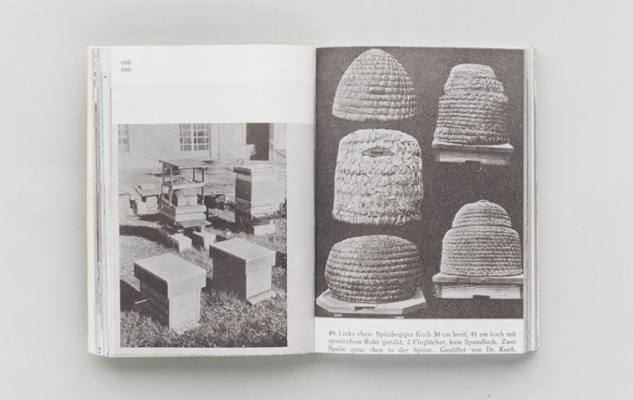
Depuis la naissance de la ruche moderne en 1852, la construction des ruches ne fait plus preuve d’innovation structurelle. En privilégiant la ruche cubique standardisée, l’apiculture tourne le dos à 4 400 ans de diversité architecturale. Ce bref ouvrage s’intéresse à la période qui précède l’homogénéisation, en remontant jusqu’à – 2 400. Le rejet d’un récit figé permet au polymorphisme de prendre le pas sur la linéarité. L’histoire des ruches est racontée d’un nouveau point de vue, à travers le graphisme, la photographie et le texte. 375 illustrations donnent un aperçu de l’histoire prolifique de l’architecture destinée aux non-humains.
Cet ouvrage constitue le fragment d’un projet de recherche permanent et ouvert, intitulé « Apian » qui fait appel à des méthodes théoriques, iconographiques et ethnographiques pour étudier la relation entre abeilles et humains.
EN ::
Since the birth of the modern beehive in 1852, structural innovation in hive construction has entered a dormant period. By favouring the standardised box hive, beekeeping turns its back on 4,400 years of architectural diversity. This little book focuses on that period of history prior to homogenisation, drawing from as far back as 2400 BCE. By rejecting a fixed narrative, linearity makes way for polymorphism, introducing graphic design, photography and writing to retell the story of beehives. The 375 images offer a glimpse into this proliferous history of architecture for non-humans.
This book is a fragment of an ongoing and open-ended research project titled “Apian” which uses theoretical, iconographic and ethnographic methods to research on the relationship between bees and humans.
Soft cover
448 pages
375 photographs
| Poids | 320 g |
|---|---|
| Dimensions | 11 × 15,5 cm |
Produits similaires

Livre architecture
42,00 €
La Construction est le journal d’un architecte auquel on vient de confier la réalisation d’un asile psychiatrique


Livre d'artiste
38,00 €
Marie Mons a passé trois mois d’hiver dans un petit village des fjords de l’est de Islande où elle est devenue Aurore Colbert
Livre d'artiste
24,00 €
Regardant ces pages tracées dehors, on ne peut rien situer, ou pas grand chose.
Livre d'artiste
Lazy Painter – Angela Gjergjaj, Jordi Bucher and Mirco Petrini
22,00 €
Pictures by a robot vacuum cleaner
Dits & Écrits d'artistes
25,00 €
Aboukaïev est d’abord atteint de mélancolie comme certains oiseaux enivrés et dont le coeur ne veut plus s’arrêter de voler, de capituler face à l’horizon.

Graphzine
12,00 €
uses more specifically a work on color, interaction between warm and cold ones, from the enlargement of a photograph.

Livre d'artiste
25,00 €
Blackywall est un livre attribué à Sihab Baik sur le travail de Claude Closky. Il est composé de courts textes publiés le long d’une sélection de pièces de l’artiste. Ces « critiques » sont alimentées par des citations d’Internet, trouvées par une série de recherches par mots-clés, programmées algorithmiquement pour suivre des sujets d’une manière rationnelle et objective.