

-
×
 Gnose & Gnose & Gnose - Aymeric Vergnon-d'Alençon
1 × 25,00 €
Gnose & Gnose & Gnose - Aymeric Vergnon-d'Alençon
1 × 25,00 €


People of the Mud – Luis Alberto Rodriguez


55,00 €
People of the Mud is a powerful new series by Luis Alberto Rodriguez, made collaboratively amongst the communities of County Wexford in Ireland, where ancient tradition and modern life rub shoulders daily.
Rupture de stock
People of the Mud is a powerful new series by Berlin-based US-Dominican artist Luis Alberto Rodriguez, made collaboratively amongst the communities of County Wexford in Ireland, where ancient tradition and modern life rub shoulders daily.
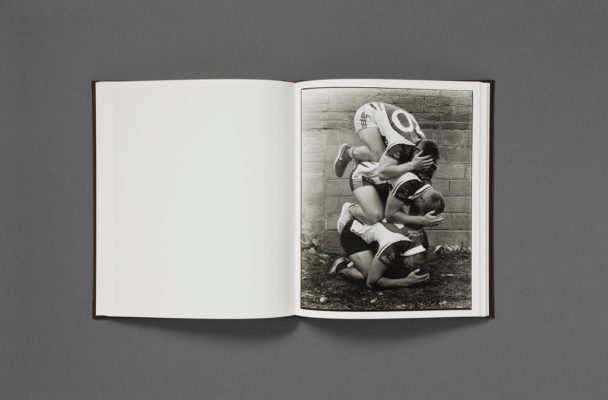
With a background in professional dance, Rodriguez’s work pays tribute to the metaphorical weight of centuries of physical labour behind cultivating the landscape and maintaining cultural heritage. Images of scarred limbs and hands, weathered faces and choreographed bodies appear as a cartography of this labour, reflecting how culture both shapes and is shaped by individuals. Elsewhere, we see the exaggerated glamour of modern female Irish dancers taken out of the glitzy ballrooms and into the fields, creating a rupture across time and space.
While in Wexford, Rodriguez was struck by the intense physicality of the sport of hurling. Considered to be the fastest sport on grass, while watching slow-motion footage of hurling Rodriguez saw that within seconds the players would go through pushing, shoving, grabbing, hugging, knocking each other down and then lifting one another up. Rodriguez worked with players to reform these gestures: creating sculptures out of bodies, directing and literally layering players upon one another.
At the outset of his project, Rodriguez wanted to create a large family photograph, an idea that was quickly surpassed by other strands of enquiry. However, with a step backwards we can see People of the Mud as just that – a collective community portrait of all the different elements that construct modern, rural Irish identities. Just like any family portrait, it is at times dysfunctional and contradictory; it gathers all the ruptures and continuities between the past and present in modern Ireland, while being held in a landscape and moment in time. This moment is both still – posed and paused – and in perpetual motion, looking towards the future.
| Poids | 700 g |
|---|---|
| Dimensions | 23 × 27,5 cm |
Vous aimerez peut-être aussi…

Livre architecture, design & urbanisme
28,00 €
Le livre de Laurent Chardon Dédale regroupe différentes séries de photographies prises au cours des années 2003 à 2013 et documente un Paris et ses alentours en transformation.
Produits similaires

Livre Photo
19,00 €
L'image révèle autant l’artifice que la fascination qu’il exerce.

Livre paysage
25,00 €
Les Climats II (Japon), premier livre de Lola Reboud, a pour fil conducteur la relation que nous entretenons aux Climats.

Livre Photo
24,00 €
La région de Bugarach est aux sources de multiples récits et légendes populaires.

Livre d'artiste
38,00 €
Marie Mons a passé trois mois d’hiver dans un petit village des fjords de l’est de Islande où elle est devenue Aurore Colbert

Livre Photo
32,00 €
Des silhouettes solitaires en attente d’un départ.


Livre Photo
17,00 €
Fluent de Laëtitia Donval est la deuxième des trois résidences initiées par Lumière d’Encre ↗ autour des fleuves côtiers des Pyrénées-Orientales

Livre Photo
20,00 €
SKKS est une partie du code que l’on retrouve sur les plaques d’immatriculation en Slovaquie.