

-
×
 16 x 421 - Lorraine Druon
1 × 3,00 €
16 x 421 - Lorraine Druon
1 × 3,00 € -
×
 Je ne peux pas ne pas - Geneviève Romang
1 × 24,00 €
Je ne peux pas ne pas - Geneviève Romang
1 × 24,00 € -
×
 Eros Negro # 1 - Demoniak
1 × 5,00 €
Eros Negro # 1 - Demoniak
1 × 5,00 € -
×
 Dear Paul - Paul Van der Eerden
1 × 20,00 €
Dear Paul - Paul Van der Eerden
1 × 20,00 € -
×
 Atopoz - Collectif
1 × 14,00 €
Atopoz - Collectif
1 × 14,00 € -
×
 Le blanc nez - Fouss Daniel
1 × 20,00 €
Le blanc nez - Fouss Daniel
1 × 20,00 € -
×
 La peinture c'est comme les pépites - Pierre Yves-Hélou + Tirage
1 × 15,00 €
La peinture c'est comme les pépites - Pierre Yves-Hélou + Tirage
1 × 15,00 € -
×
 Holyhood, vol. 1 — Guadalupe, California - Alessandro Mercuri
1 × 12,00 €
Holyhood, vol. 1 — Guadalupe, California - Alessandro Mercuri
1 × 12,00 € -
×
 ARTZINES #7 - Berlin issue
1 × 10,00 €
ARTZINES #7 - Berlin issue
1 × 10,00 € -
×
 People Painting - Fabienne Radi
1 × 25,00 €
People Painting - Fabienne Radi
1 × 25,00 € -
×
 Alma Mater n°1
1 × 12,00 €
Alma Mater n°1
1 × 12,00 € -
×
 Umami - Ariane Vonmoos
1 × 10,00 €
Umami - Ariane Vonmoos
1 × 10,00 € -
×
 Good Company - Paul Van der Eerden
1 × 15,00 €
Good Company - Paul Van der Eerden
1 × 15,00 € -
×
 Image Canoë - Jérémie Gindre
1 × 8,00 €
Image Canoë - Jérémie Gindre
1 × 8,00 € -
×
 The Shelf - Journal 3
1 × 20,00 €
The Shelf - Journal 3
1 × 20,00 € -
×
 Pour voir, Emscher Park - Gaëtane Lamarche-Vadel
1 × 7,00 €
Pour voir, Emscher Park - Gaëtane Lamarche-Vadel
1 × 7,00 € -
×
 Philatélie - Magali Brueder
1 × 12,00 €
Philatélie - Magali Brueder
1 × 12,00 € -
×
 Critique & création - L.L. de Mars
1 × 5,00 €
Critique & création - L.L. de Mars
1 × 5,00 € -
×
 Harry Thaler's Pressed Chair
1 × 11,50 €
Harry Thaler's Pressed Chair
1 × 11,50 € -
×
 Titanic Orchestra - Julien Mauve
1 × 25,00 €
Titanic Orchestra - Julien Mauve
1 × 25,00 €


La grande surface de réparation – Gilles Pourtier


20,00 €
Un an au 3 bis f, un centre d’art contemporain situé au cœur de l’hôpital psychiatrique Montperrin à Aix-en-Provence.
En stock
Textes de Jean-Christophe Arcos, Philippe Prost
Design : Bureau Wolewinski
Couverture souple
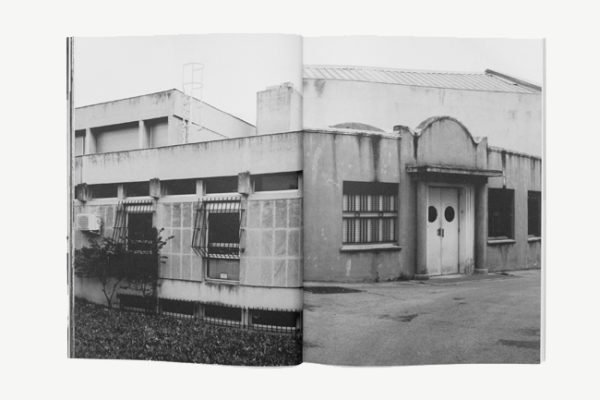
Gilles Pourtier a été accueilli pendant un an au 3 bis f, un centre d’art contemporain situé au cœur de l’hôpital psychiatrique Montperrin à Aix-en-Provence. La grande surface de réparation s’intéresse à ce lieu de soin et à son architecture sérielle, examinant les variations typologiques des pavillons où sont accueillis les patients.
Les photographies insistent sur le caractère répétitif et la production de masse de ces édifices, rapprochant cette esthétique industrielle des problématiques de l’art minimal. Gilles Pourtier développe également une série de dessins titrés Wunderblocks qui interroge la relation entre le bâti et les individus. La pluridisciplinarité, défendue dans cet ouvrage croisant dessins, photographies, architecture, permet d’apporter un regard nouveau sur le sujet de la psychiatrie en s’intéressant au rapport étroit entre des pathologies et des environnements. Les textes de Jean-Christophe Arcos (commissaire d’exposition) et de Philippe Prost (architecte) appuient et éclairent cette démarche tout au long de l’ouvrage.
Gilles Pourtier took part in a one-year artist’s residency at 3 bis f, a contemporary art centre located in the Montperrin psychiatric hospital in Aix-en-Provence. La grande surface de réparation (The Great Observation Box) focuses on this mental health institute and its serial architecture, examining the typological variations of the pavilions where the patients are admitted.
The photographs underline the repetitive nature and the mass production of these buildings, establishing a parallel between this industrial aesthetic and the issues of minimal art. Gilles Pourtier also developed a series of drawings entitled Wunderblocks that questions the relation between built environments and individuals. The multidisciplinary approach in this publication mixes drawings, photographs and architecture. It brings a new perspective on the subject of psychiatry by observing the close relationship between pathologies and environments. Throughout the book, the texts by Jean-Christophe Arcos (exhibition curator) and Philippe Prost (architect) complement and shed light on this process.
| Poids | 340 g |
|---|---|
| Dimensions | 19 × 26 cm |
Vous aimerez peut-être aussi…

17,00 €
Dans la vallée de l’Agly, Gilles Pourtier et Anne-Claire Broc’h ont observé la géologie du terrain, au plus près du cours du fleuve.

Livre Photo
20,00 €
SKKS est une partie du code que l’on retrouve sur les plaques d’immatriculation en Slovaquie.
Produits similaires

Livre Photo
35,00 €
Choisir de regarder Michel Journiac en travesti

Livre d'artiste
38,00 €
Marie Mons a passé trois mois d’hiver dans un petit village des fjords de l’est de Islande où elle est devenue Aurore Colbert

Livre architecture, design & urbanisme
28,00 €
Le livre de Laurent Chardon Dédale regroupe différentes séries de photographies prises au cours des années 2003 à 2013 et documente un Paris et ses alentours en transformation.

Livre Photo
35,00 €
Où qu’on se déporte et quels que soient les moyens mis en œuvre, l’inquiétant silence devient assourdissant, juste interrompu çà et là par les tonitruantes débilités de quelque leader mondial.

Livre Photo
32,00 €
Des silhouettes solitaires en attente d’un départ.

Livre Photo
15,00 €
akaBB – tribute to Roni Horn is not a photographic diary, and neither is it a simple hommage to Roni Horn’s book.

Livre Photo
17,00 €
Fluent de Laëtitia Donval est la deuxième des trois résidences initiées par Lumière d’Encre ↗ autour des fleuves côtiers des Pyrénées-Orientales
-20%
Livre paysage
Le prix initial était : 25,00 €.20,00 €Le prix actuel est : 20,00 €.
La poésie et le beauté des rivages