

-
×
 Musée des Beaux-Arts - Pierre Martel
1 × 15,00 €
Musée des Beaux-Arts - Pierre Martel
1 × 15,00 € -
×
 La troisième oreille et autres textes + CD - Bryan Lewis Saunders
1 × 32,00 €
La troisième oreille et autres textes + CD - Bryan Lewis Saunders
1 × 32,00 € -
×
 Aristide n°4
1 × 13,50 €
Aristide n°4
1 × 13,50 € -
×
 Les Climats II (Japon) - Lola Reboud, Mariko Takeuchi
1 × 25,00 €
Les Climats II (Japon) - Lola Reboud, Mariko Takeuchi
1 × 25,00 € -
×
 Saint Julien l'hospitalier Tome 2 - Claire Pedot
1 × 25,00 €
Saint Julien l'hospitalier Tome 2 - Claire Pedot
1 × 25,00 € -
×
 Dernier royaume - Quentin Derouet
1 × 24,00 €
Dernier royaume - Quentin Derouet
1 × 24,00 € -
×
 Un peu comme voir dans la nuit - Leif Elggren + CD
1 × 28,00 €
Un peu comme voir dans la nuit - Leif Elggren + CD
1 × 28,00 € -
×
 It was a good day - Jeremy Le Corvaisier
1 × 12,00 €
It was a good day - Jeremy Le Corvaisier
1 × 12,00 € -
×
 Before Science - Gilles Pourtier, Anne-Claire Broc'h
1 × 17,00 €
Before Science - Gilles Pourtier, Anne-Claire Broc'h
1 × 17,00 € -
×
 Good Company - Paul Van der Eerden
1 × 15,00 €
Good Company - Paul Van der Eerden
1 × 15,00 € -
×
 Prose postérieure - Les commissaires anonymes
1 × 15,00 €
Prose postérieure - Les commissaires anonymes
1 × 15,00 € -
×
 SKKS - Gilles Pourtier
1 × 20,00 €
SKKS - Gilles Pourtier
1 × 20,00 €


Huts, Temples, Castles – Ursula Schulz-Dornburg


45,00 €
In 1969, when the architectural photographer Ursula Schulz-Dornburg moved to Düsseldorf with her two young children
En stock
In the wake of the Second World War, aiming to occupy the children rampaging streets and parks, the City of Amsterdam founded Jongensland, a space where boys (and the occasional, officially disallowed girl) could play, build, create, and destroy, largely without supervision. Located on an island accessible only by rowboat, Jongensland grew into a sprawling settlement built experimentally from scrap materials by its young inhabitants. Here, children would cook food, raise animals, build fires, and trade with each other. Without adult intervention, they relied on shared resourcefulness and collaborative ingenuity.
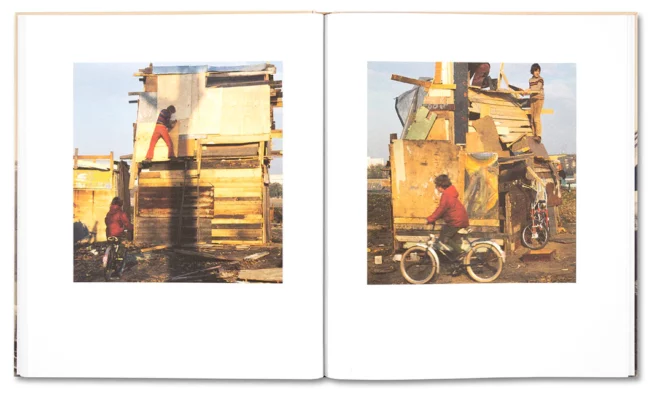
In 1969, when the architectural photographer Ursula Schulz-Dornburg moved to Düsseldorf with her two young children, she discovered Jongensland the other side of the border from Germany’s strictly regulated playgrounds. Fascinated by the improvised buildings where her children would play, she made extensive photographs capturing them being constructed, used, demolished, and reshaped. Her images capture an intuitive architectural intelligence and capture a genre of vernacular construction with its own conventions and innovations, one which illuminates the role of imagination in defining a building’s identity and purpose.
This book presents Schulz-Dornburg’s largely unseen series alongside an extended alongside an extended essay by architectural historian Tom Wilkinson reflecting on the architectural themes and lessons Jongensland continues to offer.
| Poids | 650 g |
|---|---|
| Dimensions | 23 × 26 cm |
Produits similaires

Collage
20,00 €
Apparaissent des restes épars et altérés de photographies, cartes, paysages, empreintes, visages, corps et fossiles.

Livre Photo
35,00 €
Choisir de regarder Michel Journiac en travesti
-20%

Livre art contemporain
Le prix initial était : 16,00 €.12,80 €Le prix actuel est : 12,80 €.
Combats polymorphes, divertissants, déraisonnables ou nécessaires
-20%

Livre Photo
Le prix initial était : 38,00 €.30,40 €Le prix actuel est : 30,40 €.
Loose amid unique landscapes in a timeless bubble
-20%

Livre paysage
Le prix initial était : 25,00 €.20,00 €Le prix actuel est : 20,00 €.
La poésie et le beauté des rivages

Livre architecture, design & urbanisme
28,00 €
Le livre de Laurent Chardon Dédale regroupe différentes séries de photographies prises au cours des années 2003 à 2013 et documente un Paris et ses alentours en transformation.

Livre Photo
17,00 €
Raclose de Geoffroy Mathieu est la première des trois résidences initiées par Lumière d’Encre ↗ autour des fleuves côtiers des Pyrénées-Orientales
Livre Photo
24,00 €
La région de Bugarach est aux sources de multiples récits et légendes populaires.