

-
×
 Délié - Baptiste Oberson
1 × 24,00 €
Délié - Baptiste Oberson
1 × 24,00 € -
×
 Modern Instances, The Craft of Photography - Stephen Shore
1 × 38,00 €
Modern Instances, The Craft of Photography - Stephen Shore
1 × 38,00 € -
×
 Anderlecht — Molenbeek - Pierre Blondel
1 × 18,00 €
Anderlecht — Molenbeek - Pierre Blondel
1 × 18,00 € -
×
 We want to look up at the Sun, but could the Sun be looking down on us? - Rudy Guedj & Olivier Goethals
1 × 20,00 €
We want to look up at the Sun, but could the Sun be looking down on us? - Rudy Guedj & Olivier Goethals
1 × 20,00 € -
×
 Der Erste Rotkehlchen - Le livre
1 × 17,00 €
Der Erste Rotkehlchen - Le livre
1 × 17,00 € -
×
 Mission Control - Emir Karyo & Jan Wojda
1 × 10,00 €
Mission Control - Emir Karyo & Jan Wojda
1 × 10,00 € -
×
 Critique & création - L.L. de Mars
1 × 5,00 €
Critique & création - L.L. de Mars
1 × 5,00 € -
×
 Pectus Excavatum - Quentin Yvelin
1 × 8,00 €
Pectus Excavatum - Quentin Yvelin
1 × 8,00 € -
×
 Papier magazine n°06 - Coupe du monde
1 × 20,00 €
Papier magazine n°06 - Coupe du monde
1 × 20,00 €


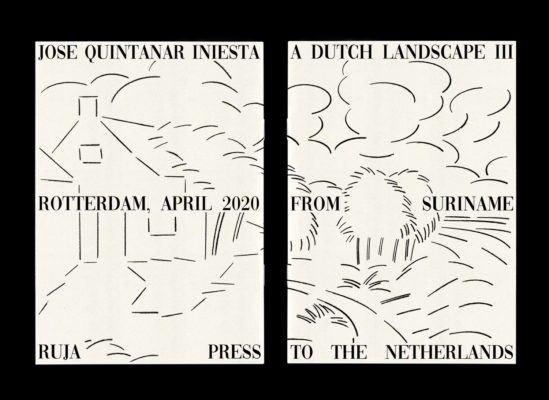
A Dutch Landscape III- From Suriname to The Netherlands – José Quintanar


8,00 €
From Suriname to The Netherlands
Rupture de stock
Highlighting the significance of the landscape in Dutch culture, José’s project is not only observatory by nature, but also investigatory. He notes how the Dutch landscape was “built by people in an artificial way,” as man-made interventions connected ground to sea more easily. “Hence it is understood that the golden age of landscape painting was not a representation of the landscape, but the representation of an illusion.”
The book is built from two landscapes, that of Suriname’s – an old Dutch colony – and the Netherland’s. “Each landscape is drawn over and over again,” says José of the 20 page, Risograph-printed volume , “building a series of ten drawings each. In each drawing, the rules of the game have been progressively altered so that each drawing of the same landscape is always different.” Interestingly, the rules used in landscape A are the same rules applied in landscape B but inverted. And in this way, “A and B only make sense when they are connected within the temporary space format of the book.” As a result, the concept of the publication, drawn from geometric patterns of circles that grow in each drawing, in turn, also becomes the narrative of the work.
20 pages.
| Poids | 64 g |
|---|---|
| Dimensions | 29,7 × 21 cm |
Produits similaires

Bande Dessinée
10,00 €
The repetition of black squares is WREK’s brilliant running gag.

livre Dessin
25,00 €
Sédimentaire ou volcanique, sur terre ou dans les airs, en long ou en large.


livre Dessin
13,00 €
Une forme qui aurait un pied dans le design et un autre dans l'onirique.
