

-
×
 Jawa Tengah Combo - Fred Maillard
1 × 30,00 €
Jawa Tengah Combo - Fred Maillard
1 × 30,00 € -
×
 Imagos - Noémie Lothe
1 × 20,00 €
Imagos - Noémie Lothe
1 × 20,00 € -
×
 Entretiens – Jérôme Dupeyrat
1 × 25,00 €
Entretiens – Jérôme Dupeyrat
1 × 25,00 € -
×
 Good Company - Paul Van der Eerden
1 × 15,00 €
Good Company - Paul Van der Eerden
1 × 15,00 € -
×
 Cruiser l'utopie – L'après et ailleurs de l'advenir queer - José Esteban Muñoz
1 × 22,00 €
Cruiser l'utopie – L'après et ailleurs de l'advenir queer - José Esteban Muñoz
1 × 22,00 € -
×
 Photographic Fields - Joël Van Audenhaege
1 × 25,00 €
Photographic Fields - Joël Van Audenhaege
1 × 25,00 € -
×
 Étrangement seuls - Jean-Pascal Princiaux
1 × 12,00 €
Étrangement seuls - Jean-Pascal Princiaux
1 × 12,00 € -
×
![Économies silencieuses et audaces approximatives - Guy Chevalier [& coll.]](https://i0.wp.com/librairie-lame.com/wp-content/uploads/2019/03/PPT_Elastic01_couv.jpg?fit=250%2C353&ssl=1) Économies silencieuses et audaces approximatives - Guy Chevalier [& coll.]
1 × 18,00 €
Économies silencieuses et audaces approximatives - Guy Chevalier [& coll.]
1 × 18,00 € -
×
 Le vieux père - Laurent Kropf
1 × 20,00 €
Le vieux père - Laurent Kropf
1 × 20,00 € -
×
 Tchat - Gary Colin
1 × 12,00 €
Tchat - Gary Colin
1 × 12,00 € -
×
 Un essai sur la typographie - Eric Gill
1 × 17,00 €
Un essai sur la typographie - Eric Gill
1 × 17,00 € -
×
 Mökki n°4
1 × 10,00 €
Mökki n°4
1 × 10,00 € -
×
 Rasclose - Geoffroy Mathieu
1 × 17,00 €
Rasclose - Geoffroy Mathieu
1 × 17,00 € -
×
 L’Écureuil de James - Alice Brière-Haquet, Liuna Virardi
1 × 9,00 €
L’Écureuil de James - Alice Brière-Haquet, Liuna Virardi
1 × 9,00 € -
×
 Éclats III - Athanor
1 × 10,00 €
Éclats III - Athanor
1 × 10,00 € -
×
 Burning Images, A History of Effigy Protests - Florian Göttke
1 × 26,50 €
Burning Images, A History of Effigy Protests - Florian Göttke
1 × 26,50 € -
×
 Fluent - Laëticia Donval
1 × 17,00 €
Fluent - Laëticia Donval
1 × 17,00 €


Outburst – Vincent Levrat


35,00 €
The images featured in this publication are the result of many days and nights enjoying a wasteland.
Rupture de stock
Wasteland, as a result of their emptiness and lack of purpose reveal themselves to be nonconforming to social norms. They thus represent locations for freedom and are conducive to the imagination. From this observation is born a desire to undergo a life experience in a waste ground, turning this location into a kingdom, an open-air studio. It becomes a playground where one may celebrate materiality and physical experimentation, a territory where one may escape the virtual and technological world. Wanting to operate a return to a form of simplicity, the naive desire to undergo a kind of « tabula rasa » is not without recollecting a kind of rebellion.
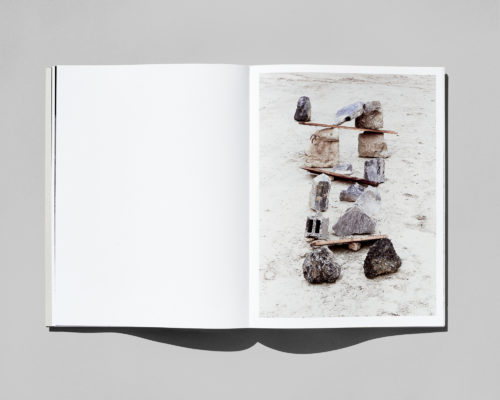
Constructing in order to destroy – all of which is bound to physical and intuitive experiences, which is somewhat absurd, yet resolutely childlike. From this emptiness which waste grounds can evoke, they are in reality a reserve of shapes and impoverished materials. An economy of means which, when nourished by the virtue of a childlike naivety, allow us to envisage these materials as the essence of various games and constructions.
64 pages, 23×30cm
Offset printing
Silkscreen cover
| Poids | 320 g |
|---|
Produits similaires

25,00 €
La démarche photographique de Nicolas Savary et Tilo Steireif porte sur la représentation du politicien en tant que figure dans le système politique « de milice », en Suisse.

Livre Photo
32,00 €
Des silhouettes solitaires en attente d’un départ.

Livre paysage
25,00 €
Les Climats II (Japon), premier livre de Lola Reboud, a pour fil conducteur la relation que nous entretenons aux Climats.

Livre Photo
20,00 €
SKKS est une partie du code que l’on retrouve sur les plaques d’immatriculation en Slovaquie.
Collage
20,00 €
Apparaissent des restes épars et altérés de photographies, cartes, paysages, empreintes, visages, corps et fossiles.

Livre Photo
35,00 €
Choisir de regarder Michel Journiac en travesti

Livre Photo
25,00 €
Ces images ne sont ni fenêtres, ni miroirs.