

-
×
 Rocher du Ciel - Martin Desinde
1 × 8,00 €
Rocher du Ciel - Martin Desinde
1 × 8,00 € -
×
 Radio-Art - Tetsuo Kogawa
1 × 20,00 €
Radio-Art - Tetsuo Kogawa
1 × 20,00 € -
×
 Pour voir, Emscher Park - Gaëtane Lamarche-Vadel
1 × 7,00 €
Pour voir, Emscher Park - Gaëtane Lamarche-Vadel
1 × 7,00 € -
×
 Après la révolution – numéro 1
1 × 30,00 €
Après la révolution – numéro 1
1 × 30,00 € -
×
 Lili, la rozell et le marimba / revue n°2
1 × 15,00 €
Lili, la rozell et le marimba / revue n°2
1 × 15,00 € -
×
 Editer l’art – Leszek Brogowski
1 × 33,00 €
Editer l’art – Leszek Brogowski
1 × 33,00 € -
×
 La construction - Perrine Le Querrec
1 × 42,00 €
La construction - Perrine Le Querrec
1 × 42,00 € -
×
 Gros Gris n°4 - Duel
1 × 12,80 €
Gros Gris n°4 - Duel
1 × 12,80 € -
×
 Temps d'arrêt - Etienne Buyse
1 × 32,00 €
Temps d'arrêt - Etienne Buyse
1 × 32,00 €


Flower Smuggler – Diana Tamane


30,00 €
« close to a narration on something as large as the European transformations that took place during the last 30 years. »
Plus que 1 en stock
If we look briefly at what makes good art, it is of course to work with what is in front of us.
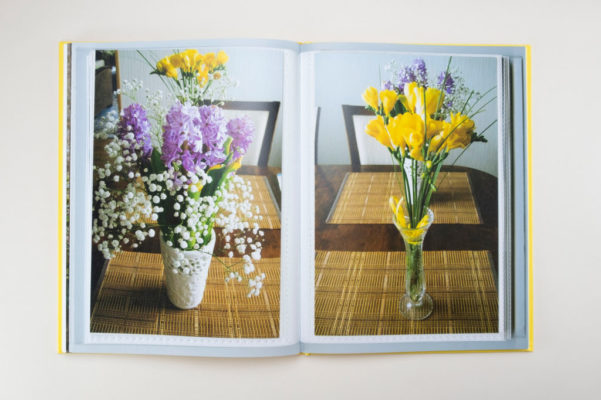
Inventions are good, but if the point of escape into the unknown is the known, even better. Certainly nothing is more readily available than one’s own family. It is a matrix we will never leave, and if we escape it, we inevitably escape in relation to it. Diana worked with the image material her family generated on many formal and technical layers, visually formulating such larger questions as: who sees whom in which way, and smaller questions, such as: What is one doing when the camera is turned off? To what extent is a skin really our last boundary, and what happens when one dies? Diana exploits every possible representation of (her) family, and transforms it with a sharp eye into an art that is entirely its own. She uses the whole repertoire of the contemporary photo-filmic infrastructure, from the mobile phone to the memory stick of her father’s product palette from the last 10 years, to the dashcam of her truck-driving mother, to email, also in order to fulfill yet subvert every possible cliché about the East one could imagine. We should not forget the proper art historical knowledge sleeping behind her approach, which she luckily applies in a very liberating, un-academic and free manner. You wouldn’t need a reference with the simple function of affirming the position of her work, as it is with a lot of art these days. In the end, Diana uses something as personal as family to say something public, close to a narration on something as large as the European transformations that took place during the last 30 years. (Martin Germann)
| Poids | 350 g |
|---|---|
| Dimensions | 22,5 × 30 cm |
Vous aimerez peut-être aussi…

Produits similaires

Livre Photo
17,00 €
Raclose de Geoffroy Mathieu est la première des trois résidences initiées par Lumière d’Encre ↗ autour des fleuves côtiers des Pyrénées-Orientales

Livre Photo
20,00 €
Une traversée entre Marseille et la Corse entre mer et terre

25,00 €
"It was april and cherry blossom time was just over"

Livre Photo
35,00 €
Choisir de regarder Michel Journiac en travesti

Livre paysage
25,00 €
Les Climats II (Japon), premier livre de Lola Reboud, a pour fil conducteur la relation que nous entretenons aux Climats.
-20%

Livre paysage
Le prix initial était : 25,00 €.20,00 €Le prix actuel est : 20,00 €.
La poésie et le beauté des rivages

-20%

Livre Photo
Le prix initial était : 20,00 €.16,00 €Le prix actuel est : 16,00 €.
Ayline Olukman marche, roule, fait des rencontres